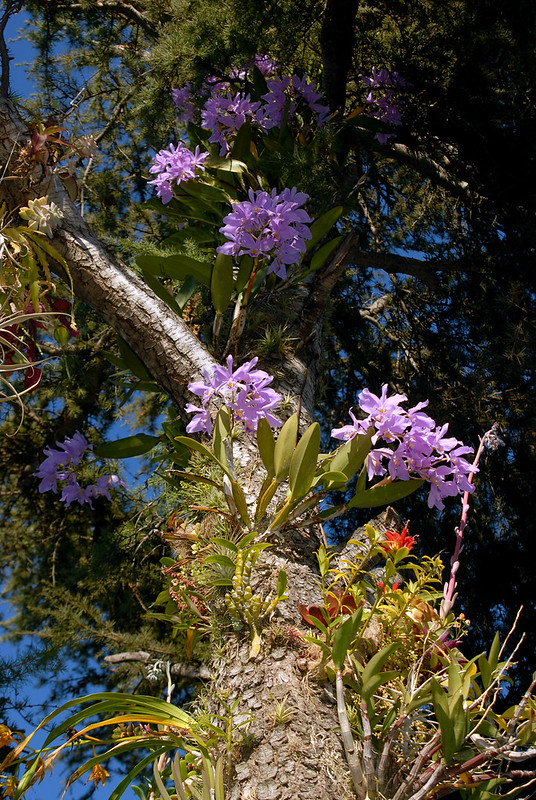
Showing posts with label orchid. Show all posts

Thursday, July 26, 2018

Everybody Should Trade Plants In Los Angeles

Nobody walks in LA, but everybody in LA should trade plants.  And give them away as well.  In previous years I've posted free plants on Craigslist and usually quite a few people have responded.  This year not so much.  But one of the responses was an invitation to check out the Facebook group for Plant Traders Los Angeles/OC Garden Trading Community.  I did so and it sure seems like a pretty great bunch of plant people.  How come it took me so long to get the memo???

They have a trade coming up this Saturday and I've been trying to prioritize which plants to share.  So far I've posted that I have seeds of Echeveria coccinea available...


Here are some other seeds or cuttings that I should share...

Columnea Elmer Lorenz seeds


The Best Orchid Companion


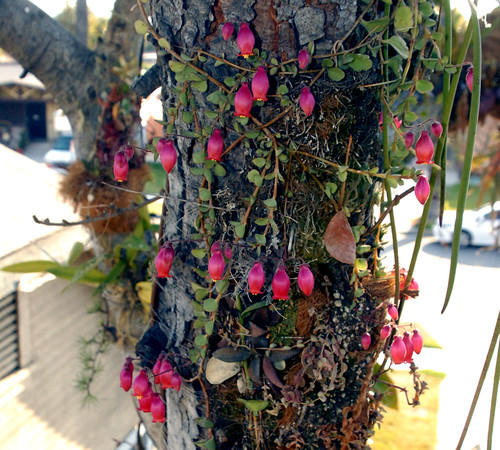
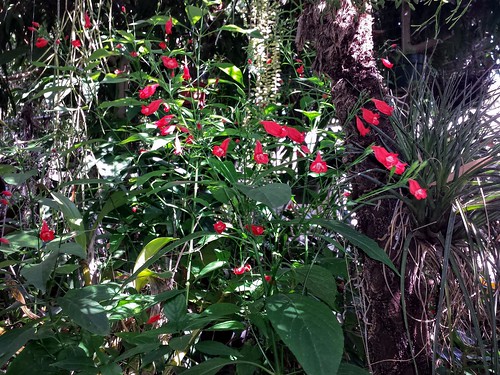
Not sure what its "real" name is... maybe it's Columnea crassifolia?  The leaves are certainly very succulent... for a Columnea.  My plant mentor Elmer Lorenz gave it to me several years ago and I've been really happy with it.  This epiphyte is exceptional because it stays in bloom for almost the entire year.   My friend Dave says the same is true of Columnea schiedeana.  I wonder which one would grow the best epiphytically.

Anthurium scandens (xeric form) seeds


Anthurium scandens Growing Epiphytically


This epiphyte is the winner of the 2011 Epiphyte Grand Prix.  The flowers aren't showy but it does make nice clusters of purplish fruits.

Epiphytic Kalanchoe cuttings (bundle)

Here's what would be included in the bundle...

- Kalanchoe ‘Orangery’ (K. manginii × K. jongmansii)
- Kalanchoe schizophylla (hemiepiphyte)
- Kalanchoe 'Tessa' (K. gracilipes x K. manginii)
- Kalanchoe uniflora (my favorite)


Kalanchoe uniflora Growing Epiphytically


Mixed succulent seeds

I have lots of different succulents, mostly in the Crassulaceae family, happily growing on my tree.  For example...


I'm guessing that this little succulent is Echeveria minima.   The seeds from this succulent, and from several other ones growing on my tree, will be included in this mix.

Mixed Tillandsia seeds

The seeds from various Tillandsias growing on my tree.  Primarily from Tillandsia aeranthos but also from a few others such as ionantha...


Tillandsia ionantha -  My Highest Epiphyte


Reed-stem Epidendrum seeds

Most orchid seeds don't have enough nutrients to germinate on their own.  In order to germinate in nature they depend on specific varieties of microscopic fungus to supply the necessary nutrients.  My impression is that the seeds of some orchids, such as those of reed-stems, are an exception to the rule.

Sowing Instructions

I sow all these seeds, except for the Tillandsia seeds, the same way.  First I put some well-drained medium into a small pot.  Then I add a layer of New Zealand Sphagnum moss on top.  I sow the seeds on the moss, put the pots in zip lock bags and place them near a bright window or under grow lights.

For the pots I use 500 ml water bottles.  I cut the tops off, remove the labels and cut some drainage holes in the bottom.  Three of these fit nicely in a gallon zip lock bag.

Usually I don't completely seal the bags, but this means that every so often I'll have to inspect them to make sure that pots aren't drying out too much.  I think it's safer to err on the side of too dry rather than too moist.  If the pots are too moist then they can start to get slimy.

I rarely ever sow one type of seed by itself.  For example, when I sow the reed-stem seeds I'll include one or two seeds from Anthurium scandens in the pot.  This helps me hedge my bets.  Using small pots also helps to hedge bets.  It's important to avoid putting too many eggs in one basket.  For example, my friend had several different nice plants in a terrarium.  They were all wiped out when she introduced a new plant.  Putting three small pots in one bag helps to limit the spread of pathogens.

I also hedge my bets by using different medium mixes.  Mixes include different combinations of...

- peat
- perlite
- pumice
- small bark

For the Tillandsia seeds I usually sow them directly on suitably sized branches which I'll soak at night 3-4 times per week.

Seed Sowing Logic

The point of growing plants from seed is select for trait combinations which are the most closely suited to your conditions.   Seeds are all different, which means that they won't all prefer the same exact conditions.  Some seeds will be better suited to your conditions than others.  Plus, seeds won't be equally tolerant of heat or cold or dryness.   All progress with plants depends on growing them from seed.

Updates 


While I'm at it, here are some recent pics of the plants growing on my Cedar tree...


Meiracyllium trinasutum pretending to be an Encyclia (nematocaulon).  Also in the photo is Tillandsia albertiana and Microgramma vacciniifolia.


This Tillandsia aeranthos volunteer looks a little different... like it's more star-shaped or something.  Looks similar to this one.


This looks like a seedling of Cotyledon orbiculata.... but I don't remember sowing any of these seeds on the tree.


This Crassula pruinosa isn't the most exciting, and this photo isn't so great, but I'm happy with this little dangling succulent.  It has earned some attention.


Several years ago Elmer gave me several seedlings of Anthurium coriaceum.  I shared several with my friends and put a few on my tree.  Mine grew so much slower than my friends'.  Well yeah, they put theirs in pots!  But I'm happy to see that the new leaf on this one is significantly larger than the older leaves.


This is Lemmaphyllum microphyllum, a miniature fern from Japan, growing on a big bunch of New Zealand Spahgnum moss around three stories up on my tree.  The fern hasn't managed to escape from the moss, but a different variety of moss is trying to....


The challenge is that the bark isn't very good at storing water.  Here you can see the fern in context...


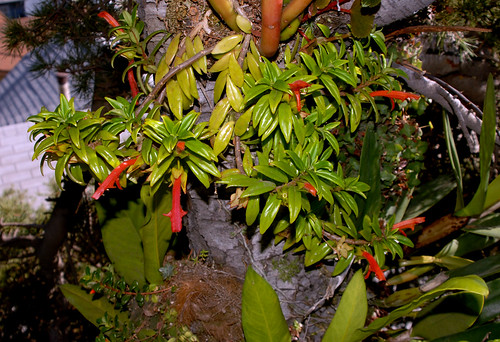
The orange flowers are from Columnea Elmer Lorenz.  I wish that I had attached it to a horizontal branch instead.

Further up on the tree I noticed that my clump of plants growing all over Aglaomorpha coronans had been dislodged by some critter.  It didn't help that a nice, but heavy, Echeveria gibbiflora was pulling down on the clump.  Here's a picture that I took last year of the Echeveria...


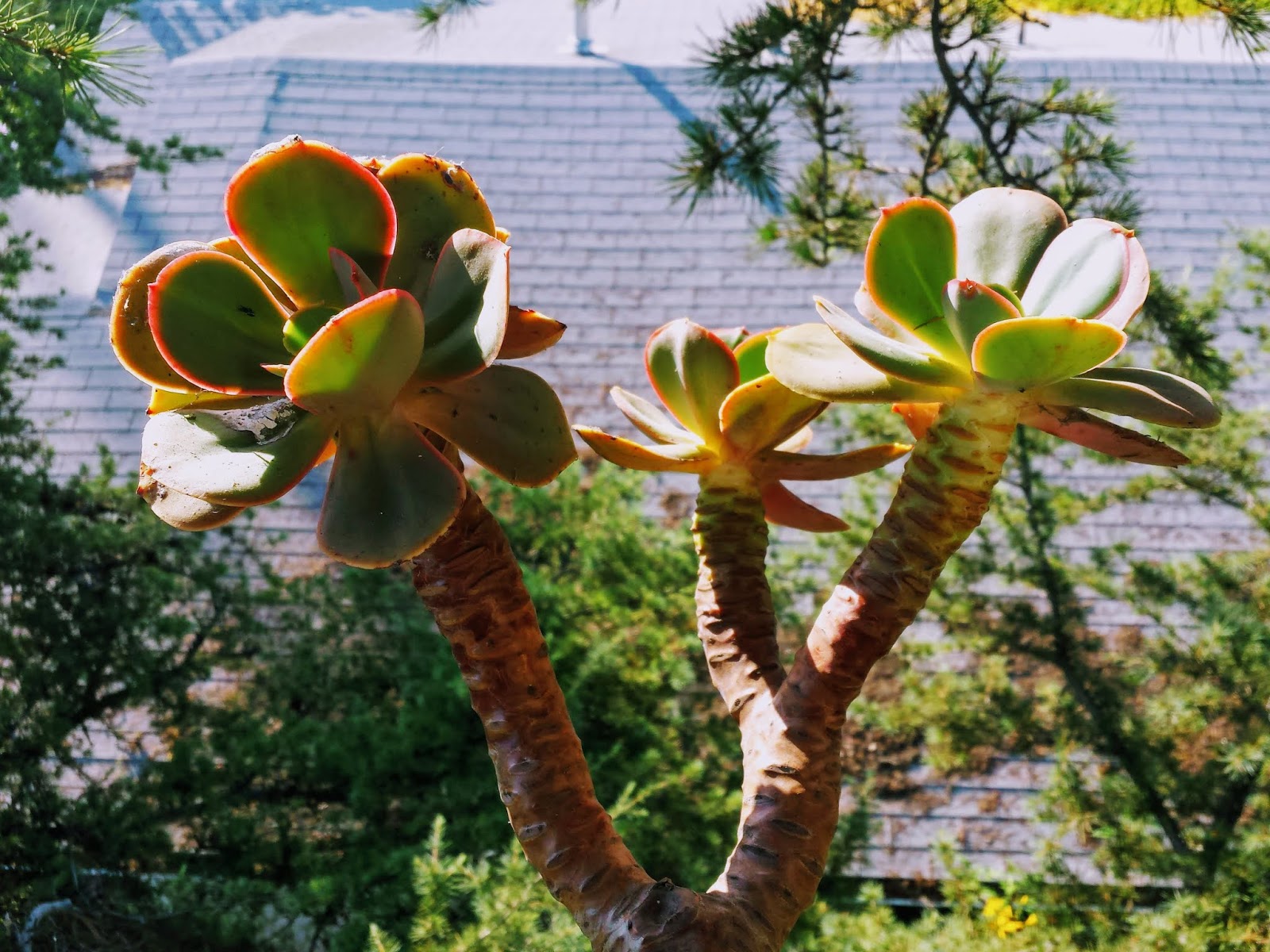
This Echeveria, which grew from seed that I had sown on the tree, is different from the other seedlings because its leaves are more rounded and the plant itself branches.  None of the numerous other seedlings have branched.  I really like the idea of a branching gibbiflora so I decided to cut this one off in order to give it more TLC than it has been receiving.  Here's the pic I took after removing it...


And here's a pic of it with a one gallon pot for reference...


How awesome would it be to have an Echeveria that branches just as much as a Jade plant?

Lastly, here's a context pic of Anthurium scandens....


In retrospect, Columnea Elmer Lorenz should have been a contestant in the 2011 Epiphyte Grand Prix.  How different would the tree look?

I water the entire tree twice a week at night during the summer.  When the weather starts to get cooler, I water less and less frequently and earlier and earlier in the day.

Every tree in California should have at least a few plants growing on it!

Tuesday, July 3, 2018

Patio Peek

This last weekend I attended a patio peek that my friend Scadoxus participated in.  I'm really glad that I did!  I saw some nice patios/plants and met some pleasant plant people. 

Here's one plant that caught my attention...


It's a Trachelium (Blue Throatwort).  I'm particularly interested in it because it readily volunteers.  One of my favorite volunteering plants is Ruellia brevifolia...


Ruellia brevifolia - My Favorite "Weed"


Earlier in the year Scadoxus gave me Ruellia elegans which she had received from her two friends.  They had purchased it from Annie's Annuals.  Coincidentally, while in the Trachelium patio, I randomly met Scadoxus' two friends for the first time.  They mentioned Annie's Annuals, I mentioned the Ruellia, and we put two and two together.  We uncovered a hidden connection. 

I think that R. brevifolia is a warmer grower/bloomer while R. elegans is a cooler bloomer/grower.  The elegans has been blooming non-stop while the brevifolia hasn't started blooming yet.  When it starts to bloom, I'd like to try and cross the two species in order to hopefully create a hercuthermal hybrid (grows/blooms in a wider range of temps).

Here's something that you don't see everyday...


It's a humongous Staghorn fern (Platycerium bifurcatum) growing directly on a brick wall. 

Here's a really nice epiphyte...


It's either a bromeliad or a Tillandsia.  I'm guessing that it's a Tillandsia, but I could be wrong.   I'm also guessing that it's monocarpic.  This would mean that it wouldn't produce any offshoots after it dies.  Ugh, I'm not a fan of monocarpic plants.  Hopefully this one is not monocarpic because I'd sure love to have an offshoot!  The vine with the pink flowers is Mandevilla.  In front of it is a very inviting couch.  It's wonderful when the lines between "inside" and "outside" are blurred.

Here's another really nice epiphyte...


Maybe it's Anthurium schlechtendalii?  It's being propped up by some cherubins.  The lady statue, the owner of the Anthurium, and me in the mirror are all interestingly arranged.  The three of us are facing in different directions... just like in a Hal Hartley movie. 

 Here's a tree fern...


Sorry about the blurry photo.   What's remarkable about this tree fern is that it's developing several heads.  It's not every day that you see a multi-headed tree fern.  More heads are better than one!

Here's a multi-headed tree Aloe...


Wow!  Wow!  Wow!  This is by far the best Aloe arborescens that I've ever seen in person.   I'm pretty sure that it's arborescens.  It is one of the most commonly grown Aloes here in California.  For some reason, despite its name, all the ones that I've seen are more like shrubs than trees.  But in nature you can see some distinctly tree like forms... for example.  Sometimes orchids will grow on them. 

The Aloe in the photo should definitely have one, or two, orchids growing on it.  Then it would be a phorobana.  Here's one orchid that sometimes grows on Aloe arborescens in nature...


A few years ago I attached this Mystacidium capense to a potted Bougainvillea.  Unfortunately, the medium in the pot was too barky and the Bougainvillea didn't make it.  In retrospect, I should have used a more gritty medium.  The plan was to have the white flowered orchid and the red flowered Bougainvillea bloom at the same time.  It would have been a lovely living bouquet.  Here's an example in nature.

Another great epiphyte for the Aloe would be a Tillandsia...


This Tillandsia kirschneckii is attached to my potted Ficus rubiginosa (Rusty Leaf Fig). 

Because epiphytes can grow on other plants, and even sometimes on walls, they are very useful for maximizing the diversity, interest and charm of small spaces.  The challenge is choosing the right ones.

One idea that I shared with one of the organizers of the patio peak is to create a plant society for the plant people in the area.  This way all the members can benefit from each other's different plant knowledge.  Plus, they can share plants and seeds with each other. 

Another idea that I had is that it would be nice to see other people's photos of the patios.  I wasn't the only person taking photos.  Personally I think Flickr is a useful platform for sharing photos. 

While it would be nice to see other people's photos of the patios, it would be even nicer to see their valuations.  This could be accomplished by using donations to judge the patios.  People would have the opportunity to "donate vote" for their favorite patios.  The money that was raised would go to a good cause... such as helping to transform local schools into botanical gardens.  Of course some of the money could also be awarded to the people with the top patios. 

Everybody who toured the patios was given a helpful map beforehand.  It was essentially a treasure map... but there was no indication of each treasure's value.  Would the map be even more helpful if everyone could see and know the value of each treasure? 

When a bee visits a patch of flowers, she uses dancing to communicate its value to the other bees.  This creates a dynamic and interactive treasure map of the flower patches in the area.  The more valuable a flower patch is, the more bees that will visit it.  I think it would be so cool if we could also see this treasure map.  Naturally, if somebody's garden in our area spiked in value, we would be very curious to learn the cause. 

No bee can be in two places at once, and the same is true for us humans.  This is why it's so useful to be able to communicate to each other the value of our discoveries. 

Wednesday, December 21, 2016

The Number One Plant Rule

My comment on Tom's blog entry: The staghorn fern, Platycerium bifurcatum, a cold hardy subtropical fern

My comment has a bit of spoiler so I recommend reading his entry first!

********************

Wow!  Really excellent story!  Great info and pics!  It was very interesting and entertaining to read about your Platycerium's successes and setbacks. I kept thinking that the "reveal" would be that your Platy was finally killed by an exceptionally cold winter.  So the suspense had me sitting on the edge of my seat.

Several years back, thanks to Craigslist, I got a really great deal on an overgrown NOID Cattleya. I divided it and ended up putting divisions on around a dozen different trees.  All the divisions quickly established and grew quite well.  Each year they all flowered.  Then a few years later... my garden got hit by a freeze and around half of the divisions were killed.  Some of the causalities were only a foot away from survivors.

This exceptionally cold event confirmed my number plant rule... don't keep all my eggs in one basket.  Hedge my bets! No two locations in any garden are going to provide the same exact amount of protection. Every garden has an incredible variety of microhabitats.  So if it's a plant that I'd be sad to lose, then I endeavor to maximize my chances of success by hedging my bets.

With this in mind, whenever I share divisions of cherished plants with friends... I be sure to let them know that I'm not being nice or generous or altruistic... I'm simply insuring my plant!

Sharing is caring?  Sharing is insuring! So it's a good idea to cultivate a network of strategically situated plant friends!  Heh.

Of course for plenty of plant enthusiasts a primary goal is to have an impressive specimen.  Which is fine... if the plant has already been adequately insured.  But with plenty of plants it's easy enough to propagate them from seed/spore. Just sprinkle some Platy spore on some wet floral foam in a pot... place the pot in a zip lock bag, set it by a window and voila! Your Platy's insured!

The benefit of propagating from seed/spore is that the apple might fall far from the tree in the direction of greater cold tolerance.  Progress is a function of difference.

Here's a pic of the Cattleyas a few years ago...


Cattleya Portia coerulea


And a relevant quote from the father of modern economics...

When a great company, or even a great merchant, has twenty or thirty ships at sea, they may, as it were, insure one another. The premium saved upon them all, may more than compensate such losses as they are likely to meet with in the common course of chances. - Adam Smith, Wealth of Nations

Wednesday, April 20, 2016

Creating The Perfect Orchid For Southern California

In an e-mail, u u (flickr, OB) said that creating the perfect epiphytic orchid for SoCal is a "Herculean" goal.  What's life without one, or two, or... a dozen... Herculean goals?!  But just how Herculean is this goal anyways?

For those of you who haven't been following along at home... the perfect epiphytic orchid for SoCal would be a lot like Aloe Hercules (AH)...

- Hercules, Hercutherm, Hybridize This and Hercules
- Hercuthermal Experiment

Let's geek out a bit...
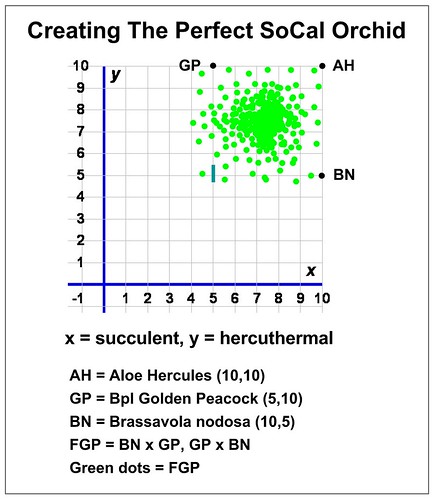

Creating The Perfect Orchid For Southern California


Brassavola nodosa (BN)

x = 10
y = 5

Golden Peacock (GP)

x = 5
y = 10

BN is twice as succulent as GP... but GP is twice as hercuthermal as BN.   BN only grows half the year here in SoCal while GP grows the entire year.  What we want is the best of both worlds!  We want an orchid that needs less water to grow the entire year.

So let's imagine that we crossed GP and BN.  This would give us a Fatter Golden Peacock (FGP).  Here are a few basic assumptions...

1. No two FGPs would be exactly alike
2. The more FGPs there are, the more variation there will be

We've all heard the expression about the apple not falling far from the tree.   It's a given that the more apples that fall from the tree... the greater the distances that some of the apples will fall from the tree.  This is what I've tried to illustrate in the x y graph.

In our case, we want the apple to fall far from the tree... but in the direction of AH.  The more FGPs that are produced... the greater the chances that we'll end up with a fabulous outlier.  This is known as the law of truly large numbers.

If there's one thing that orchids are really good at, it's producing a truly large number of seeds...
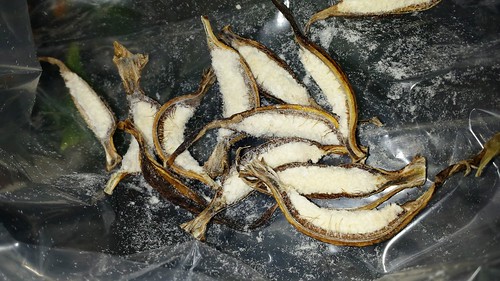

Cattleya Penny Kuroda Pods and Seeds

A single seed pod can contain a million seeds!  A million seeds is a truly large number of seeds.  I'm pretty sure that this goes a long way in explaining the success (diversity) of the orchid family.

Since orchids are exceptionally good at producing a large number of seeds, all else being equal, we should be able to make a lot more progress in a lot less time with orchids than we could make with coconuts.  An average size flask of orchids can contain around 30 seedlings.  But the same size flask wouldn't be large enough for even one coconut seedling.  Therefore, creating the perfect orchid for SoCal should be a less Herculean goal than creating the perfect coconut for SoCal.

So how many FGP seedlings would we need to grow in order to find the fabulous outlier?  A million seedlings?  Maybe 300,000 seedlings?  If so, that would be 10,000 flasks!  That's a lot of flasks!  If this is the case then...

Herculean = Expensive

In the x y graph I put AH and BN both as a 10 in terms of succulence.  Clearly, in absolute terms, AH is a lot more succulent than BN.  But in relative terms... perhaps they are reasonably equivalent.  For some evidence that this is roughly correct, check out this photo of a BN growing on a cactus in nature.

If you looked through that gallery of orchids growing on succulents/cactus... you would have noticed that BN isn't the only Cattleya alliance orchid that grows on cactus.  There are 100s of species in the Cattleya alliance that grow in seasonally dry forests and many of these orchids are happy to grow on the cactus that share the same habitat.

Here's a partial listing of some of the relatively drought tolerant species in the Cattleya alliance...

Barkeria (all)
Brassavola (all)
Broughtonia (all)
Cattleya nobilior
Cattleya walkeriana
Encyclia (all)
Laelia (Mexican... all)
Laelia sincorana
Myrmecophila (all)
Psychilis (all)
Rhyncholaelia (all)
Schomburgkia (all)
Sophronitis brevipedunculata
Tetramicra (all)

They all use different strategies to deal with drought.   Barkerias are the only ones that are deciduous.  Brassavolas are the only ones with entirely terete leaves... they also have very skinny pseudobulbs.   Tetramicras have canaliculate/fleshy leaves, skinny pseudobulbs and multiple leaves on each pseudobulb.  The pseudobulbs of the Rhyncholaelias aren't skinny or fat... but their leaves are relatively succulent.  Psychilis do not have very fat pseudobulbs either... but neither are their leaves relatively succulent.  Instead, their leaves are quite stiff (coriaceous).   Myrmecophilas are the only ones with hollow pseudobulbs (for the ants to live in).  Most of the others species have fat/succulent pseudobulbs but there's considerable variety in the size/shape of their pseudobulbs and in the quantity/size/shape of their leaves

One type of form that I find particularly appealing is the "teapot" form (short and stout).   Encyclia pyriformis is a good example...
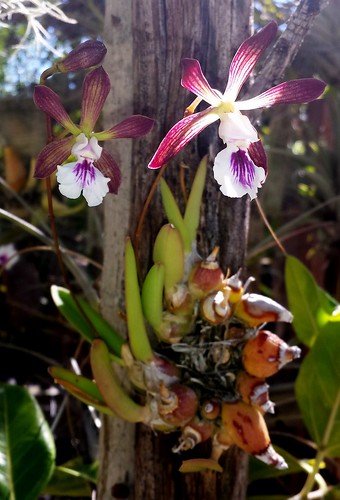

Encyclia pyriformis

The plant is so short and stout!  And here's a good photo that illustrates how stout Cattleya walkeriana can be.

Given the number of...

A. species in the Cattleya alliance that occur in dry forests
B. crosses that have been made with these species

... what are the chances that BN is truly the most drought tolerant orchid in the Cattleya alliance?  Pretty slim!  So ideally we'd want to cross GP with both A and B in order to find the combination of traits that is closest to AH on the x y graph.

How long would it take us to test out all these different possible combinations?!  And how much money would it cost us to flask all the seeds?!  Clearly the answer depends on how many of "us" there are.

Recently a friend in Australia shared a photo of a nice tree in Perth.   As nice as the tree is... it has a pretty big problem.  It's naked!  The tree doesn't even have a single orchid growing on it.  Perth doesn't have any native epiphytic orchids.  And neither does Los Angeles.

Perth and Los Angeles have something else in common.  Both cities have many people who love growing orchids... Orchid Society of Western Australia (OSWA) and the Orchid Society of Southern California (OSSC).

As the saying goes... many hands make light work.  What if we collaborated with the OSWA to create the perfect orchid for... Southern California?  For Perth?  And what if we invited the members of the Cape Town Orchid Society to join us?

Here's how I've illustrated this...
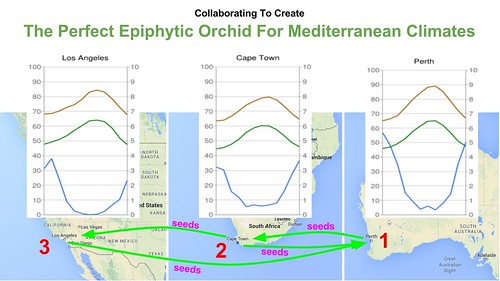

Creating The Perfect Orchid For Mediterranean Climates

Even though each of these three cities has a Mediterranean climate... there's a considerable amount of variation in precipitation (mm/inches)...

1. Perth: 730.5 / 28.76
2. Cape Town: 515 / 20.28
3. Los Angeles: 379.2 / 14.93

Out of these three cities... the least Herculean goal would be to create the perfect epiphytic orchid for Perth.  This is because Perth receives a lot more rain than Cape Town... and twice as much rain as Los Angeles.

Participants in Los Angeles and Cape Town would make promising crosses and send the seeds to participants in Perth.  The participants in Perth would flask the seeds and allow their climate to select the most suitable individuals.  The survivors of this selection process would be crossed with other promising candidates (recombination) and eventually the perfect epiphytic orchid for Perth would be found.  Participants in Perth would send seeds of this cross to participants in Cape Town.  The same selection/recombination process would eventually yield the perfect epiphytic orchid for Cape Town.  The seeds of this orchid would be sent to Los Angeles and the same process would eventually yield the perfect epiphytic orchid for Southern California.

What would we call this system?   Trickle down epiphytics (TDE)?

Perth, Cape Town and Los Angeles aren't the only cities with Mediterranean climates.   There are quite a few other cities in the same boat.  So if we want to get the ball rolling as fast as possible (maximize the rate of progress)... then we should be as inclusive as possible...


For comparison, here are the climate graphs for Brassavola nodosa, Barkeria barkeriola and Laelia speciosa (source) ...


For even more comparison, here's the climate graph for Melbourne...


Porto gets so much rain!!!  *green with envy*  With as much rain as Porto gets... is there already some epiphytic orchid species or hybrid that could thrive, or at least survive, there without any supplemental watering?  I'm guessing that the answer is yes.  And maybe the orchid growers in Porto are already growing this orchid?

Personally, I don't know any orchid growers in Porto.  And I'm guessing that I'm the rule rather than the exception.  I do know an orchid grower in Rome... but I really can't say that I'm doing a very good job of networking with other orchid growers in Mediterranean climates.

Here's a partial listing of orchid societies located in Mediterranean climates...


Maybe we should create a Facebook page/group for orchid growers in Mediterranean climates?

Googling around I found this photo in Wikipedia commons....


Cordoaria


The photo was taken by Marcia Breia in Cordoaria Garden which is in Porto, Portugal.  The tree is the London plane tree (Platanus × acerifolia).   The truck is so big, fat and mossy!  It would be perfect for an orchid... or two.

We would certainly linger longer and be more inclined to take a photo of this tree if it had an orchid growing on it.  But not only would this specific space be more appealing, it would also be more diverse.

Regarding the value of diversity...

Biological diversity is a natural protection against surprises and shocks, climatic and otherwise. Among diverse species will be some adapted to prosper in a new landscape in new circumstances.  - Daniel J. Evans et al, Policy Implications of Greenhouse Warming: Mitigation, Adaptation, and the Science Base 
More genetic variety in a species or a population means a higher likelihood that some individuals will adapt to changing conditions.  Lower genetic variety results in uniformity of species, and ultimately translates into vulnerability. 
As an example, modern agricultural practices typically are monocultures - the practice of planting vast swathes of genetically identical plants.  This is an advantage when it comes to growing and harvesting crops, but it can be a problem when a disease or parasite attacks the field, as every plant in the field will be susceptible.  Monocultures are also unable to deal well with changing conditions, such as the changing percipitation and temperature regimes associated with climate change. - Sarah L. Burch, Sara E. Harris, Understanding Climate Change: Science, Policy, and Practice

Regarding our natural preference for orchid diversity...

One would think that man could find enough variation in the orchid family, as it occurs in nature, to more than satiate his taste for variety. Yet man's appetite for variety is never appeased. He has produced over two times as many hybrids, in the past 100 years that he has been engaged in orchid breeding, as nature has created species in her eons of evolutionary effort. - Calaway H. Dodson, Robert J. Gillespie, The Botany of Orchids

Regarding our natural preference for collecting/sharing...

The absence of [Dendrobium johannis var. semifuscum] from the mainland of the Northern Territory and its presence on Melville and Bathurst islands leads to the speculation that it might have been introduced to the islands by Macassamen (trepang fishermen) who were known to plant all manner of things on some of the places they visited during their travels. - A. W. Dockrill, Australian Indigenous Orchids 
People collect baseball cards and people collect plant seeds.  In reality, it is not all that surprising that as people move around they help preserve the genetic diversity of plants. - Norman C. Ellstrand,  Maize Germplasm Conservation in Southern California’s Urban Gardens: Introduced Diversity Beyond ex situ and in situ Management
A far less technical way of preserving a species is in gardens.  Although the managers of botanical gardens or arboreta are more self-conscious of their role, any gardener can help.  The wide cultivation of Bougainvillaea and the para rubber tree, for example, protects them from extinction in tropical America.  By collecting and breeding novel plants, nurserymen preserve biological diversity.  By selling novel plants, they diversify the places the plants are grown and so help preserve them. - Daniel J. Evans et al, Policy Implications of Greenhouse Warming: Mitigation, Adaptation, and the Science Base   

Regarding the virtuous cycle of diversity...

Thus, the total diversity of an area provides the pool of competitors for niches in developing ecosystems.  The larger the pool, the more likely it is that the system will evolve into a complex, highly interrelated system.  And complex, highly interrelated systems provide more niche opportunities for new species.  Over time, interspecific dependencies, both of predation and mutualism, will evolve.  Further, interspecific competition often aids in avoiding competitive exclusion, as predators concentrate on the competitively advantaged species on any given trophic level.  Thus, total diversity plays a key role in the development of ecosystem structure through ecological time.  That structure, in turn, provides opportunities for more species to survive and thereby increases total diversity further.  Therefore diversity augments diversity in a continuing upward spiral. - Bryan G. Norton, The Preservation of Species

Creating the perfect epiphytic orchids for Mediterranean climates would mean that lots of people would attach these orchids to trees.   Because, just like AH... they would require very little supplemental water to grow year around.  All these orchids on trees would create new niches for a wide variety of living things.  The logical and beneficial outcome would be more diversity.

Right now there are thousands and thousands of people growing millions of epiphytic orchids in Mediterranean climates.  All these epiphytic orchids require more supplemental water than AH requires.  And because people often don't have the time, or energy, to consistently and regularly water their epiphytic orchids... many epiphytic orchids are killed from dehydration.  Basically, people unintentionally help nature select for the most drought tolerant and hercuthermal epiphytic orchids.  This means that we will eventually end up with the perfect orchids for Mediterranean climates.  Personally, I'd love to have these orchids sooner rather than later!!!  It's really hard to imagine that I'm the only person in this boat!  So in theory, it shouldn't be a Herculean goal to encourage people to help create/buy/test/share epiphytic orchids that might be better suited for Mediterranean climates.