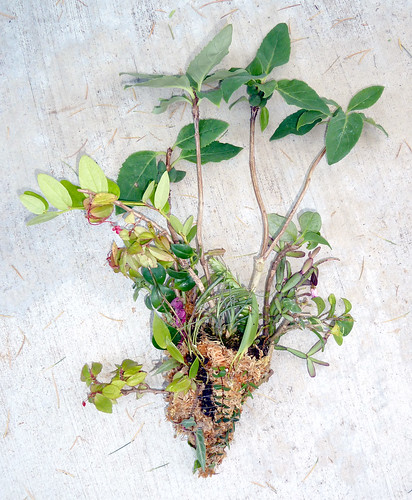
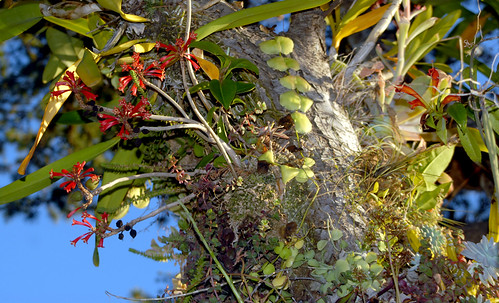
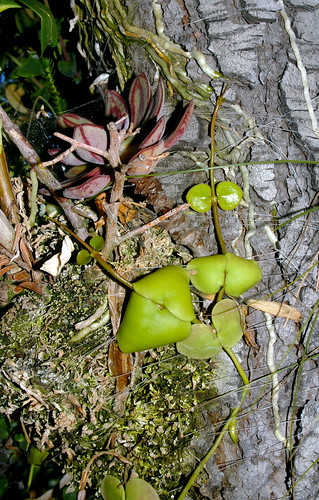
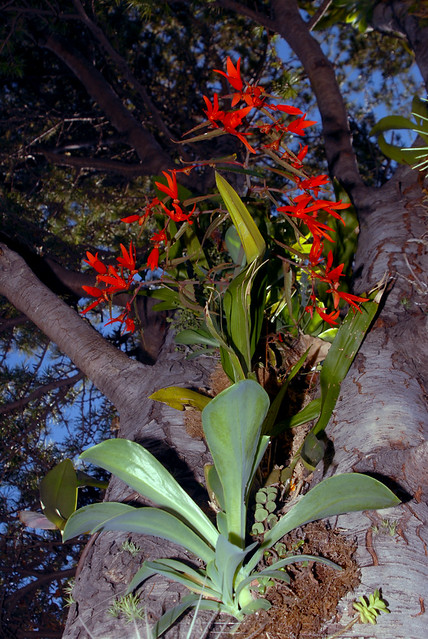
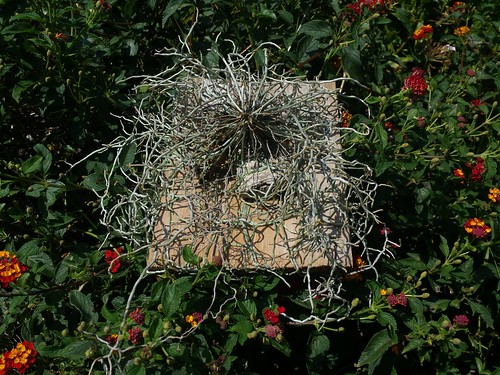
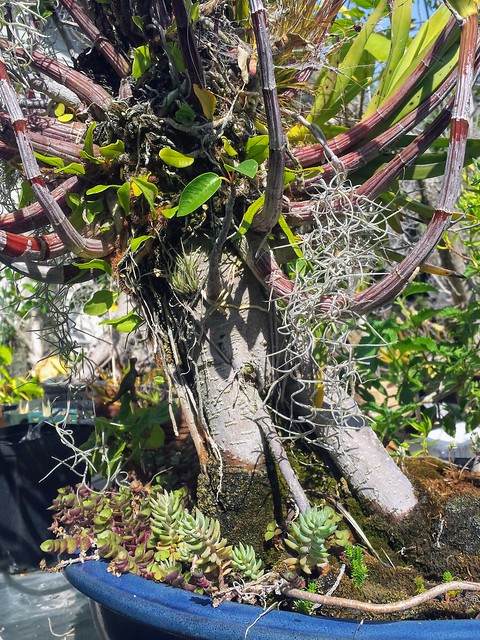
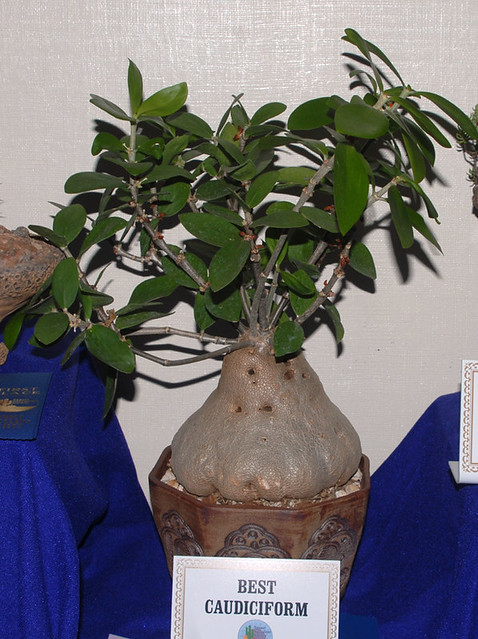
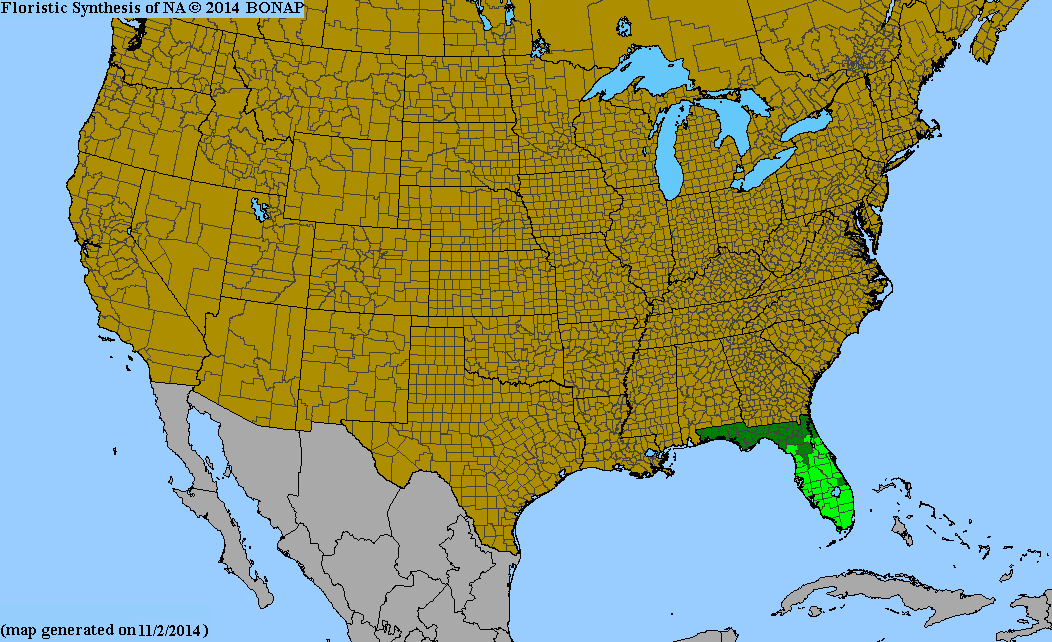
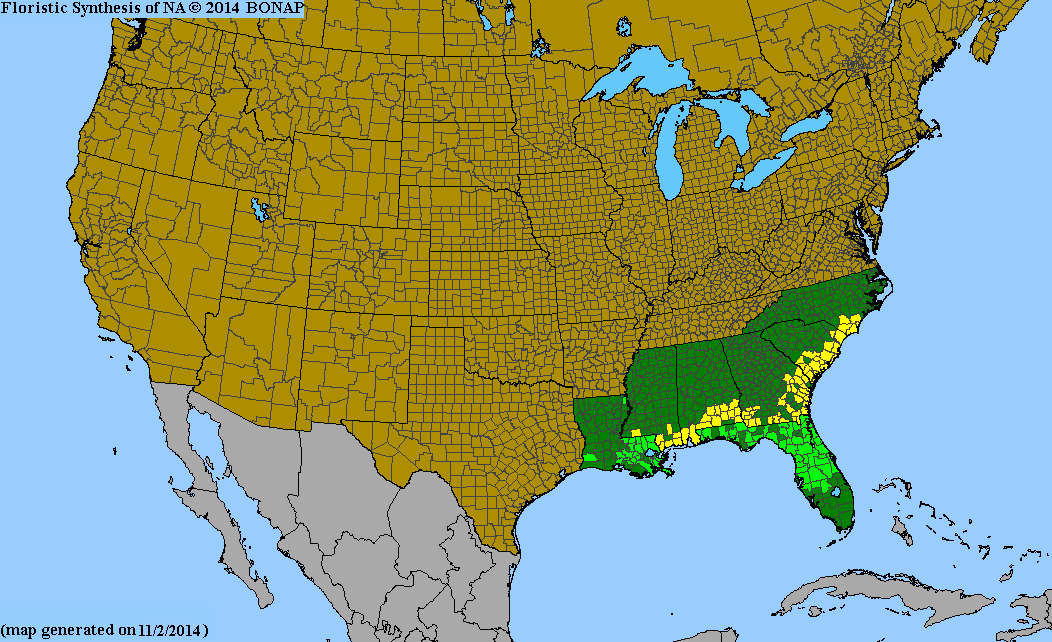
If I was in your shoes, I'd definitely try and grow Encyclia tampensis. You're right on the border of its natural limit. But you'd have to expect that, every once in a while, a particularly bad freeze might wipe out your tampensis. But if you spend $10 dollars for a tampensis, and get 5 years of enjoyment from it, then that's not the worst investment. In comparison, you only get 15 minutes of enjoyment from a $10 dollar meal.
I definitely wouldn't buy very many tampensis though. Instead, I'd buy a lot of conopseum crosses. Eplc Butterfly Kisses (Lc Trick or Treat x Epi. conopseum) isn't too shabby (photo). There's actually one available on eBay. I think it looks better than tampensis. Another cross available on eBay is Epi. conopseum x C. purpurata.
You're super fortunate that there's a vendor on eBay, bluemossguy, who regularly offers crosses with conopseum. Right now he's selling a flask of Epidendrum conopseum x Brassavola nodosa for only $15 dollars. What a great cross! I bought 3 seedlings of this cross from him a couple years ago and am really happy with them. I wish that I had gotten an entire flask. I could still do so, but it's hard to justify the purchase when I already have three plants of this cross.
Getting a flask is a good idea because you can expect some drought/temperature tolerance variation among the seedlings. The larger the pool of seedlings, the more closely suited some of them will be to your conditions. With this logic in mind, it would be optimal to sow as many seeds on your trees, and the street trees, and your neighbors' trees, as possible. I've had some success with this technique here in dry, parched and thirsty Southern California. So you should have a lot more success in rainy, wet and humid Florida.
There's a limit though to how many flowers you can personally cross-pollinate. You'd end up with a lot more seed pods if you recruited the natural pollinators. Bees are cool, but hummingbirds are the coolest. I've witnessed my hummingbirds trying to make all sorts of crazy crosses (ie Echeveria x Aloe). I've seen them visiting orchid flowers as different as Dendrobium bigibbum and Dockrillia teretifolia. Both orchids have ended up with pods.
(Epi. Pacific Eclipse x Epi. Pacific Canary) 'SVO Yellow Sun' x Epi. conopseum 'SVO'
Not sure if there are any still available. My friend bought one and let me borrow it to try and cross it. There are two pods on it but they kinda stalled out. It does have a really nice keiki on it. The plant itself is a lot more like a typical reed-stem. But it's more stout and succulent. I think it might actually make a pretty great epiphyte.
Another orchid that hummingbirds love to pollinate is Broughtonia sanguinea. It's a really awesome orchid. Coincidentally, today I just harvested a pod that was made by a hummingbird. The plant had finished blooming a while back but when I went to harvest the pod, I noticed that the spike was just starting to produce more flowers. So you don't want to cut off a spike that's still green. This species is relatively drought tolerant, but it isn't very cold tolerant.
Sophronitis cernua is another great orchid that the hummingbirds love to pollinate. Not sure if I remember correctly, but I thought that bluemossguy sold crosses of it with conopseum.
There are lots of really fun and exciting possibilities! You can choose from numerous really different orchids. When you make your choices and attach them to trees, then nature (conditions/pollinators) can choose among them. You can then choose among nature's choices. This virtuous cycle is a cross between artificial selection and natural selection. It's so much teamwork that we can think of it as collaborative selection. Or holistic selection. Or some better term.
Way back when I used to be a species guy, but then I decided that I cared more about results. For me whether an orchid was a species or hybrid was less important than whether it thrived on a tree. Then I realized that slugs sure don't care whether an orchid is a species or hybrid! Neither do hummingbirds. Or the weather.
I'm guessing that your society's input might be a little different? Heh. Variety is the spice of life. Let me know what your society says. And please share updates on your project.
The Dermatobotrys and Anthurium were the only two survivors from the original bundle. Then maybe a year, or two, ago... because of the drought, I reduced watering from 3x/week to 2x/week during summer. The Dermatobotrys crashed and burned. But the Anthurium didn't even slow down. Here's a pic that I took yesterday...
The Anthurium would be a bigger specimen but I've shared quite a few cuttings over the years. The "flowers" are insignificant to say the least, but its berries go from white to a nice light purple. What's great about this species is that it's a drier grower. When I ordered it from Black Jungle I specifically requested the xeric form. I have a few other Anthuriums on my tree (ie coriaceum, schlechtendalii) but they are standing still compared to scandens.
The scandens beat a few other plants that I added to the bundle, including an Echeveria nodulosa that I added in 2012...
The Dischidia cleistantha (shingler) did much better. It wasn't very happy though when I reduced watering to 2x/week. There are a couple places on the tree where it's still hanging on. Dischidia milne (bottom of 2013 pic and middle of 2017 pic), on the other hand, didn't have a problem with less frequent watering. It's more of a drier grower than Dischidia formosana (dangling in 2017 pic), which will die off if dry for too long. However, formosana is a lot faster than milne. I'm guessing it's partly because formosana probably grows in a wider range of temperatures.
Jumping back to Echeveria nodulosa... I recently saw this thread that Stan started for his. Seeing it reminded me that I was really interested in this Echeveria that oldstumpy1 had shared in this 2013 thread...
I shared the photos with John Trager and he said that it looks a bit like a cross between Echeveria rosea and nodulosa. For some reason I don't run across very many crosses with either. Here are a few exceptions...
The goal is to try and find/create an Echeveria that can easily beat Anthurium scandens here in Southern California. In theory it shouldn't be a mission impossible given that Echeverias are relatively easy to cross. The time it takes to accomplish this mission depends on the number of crosses tested. So let's test more crosses!
A couple years ago my best Brazilian friend, who I've never met in real life, sent me seeds of a few different plants, including a terrestrial Begonia. A terrestrial Begonia? Sometimes I'll say, "If it's not an epiphyte, or a phorophyte, then it's not for me!" There are certainly some epiphytic Begonias, but they are generally pretty thirsty, which doesn't work so well here in parched Southern California. What I've discovered is that plenty of drought tolerant terrestrials can actually make pretty decent epiphytes.
Here's a picture of my tree in 2012...
Begonia boliviensis and Echeveria gibbiflora are both terrestrials. They did well epiphytically... for a while. Each one has the opposite issue. The Begonia's pendent form is perfect for growing on a tree, and it's drought tolerant, but it isn't a drier grower. The Echeveria, on the other hand, is definitely a drier grower. It grows really fast and quickly develops a trunk, which eventually badly bends and causes the plant's gradual decline and eventual demise. So its upright form is far from perfect for growing on a tree. There have been a few rather interesting exceptions. I'd love to speed up the evolutionary process in order to see its optimal epiphytic form.
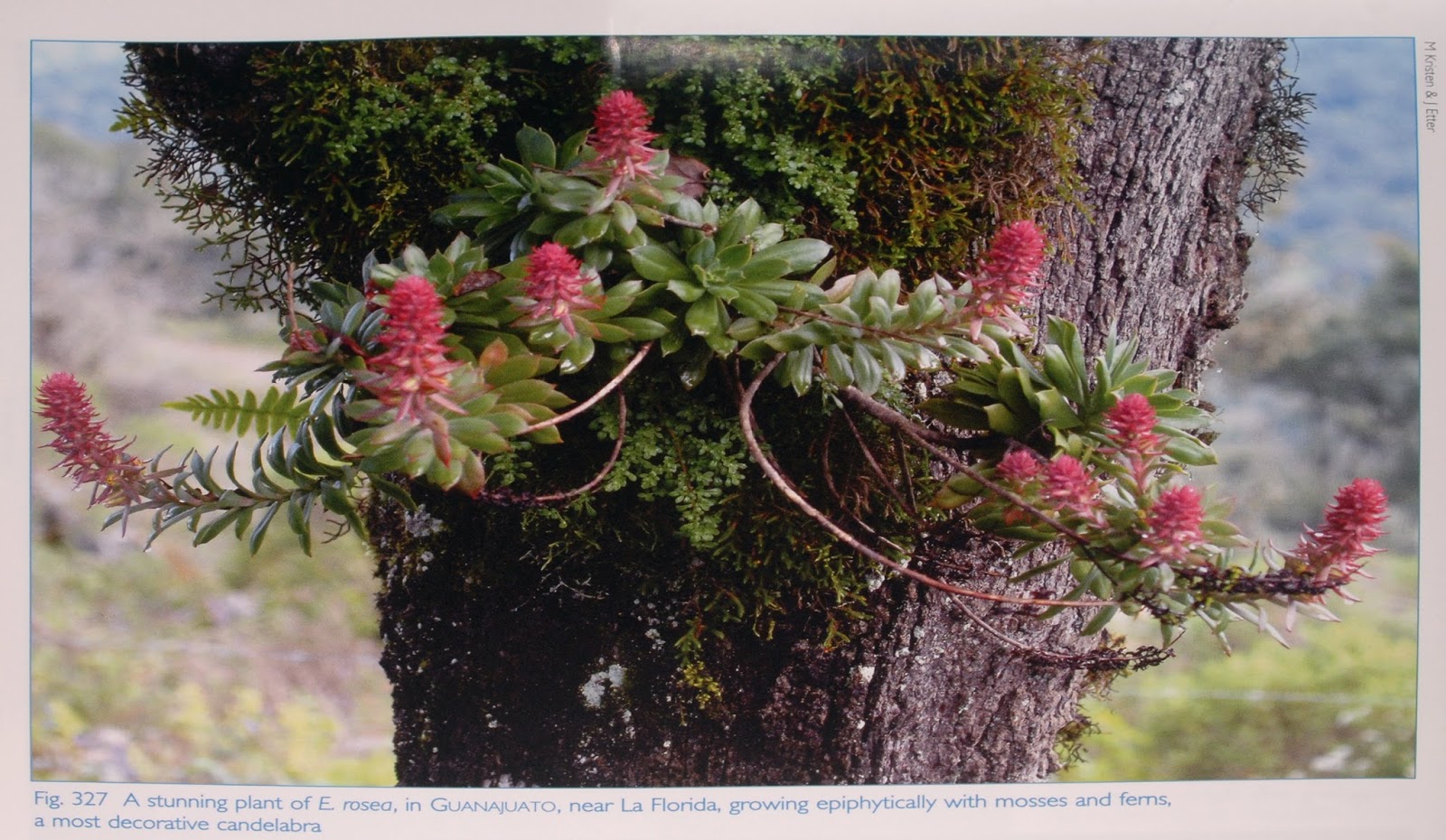
There are a few mainly epiphytic Echeverias... such as rosea. Here's a picture of it from "The Genus Echeveria" (I think) by John Pilbeam...
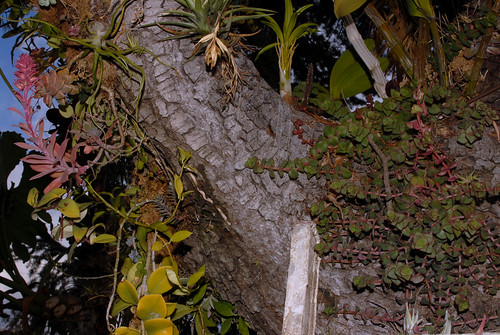
So nice!!! Here's a picture of it blooming on my tree in 2012...
It was growing a few other places on the tree as well. They were fine when I watered 3x/week at night during summer, but weren't so fine when I reduced the frequency to 2x/week.
Echeveria rosea's form is much better than gibbiflora's form for growing on trees, but gibbiflora is a much more drier grower than rosea is. It would be wonderful to have the best of both worlds!
In a small section of my garden that I water 3x/week I have some happy roseas growing in baskets and on mossy boards. When two of them bloomed earlier in the year I placed them right next to some blooming gibbifloras and coccineas growing in pots. I was hoping that the hummingbirds would do all the work of cross-pollinating them. Recently I sowed the seeds from the roseas and I'm crossing my fingers that some of the seedlings will be better at growing epiphytically here in SoCal.
My Echeveria strategy is the same one that I've planned on using with the Begonias. I've been on the lookout for drier growing Begonias... so I was really happy that my friend in Brazil sent me some seeds of one. I used water bottles for pots and put pure pumice in some and a mix of pumice and peat in others. On top of the medium I put a layer of New Zealand Sphagnum. I thoroughly watered the pots, sowed the seeds on top of the moss, misted the seeds and put the pots in ziplock bags, which I placed near windows or under lights. When the seedlings started to get too big for the bags, I gradually opened them in order to slowly acclimate the seedlings. Then I placed them outside in a somewhat shady area. I don't think that I lost a single Begonia over the winter. Here's a pic of the seedlings right before I divided and potted them up (13 Aug 2007)...
They look like nasturtiums! They were in a decent amount of shade and weren't very drought stressed. The ferns are all volunteers. They popped up when the pots were in the bags. Some might have come up from the Sphagnum, but some might have also come up from the additional epiphytic moss that I added to the pots. There were also a dozen or so regular Begonias. I'm not exactly sure where they came from.
Here's a pic of the plants after I unpotted them...
I grouped the plants according to their medium. Can you guess which group was in pure pumice? Let's just say that when I potted them up I didn't use pure pumice...
There are around 50 seedlings. I had already given one to Fernando and another to Scadoxus. I placed the Begonias in square pots in a sunnier spot that I water once a week during summer. The Begonias in the water bottle pots went back to their original location.
I'm not exactly sure which species my Begonia is. My friend said venosa but I don't think that they are. Then again, they have been growing in a decent amount of shade. They might look pretty different after getting some direct sun. I believe that my Begonias are from Chapada Diamantina. So I searched Flickr for "Diamantina" and created a gallery for the pics of Begonias. Most of the Begonias look the same but there are a few that look different. What's a little "tricky" is that there are actually two places in Brazil named "Diamantina". In the state of Bahia there's a region called Chapada Diamantina and in the state of Minas Gerais there's a city called Diamantina.
According to this article, my Brazilian Begonia might be Begonia umbraculifera. When I did an image search I found this page with a photo of a Begonia that looks quite similar to mine. What are some other possibilities? A few of the Begonias in my Flickr gallery are identified as Begonia grisea. When I search Google images for Begonia grisea, the fourth image is from an article about Begonia petasitifolia. It looks very different compared to this Begonia petasitifolia. If its leaves unfurled would they look like the leaves on my Begonia?
Whatever my Begonia is, so far it seems to be a decent drier grower. But I doubt that its tall upright form is the best for growing epiphytically. I definitely plan on trying to cross it with Begonias that have a more suitable form, such as boliviensis.
I really love plants. The first thing that I did when I moved into my house was replace the front lawn with a wide variety of super interesting drought tolerant plants. Why should that space only have one plant when it can have many plants?! In economic terms, the opportunity cost of the lawn was way too high.
The awesomeness of having more interesting plants in any given space is the basic premise of "phorobana". A phorobana is any potted plant (ie bonsai) that has epiphytes growing on it. For the sake of facilitating communication I took the liberty of creating the word "phorobana" (phorophyte + ikebana). Plus, having a unique word for the idea makes it easier to search for and find relevant material.
It's a basic fact of life that space is always limited. A larger house means a smaller garden. More lawn means less biodiversity. The beauty of phorobanas is that they facilitate biodiversity. They put more treasure on a map.
There's usually quite a bit of treasure at plant shows. However, just like gardens, shows have a limited amount of space. Check out this photo that I took at a plant show...
As you can see, the orchid is suspended in mid-air. Taking advantage of vertical space frees up horizontal space for more treasure.
The Uncarina has vertical space that could be occupied by the Dockrillia. If the same person already owned both plants, then adorning the Uncarina with the orchid would create room on the map for more treasure. If, on the other hand, the orchid was purchased for this purpose, then more treasure would be added to the map without sacrificing any horizontal space.
The Uncarina and the Dockrillia are both great ideas. Would combining these two great ideas result in an even greater idea?
Peanut butter is a great idea... so is jelly... and so is bread. Most people would agree that the combination of these three ideas is greater than any of these ideas on their own. The whole is greater than the sum of its parts.
With all the different ingredients in the world... the possibilities are endless. This is just as true for phorobanas as it is for dishes. The orchid family alone has more than 20,000 really diverse epiphytic species. Not to mention all the hybrids.
How long will it take to find the phorobana equivalent of a peanut butter and jelly sandwich? It's a numbers game. Finding the lovely outliers in less time depends on more people creating more combinations of epiphytes and potted plants. Progress depends on difference. More difference means more progress.
Right now plant shows are the equivalent of eating peanut butter, jelly and bread separately. These ingredients are good... but they are so much better together! Yes, at ikebana shows there are arrangements that people can "taste". Even though the arrangements can be aesthetically pleasing, they aren't sustainable or informative. But imagine that you are at a phorobana show and you see a Dockrillia happily growing on an Uncarina. If you're familiar with the orchid but unfamiliar with its host, then you can reasonably guess that their requirements are somewhat similar. In this case the association would be informative.
Phorobana shows will be far more informative and interesting than regular plant shows. To help support this conclusion I'll show you some of my epiphytically enhanced potted plants...
Phorobanas should be on everybody's treasure map! Nobody should overlook this valuable idea! The question is... just how valuable is it? Does it matter?
In this video a street vendor is selling artwork by Banksy. The artwork is priced far below market value... but the vendor doesn't inform anybody that it's original art by Banksy. It's the closest thing you'll see to people walking past $100 dollars bills just sitting in the middle of the sidewalk.
Imagine the equivalent scenario with some hunters and gatherers. Of course they are hungry... yet they simply walk past some plants that are loaded with perfectly ripe squash.
In some of the older orchid articles there are accounts of workers in tropical orchards regularly removing the "parasites" growing on the trees. They would rake the precious plants into huge piles and burn them.
Our behavior is far less beneficial when we don't know how valuable things are to other people. In order to maximize beneficial behavior it's necessary to share and learn the value of things.
When we go to a plant show/sale we might find numerous plants that we'd be really happy to have. We can tell a vendor... "I really love that plant!" But usually the vendor doesn't just give it to us. This is because talk is cheap. It doesn't cost us anything to simply say that we really love something. In order to prove that we truly love something, we have to be willing to spend our money on it. If we are willing to pay the price for the plant then the vendor will be happy to give it to us.
Spending our money helps to improve the treasure maps of vendors. The accuracy of their maps determines our benefit! We sure don't benefit if vendors overlook plants that we value. So we use our money to inform vendors which plants are more valuable/needed/wanted/important/relevant. Plant sales give us the immensely wonderful opportunity to superficially ("I love that plant!") and substantially ("I'll buy that plant") participate in the prioritization process. Because everyone is allowed to participate in this process, it makes it far more likely that any given shopper will be as happy as a kid in a candy store.
Perhaps this might seem pretty obvious... yet plant shows don't give everyone the opportunity to substantially participate in the prioritization process. And neither do plant forums! This forum is packed with products but we really don't substantially participate in the prioritization process. Same thing on Flickr... and Youtube... and Netflix. We're allowed to superficially participate in the prioritization process by commenting on and/or rating the different products... but we don't substantially participate. In the absence of substantial participation... the true value of the products is unknown... which means...
1. we overlook valuable products
2. less valuable products are supplied
3. we're less happy in the candy store than we should be
For Netflix the solution is simple. Subscribers should be given the option to earmark their fees to their favorite content. They'd still have complete access to all the content but they'd also have the opportunity to substantially participate in the prioritization process.
A while back on Netflix I watched BBC's documentary "Wild Arabia". In one episode I was quite surprised to see a branch that was covered in epiphytes...
The tree is in the Dhofar mountains in the country of Oman. I really didn't know that Oman has epiphytes! Did you?
Unfortunately, the scene was way too short. I wanted to see and learn so much more about these epiphytes. If Netflix had given me the opportunity to earmark my subscription dollars to specific scenes, then I definitely would have earmarked quite a few to this one. I'm guessing that there wouldn't be too many other people in the same boat as me. But how many subscription dollars would subscribers earmark to shows about plants? I don't know. Neither does Netflix. It's easy enough to find out though.
This system of substantial and specific feedback is applicable to all organizations that have subscribers. But the same system can also work with donors.
When the students in my friend's 4th grade class donate their pennies to their Book Dept, they can use them to help determine the order (relative importance) of their favorite books. When they donate their pennies to their Communication Dept, they can use them to determine the order of their favorite blog entries. This same system could be used for forum threads.
We'd all have the option to donate money to the forum in order to help determine the order of our favorite threads. Not only would our donations support the forum, but they'd also bring the most valuable threads to each other's attention... "Hey! Here's some treasure! Please don't overlook it!"
For all intents and purposes... each member of this forum is in the same tribe! :) We probably don't have to worry about any of our members overlooking squash... but how many new books, articles, blog entries, threads, videos and events are there every day? None of us has the time to read, watch and attend everything. So it's way too easy to miss many valuable things. This is why it's so important to appreciate that our tribe, as a group, can read, watch and attend far more things than any single member of the tribe can. Our tribe, as a group, has far more eyeballs, ears, hands and feet than any single member of the tribe has. Most importantly... our tribe, as a group, has far more brains than any single member of the tribe has. As a group, our tribe can cover far more ground and gather/process far more information than any single member of the tribe can. But in order to realize the incredible potential of our collective body and brain... we need to use our money to improve each other's treasure maps. When each member of our tribe has a far better treasure map, then every single one of us will make far more informed decisions which will improve our treasure maps even more. Our tribe will be the smartest and most powerful and most influential tribe on the internet. We will win the internet. At least until other tribes figure out the secret to our success.
Think about it though... if it's beneficial for each and every member of our tribe to use our money to improve each other's treasure maps... then imagine how beneficial it will be when each and every member of the human race uses their money to improve each other's treasure maps. Then we will be the smartest and most powerful and most influential species in the universe. We will win the universe.
Admittedly, for all I know, some other species has already won the universe. But I do know that phorobanas wonderfully illustrate the idea of a map having more treasure (epiphytic enrichment).
Here's a photo that I took earlier in the year of my very first phorobana...
The Dendrobium x delicatum was blooming.
Does my phorobana look crowded? Well yeah, it's crowded with coolness! This relatively small Moreton Bay Fig (Ficus macrophylla) is carrying way more than its fair share of precious biodiversity. One very tiny passenger is Cleisostoma scolopendrifolium...
Epiphytic enrichment is nicely described in this passage about an aquarium...
The condensed reef's extraordinary hues and alien life forms cast a New Age vibe. To stand in front of this rectangular bottle is to stand on a harmonic node. Here are more varieties of living creatures crammed into a square meter than anywhere else on the planet. Life does not get any denser. The remarkable natural richness of the coral reef has been squeezed further into the hyper-natural richness of a synthetic reef. - Kevin Kelly, Out of Control
Everylittle corner of the world should be packed with treasure. Every space on every person's map should be packed with treasure. Everybody should be surrounded by valuable opportunities. Everybody should clearly recognize all the valuable opportunities that are available to them. Therefore, everybody should use their money to help each other clearly see all the valuable opportunities.
Ok, so we've covered quite a bit of conceptual ground. Next we can consider some of the practical aspects... such as sources for epiphytes/hosts and matching them.
The endlessly fascinating challenge is matching epiphytes and hosts! Logically they should have similar cultural requirements. You probably don't want to attach a Dracula orchid to a Golden Barrel Cactus. Maybe the easiest way to culturally match hosts and epiphytes is to learn which hosts epiphytes naturally grow on in nature.
Here's a photo of a Cabbage tree (Cussonia spicata) in nature with an orchid (Polystachya ottoniana) growing on it...
Her C. spicata is missing a P. ottoniana and my P. ottoniana is missing a C. spicata! Should she give me her Cussonia or should I give her my Polystachya? :D Perhaps the rule is that ornaments are gifted to the owner of the Christmas tree. :)
There are a few relevant cultural details to point out. The bark on a relatively young Cussonia clearly doesn't have nearly as much texture as a mature tree. Also, when the Polystachya grows on the Cussonia in nature, even though they get roughly the same amount of water... I'm guessing that it's a lot more humid there in South Africa than here in Southern California. These two differences (texture, humidity) can be balanced out by giving the orchid some moss and/or more water. If watering frequency is increased then the Cussonia's drainage also needs to be increased (ie more gravel/pumice).
What's rather fascinating about Polystachya ottoniana is its distribution...
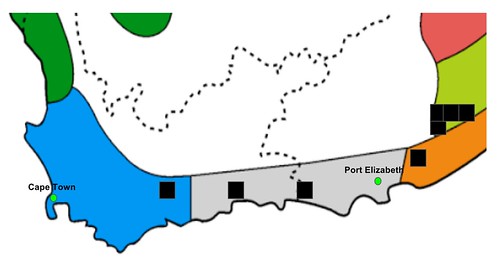
This is a map of South Africa. The blue area represents the Mediterranean climate and the black squares represent documented occurrences of Polystachya ottoniana. As far as I know this is the closest that any epiphytic orchid species comes to being Mediterranean. So maybe here in California it might actually take advantage of our winter rain and not be so bothered by somewhat less frequent watering in summer?
It's pretty easy to match hosts and epiphytes based on their natural associations. But you can also match hosts and epiphytes based on their natural habitats. Since California is so dry I'm especially interested in epiphytes that occur in seasonally dry tropical forests. On Flickr I created a gallery of orchids growing on cactus and other succulent plants.
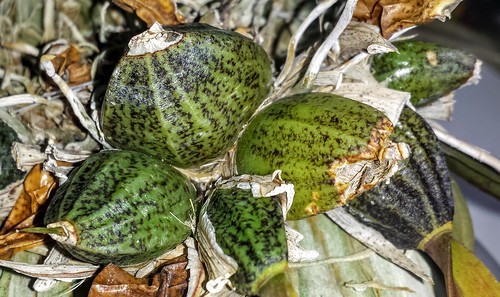
A couple of those photos are of Zelenkoa onusta growing on a cactus in the US Botanic Garden conservatory. How cool is that?! This small orchid naturally grows on cactus in Panama, Colombia, Ecuador and Peru. Not only does it have nice yellow flowers but it also has really neat pseudobulbs...
Another really nice smaller orchid from a drier habitat is Laelia sincorana...
In bright light this orchid will have roundish pseudobulbs and short succulent leaves. I refer to these type of orchids as teapot orchids (short and stout). In its native country of Brazil, Laelia sincorana naturally grows on Vellozia species. Vellozias are so very awesome! Quite a few different epiphytes grow on arborescent Vellozias in nature because their fibrous branches are especially good at holding moisture. It's a real shame that they are so scarce here in Southern California!
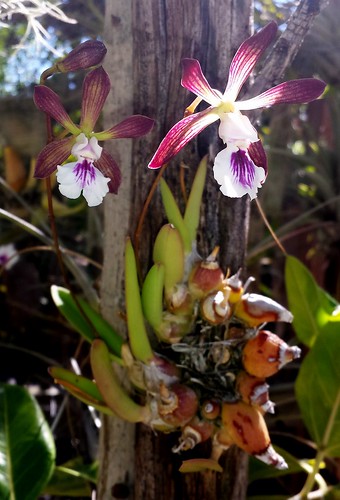
Encyclia pyriformis is another of my favorite teapot orchids...
Nature makes the best ornaments! Here are some pictures of potential hosts...
Not sure which plant this is... Dracaena draco or arborea?
Dracaena marginata is fairly common and can be grown from relatively large cuttings. Here's a relevant passage about growing hosts from substantial cuttings...
In completely tropical climates, where the temperature never falls below 55F., the trees could be placed anywhere in the garden or patio. This assumes that severe winds or very dry desert air are not a factor. In such tropical settings, larger trees could also be used. In temperate climates both the trees and the orchids will require a greenhouse or its equivalent. Anyone with a large greenhouse could plant one or more trees directly in the ground. This can be seen, in a well-done fashion, at The Marie Selby Botanical Garden in Sarasota, Florida. There are several good-sized Crescentia trees covered with orchids in their display house. Most people will probably prefer to maintain semi-dwarf trees in large pots. These might be mounted on dollies for mobility, if desired. It may be necessary from time to time to air layer new trees as the old ones become too root-bound and lanky. Probably all of the trees listed will air layer rather easily. Most will also root easily as cuttings under mist. Some, such as Calliandra, Erythrina, Codiaeum, Acnistus, Tabebuia and Crescentia, will root without mist from large cuttings, even up to fence post size. Many of the trees have showy or fragrant flowers, some have attractive edible fruit and several have unusual foliage colors. Any can be grown from seed if it is available and you have the patience. - John Beckner, Host Trees for Cultivated Orchids
Here are some other plants that can be grown from substantial cuttings...
Aloes
Aralias
Bougainvilleas
Cordylines
Cup of Gold
Ficus
Grapes
Moringa
Pachiras
Plumerias
Pomegranate
Yuccas
My friend sent me a photo of this Ficus rubiginosa growing epiphytically...
Most likely this Ficus is going to be chopped off and thrown away. A much better use for it would be for a phorobana. So I told my friend that he should ask the owner for it.
From my perspective, the one group of plants with the greatest phorobana potential are the Aloes...
This is Aloe Hercules (barberae x dichotoma) in a SoCal nursery. I have no idea how this one ended up with so many low branches. But it would be awesome if all the branches were adorned with teapot orchids.
Hercules doesn't usually branch so frequently at a low height. So it doesn't strike me as a particularly good candidate for phorobanas. A cross with far more potential was made by Karen Zimmerman...
This is a cross between Aloe ramosissima and tongaensis. Aloe ramosissima tends to have numerous low branches that are substantial enough for teapot orchids. Unfortunately... it has a few issues. It's a really slow grower, it doesn't grow so easily from cuttings and is fairly prone to rot. Aloe tongaensis is somewhere in between barberae and ramosissima in terms of branch quantity and height. It doesn't have the same issues as ramosissima and might be one of the best Aloe species for phorobanas.
The question is... is Karen's cross even better for phorobanas than tongaensis? I'd sure love to find out.
One Aloe species that is rather interesting is Aloe tenuior. It's a relatively fast grower that produces several upright stems that are around 2-3' tall. It doesn't seem to have an issue with rot. Plus, it grows easily from cuttings and when a stem is beheaded, it will produce one or more new heads. The only real drawback is that the stems aren't substantial enough for teapot orchids.
A few years ago I pollinated my tenuior with pollen from a bunch of different tree Aloes. I didn't keep track of which pollen went into which flower. But now I have four Aloes from the cross. They aren't quite blooming size but I'm pretty sure that at least three of them are hybrids. At first I guessed that they all had the same father but now I'm guessing otherwise.
Here's a photo that I took in November 2015 of one of the largest seedlings next to Aloe tenuior...
At this stage I started suspecting that this seedling and a few others might be hybrids rather than selfings. Six months later I took this photo...
Aloe tenuior is in the back. The seedlings all got taller and heftier... and then slowly flopped over. It was like watching a slow motion trainwreck! Earlier this year I potted three of them up and staked them...
The Aloe on the far right might be a cross between ramosissima and dichotoma. It's substantial enough for teapot orchids but super slow. Aloe tenuior is on the bottom right.
Here's a recent photo...
I should have used taller stakes! The plant on the left is one of my hybrids. It has a stem that is 2x as thick as tenuior's stem. To the right of it is tenuior. On its right is one of my hybrids that has a stem that is 4x as thick. On the far right is my hybrid with a stem that is 3x as thick. The tops of the stems are thicker than the bases. I'm hoping that the bases will thicken with age and then they'll be able to support the weight of the stems. In any case, the tops of the stems can be cut off and potted. Hopefully the headless stems will produce new heads like tenuior does.
The hybrid on the left is by far the slowest. The hybrid in the middle is by far the largest, which is interesting because it was the runt of the litter. It was so small that I didn't even bother including it in the first two photos. The hybrid on the right is by far the fastest.
What's fascinating is that the middle hybrid only has one basal shoot, the hybrid on the right has a gazillion and the hybrid on the left has several. My tenuior produces a few basal shoots. Here are all the potential fathers...
Aloe africana Aloe arborescens Aloe dichotoma
AloeHercules Aloe tongaensis Aloe thraskii Aloe vaombe
The only potential father that produces numerous basal shoots is arborescens. I've read, and heard, that it tends to be dominant in its hybrids. None of my hybrids resemble arborescens. Honestly I was somewhat surprised that any of the fathers were compatible with tenuior. They are superficially quite different. Aloe tenuior and similar species have recently been moved into their own genus... Aloiampelos. So all my crosses are intergeneric.
The other day I gave my friend Fernando cuttings of my two most prolific tenuior hybrids. It was the first time that I've shared cuttings. The offshoots are only now getting large enough to share. It's interesting to participate in the very first dissemination of a new plant. So far the hybrid with the least offshoots is spreading slower than the hybrids with more offshoots. I'm guessing that this will continue to be the case. It stands to reason that the shareability of a plant will significantly influence its proliferation. Here in Southern California, Aloe arborescens is a contender for the most common Aloe. It's probably not a coincidence that it produces abundant offshoots that can be easily cut and rooted. Aloe vera might be more common and it does produce offshoots, but they have to be dug up. Its prevalence is most likely the result of its medicinal properties.
I'm not sure how long it will take my hybrids to reach blooming size. I'd definitely like to see their flowers... but I'm far more curious to see their mature form. How much phorobana potential will they have? There's always room for improvement. It would be really cool to try and cross my hybrids with Karen's hybrids.
Hopefully more people will hybridize Aloes with the goal of creating varieties that make awesome phorobanas. Kinda like people trying to build better birdhouses.
I'd sure love to see lots of Aloe phorobanas! Wouldn't you? Or would you love to see other things? In all cases it's unfortunate when we overlook valuable things. This is why it's so important for us to easily improve each other's treasure maps.
Six years ago at the Los Angeles Fern and Exotic plant show my buddy Norm received a blue ribbon and a plaque for his awesome plant (Tillandsia australis). Yesterday on eBay orchidmate received $141.99 for his awesome plant (Laelia anceps x Encyclia vitellina 'Blood Orange')...
What would happen if everybody who attended a plant show could use their money to judge the plants?
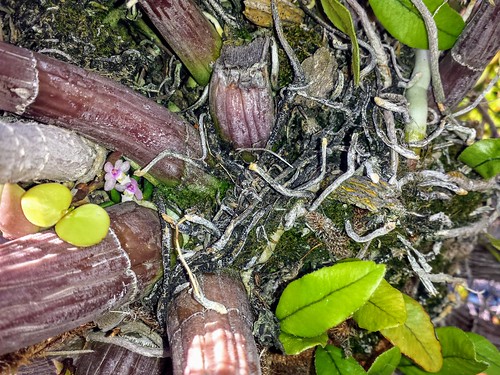
Here's a recent pic of an orchid (Microcoelia exilis) that I entered into the LA Fern and Exotic plant show a few years back...
It's just a big mess of roots! I don't remember if it received a ribbon. Personally, I don't really care about ribbons. My primary motivation was to introduce people to an awesome plant.
Pretend that you're at the show and you see my orchid. Do you think it's awesome? If so, then you could take your judging form out and write down the plant's number and your valuation. There wouldn't be a minimum valuation. It could be as small as a penny.
The next plant that you see at the show is my phorobana...
It's a big mess of roots and leaves! It's a bunch of different epiphytes growing on a Ficus macrophylla (Moreton Bay fig) in a pot. You lean in for a closer look and spot a tiny orchid in bloom...
It's a Cleisostoma scolopendrifolium orchid nestled within the canes of a Dendrobium delicatum orchid. The other two epiphytes in the vicinity are Dischidia cleistantha and Microgramma vacciniifolia. Finding the tiny orchid is just like finding an Easter Egg.
Do you think the phorobana is awesome? If so, then you'd write down its number and your valuation. After you had judged the plants, you'd turn in your form. The clerk would add up your valuations and you'd donate the money. Ideally there would be a real-time updated webpage where you could see all the plants sorted by their valuations.
Initially I figured that the society wouldn't take a cut. I thought that all the money should go to the people who had earned it. But then my friend Scadoxus pointed out that people could just spend ridiculous amounts of money on their own plants in order to win. I hadn't thought of that. Two heads are better than one! Personally, I wouldn’t prohibit people from valuating their own plants. If you bring in 10 plants, then I would want to know how you would divide your money between them. But it’s probably a good idea though for the society to take a cut. Ideally the society should get all the money that you spend on your own plants. But then you might just give your money to your friends to spend on your plants.
I'm guessing that the most common objection to this idea will be something like... "Why in the world would anybody want to pay people to do something that they are already doing for free???"
The Fern and Exotic plant show is great because it features a wide variety of plants. But I don't equally like the plants. I don't think that all the plants in the show are equally exotic or exciting or awesome or rare or fascinating or unusual or interesting or important or impressive or drool-worthy. Yes, it's very easy for me to simply tell Norm that I think his plant is super cool. This is true. What makes it so easy is that I know him.
Let's say that you see this Hydnophytum formicarum in a cactus and succulent show...
It's the first time that you've ever seen an ant-plant in a cactus and succulent show, or any show for that matter. The name of the exhibitor is next to the plant but you don't know who she is. If your valuation of her plant is $0.25 cents, are you going to track her down and give her a high-five? Probably not. But if you have a valuation form with you, and you would like to see more ant-plants in shows, then you might as well write down your valuation. It's certainly easy enough to do. Judging plants with money makes it easier for more people to give and receive more positive feedback.
What about negative feedback? If I think that somebody's plant is incredibly boring, then I'm probably not going to tell them. Especially if I don't know them. It's certainly true that I wouldn't be able to write down a negative valuation on my form. But if we all had the opportunity to use our money to judge the plants, then everybody would see everybody's valuations of the plants. This means that we would all clearly see and know the disparity in value between all the plants...
Tillandsia australis: $10.75
Hydnophytum formicarum: $9.97
L. anceps x E. vitellina: $7.24
Microcoelia exilis: $1.32
Ficus phorobana: $0.55
Geranium: $0.15
Ivy: $0.01
Which is more important, the amounts in relative or absolute terms? I can see that my M. exilis is relatively more valuable than my phorobana so I'd know that people are more interested in the leafless orchid. In terms of absolute amounts, the $1.32 might be enough to encourage me to bring the leafless orchid the next year. But because the phorobana is so much heavier, it's doubtful that the $0.55 would be enough to encourage me to bring it again. In all cases the benefit should be greater than the cost.
Personally, I've only shown my plants once... or twice... several years ago. I haven't done it since because it was too much work. Which is the same thing as saying that the reward was too small.
My friend Scadoxus went to a Begonia show this past Saturday. She said that it was pretty terrible. She didn't enter any plants into the show because it was too much work (too small a reward). However, she did see Norm there. I don't know if he exhibited any plants, but he certainly sold some... including a few to Scadoxus.
Every plant show that I've ever attended has also included a plant sale. The plants in the show area are judged by a small group of people. The plants in the sales area are judged by a much larger group of people. Are more judges better than less judges?
I accept that it's entirely possible that I'm overestimating the importance of phorobanas. So if I'm the only judge, then my delusion will fully skew the results. What if another judge is added? He probably won't also overestimate the importance of phorobanas. If he correctly estimates their importance then my delusion will only halfway skew the results. If he underestimates their importance, then his delusion will diminish, or even cancel out, my own.
Therefore, more judges are always better than less judges. The more judges there are, the less impact that delusions, misperceptions, craziness and biases will have on the results. Filtering out more fantasy brings us closer to reality.
It's certainly possible though that everybody else underestimates the importance of phorobanas. But this is hardly an argument for having less judges. If I'm the only person who correctly estimates the importance of phorobanas, chances are slim that I'll be included in a small group of judges. However, when everybody can be a judge, then at least my correct estimate will have some influence on the results. My influence might be vanishingly small but that's still better than nothing.
In all cases more heads are better than less heads. Voila! Please use your head to judge the idea of allowing everybody to use their money to judge plants at shows.
Unlike most orchid seeds, the seeds of reed-stems have enough nutrients to germinate on their own. So you can sow the seeds pretty much like you would any succulent with very small seeds (ie Echeverias).
Moss attached to a wooden board placed diagonally in a pot in a zip lock bag. Reed seeds germinating along with Rhipsalis seeds. There's also a rhizome of Microgramma vacciniifolia.
Reed protocorms with Pyrrosia piloselloides. Medium was bark with some moss on top. Pot also in a zip lock bag.
Echinocactus grusonii VS Epidendrum secundum. The Golden Barrel cactus won this round. I guess the pumice was too large for most of the reed seeds. Pot in a cat litter bin covered in clear trash bag.
Reed seedlings with Anthurium scandens seedlings. Medium was bark with moss on top. Pots in zip lock bag.
********************************
Update: 2 Oct 2018
In July I sowed some Bletilla striata seeds that I received from Fernando. Here's a recent pic...
I also included some seeds from his Begonia thiemei and/or carolineifolia.
What other orchids can grow from seed as easily as reed-stems and Bletilla striata?
Update: 13 Oct 2018
Here are some reed-stem Epidendrums from seeds that I sowed a year ago...
The other day on Flickr I was trying to remember the username of one of the members that I follow. So I sorted all my contacts by the date that they last uploaded photos. I realized that it has been a really long time since most of my contacts have uploaded any photos.
For sure part of it is because of Instagram and Facebook and similar sites. But for me the main issue is figuring out my own responsibility in nurturing other people's beneficial behavior.
I have a garden and it's clearly my responsibility to nurture my plants. If they fail to grow and thrive it's probably because I dropped the ball. I failed to give a plant adequate drainage and/or light and/or food and/or protection from cold/heat/pests.
Tom, for example, isn't a plant in my garden! :) But I definitely derive enjoyment from his blog entries, forum posts and videos. So isn't it my responsibility to nurture him? Admittedly that does sound kinda funny!
But what are the alternatives?
A. It's not my responsibility to nurture Tom
B. Tom doesn't need to be nurtured
C. Tom is adequately nurtured
Tom doesn't need to be nurtured? This would seem to imply that he takes the time and makes the effort to share plant info entirely for his own benefit. That doesn't seem very likely. Clearly he can derive benefit from the act of sharing... but it's gotta be based somehow on the idea that others are going to benefit to some degree from his sharing.
Tom is adequately nurtured? Only Tom can know this! But what if he feels like he isn't being adequately nurtured? "Hey guys, I'm really not feeling enough love!" Is he going to say that?
Imagine if your plants could text you if they weren't feeling adequately nurtured! I think I'd be receiving a lot of texts right about now! Tomorrow I really need to water.
In no case are we mind-readers! As far as plants are concerned, all of us are good at interpreting the clues. If a plant looks wilty, we can reasonably guess that it doesn't have enough water. Obviously plants can't verbally communicate with us but they can certainly nonverbally communicate with us.
Despite the fact that we aren't mind-readers... most of us don't quite feel comfortable communicating that we aren't feeling adequately nurtured. Well... at least not in this context. If we aren't feeling adequately nurtured then we either suck it up... or spend our time doing other things. I think "suck it up" is a military expression? I'm drawing a blank for the non-military equivalent.
I don't quite perceive that it's Tom's responsibility to communicate that he isn't feeling adequately nurtured. I feel like it's my responsibility to communicate my enjoyment of what he's taken the time and made the effort to share. And sometimes I do so.... but I really don't do so all the time. Sometimes I don't have the time or energy to provide some decent positive feedback. Yet, I don't usually feel comfortable simply replying with "That's really great!" It just seems too inadequate. So I settle for nothing.
On Reddit (orchids group) you can vote people's posts up... or down. And for sure a vote up is better than nothing. Yet, if you really enjoyed a post, then a vote up is very inadequate.
On Flickr you can "vote" for a photo simply by clicking the star button. I've "voted" for a lot of photos! In some cases a "vote" was adequate. But in plenty of cases a "vote" was woefully inadequate.
Clearly you're not supposed to bite the hand that feeds you. This is a no-brainer. But there does seem to be a bit of confusion regarding rewarding the hand that feeds you. Of course everybody loves a free lunch! Yet...
It is not from the benevolence of the butcher, the brewer, or the baker that we expect our dinner, but from their regard to their own interest. - Adam Smith
We expect plant people to give their valuable time and energy and expertise away for free... and clearly some people are willing to do so in various degrees. But the supply can only truly be optimal when it reflects the demand. So... what's the demand? I'm the only one who knows my demand for Tom's info. Stan doesn't know my demand for Tom's info and vice versa.
I'm pretty sure that it should be really easy to communicate our demand for each other's threads. For most people though this is an uncomfortable concept. We all have absolutely no problem spending our money on plants. Most of us have absolutely no problem spending our money on plant books. Yet, when it comes to spending our money on plant threads... there seems to be an issue.
Why spend your limited money on something that people are willing to give away? Why buy the cow when you can get the milk for free? But if we feel like the supply of milk is inadequate... and we're not actually paying for milk... then... do we really need to call Sherlock Holmes? Sounds more like a case for Adam Smith!
The other day I joined a new forum. It's not a plant forum. When I joined I made a $10 dollar donation and became a VIP! I didn't do it for the VIP or because I wanted to support the forum. I simply wanted to use the $10 dollars to communicate my valuation of the threads. Well... I really didn't find many threads that were worth my money. So I created some! I created a thread for Adam Smith's book... The Wealth of Nations. And then I allocated half of my donation to my thread. It's a tricky concept because the money didn't go back into my pocket. I simply used it to communicate my valuation of Smith's book. Then I created a thread for Mill's book... On Liberty... and spent $3 dollars on it. These books are available online for free. It was the first time that I had spent any money on them.
And clearly I really wasn't trying to nurture Smith or Mill! Even though they can't see my demand for their books... other people can see my demand for their books. So I was trying to nurture the topic.
Today I was trying to explain this idea to a friend and I was doing a terrible job. A few hours later he e-mailed me a link and asked if that was what I was trying to describe. The link is to a page on the libertarian party (LP) website. To be clear, I'm not a libertarian and I'm definitely not trying to promote their agenda. But on that page, the LP explains that they are trying to...
1. Raise money
2. Choose a theme for their 2018 convention
They essentially combine these two things. People who are interested in a theme can spend as much money as they want on it. If you scroll down the page you can see how much money has been donated for the various themes. So it's essentially a survey, but voting has been replaced with donating. Participants essentially kill two birds with one stone. They donate money to the LP and use their donation to communicate their demand for a specific theme.
For politics it's often argued that buying influence subverts the will of the people. But if somebody donates money to a plant forum, does it subvert anybody's will if the donor uses their contribution to communicate their demand for specific threads?
From my perspective, it should be easier, rather than harder, to find and nurture things we love.