Showing posts with label vitellina. Show all posts

Monday, July 17, 2017

Reimagining Plant Judging

Tillandsia australis


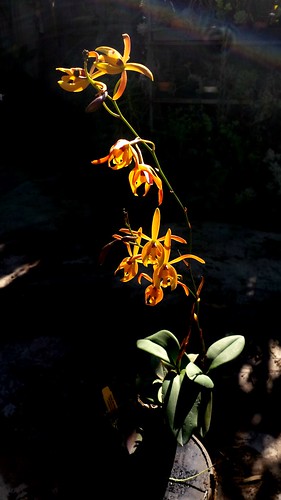
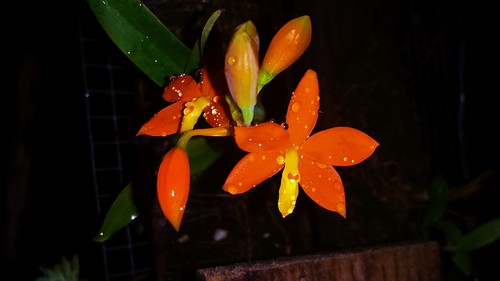
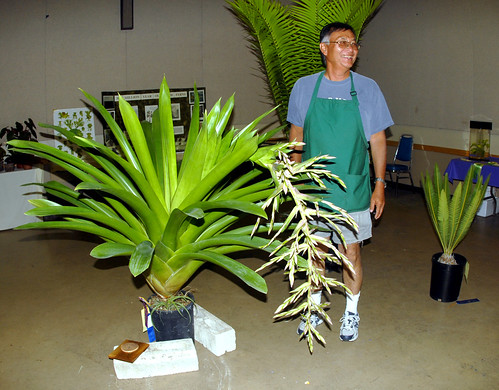
Six years ago at the Los Angeles Fern and Exotic plant show my buddy Norm received a blue ribbon and a plaque for his awesome plant (Tillandsia australis).  Yesterday on eBay orchidmate received $141.99 for his awesome plant (Laelia anceps x Encyclia vitellina 'Blood Orange')...


What would happen if everybody who attended a plant show could use their money to judge the plants?

Here's a recent pic of an orchid (Microcoelia exilis) that I entered into the LA Fern and Exotic plant show a few years back...
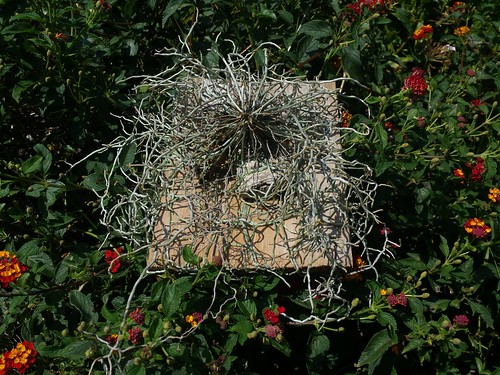

Microcoelia exilis


It's just a big mess of roots!  I don't remember if it received a ribbon.  Personally, I don't really care about ribbons.  My primary motivation was to introduce people to an awesome plant.

Pretend that you're at the show and you see my orchid.  Do you think it's awesome?  If so, then you could take your judging form out and write down the plant's number and your valuation.  There wouldn't be a minimum valuation.  It could be as small as a penny.

The next plant that you see at the show is my phorobana...
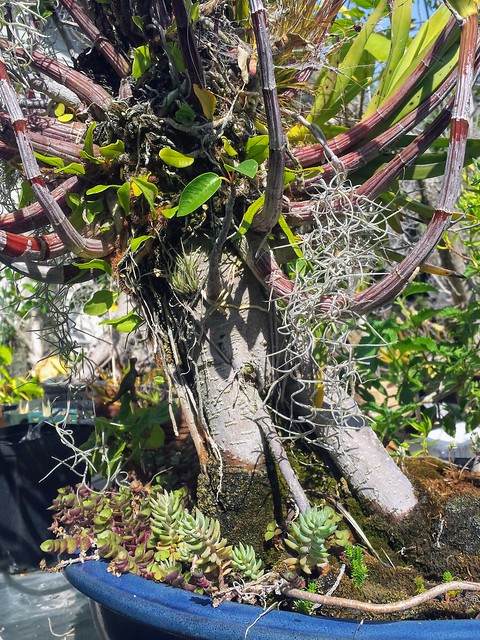

Ficus macrophylla Phorobana


It's a big mess of roots and leaves!  It's a bunch of different epiphytes growing on a Ficus macrophylla (Moreton Bay fig) in a pot.  You lean in for a closer look and spot a tiny orchid in bloom...
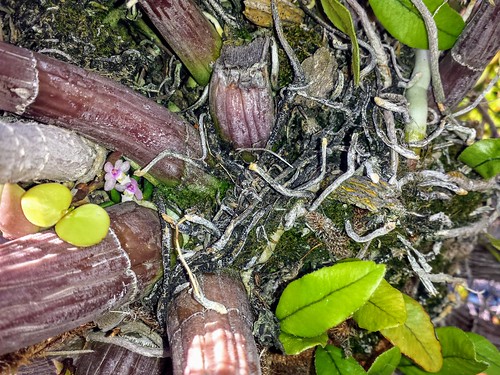

Cleisostoma scolopendrifolium


It's a Cleisostoma scolopendrifolium orchid nestled within the canes of a Dendrobium delicatum orchid.  The other two epiphytes in the vicinity are Dischidia cleistantha and Microgramma vacciniifolia.  Finding the tiny orchid is just like finding an Easter Egg.

Do you think the phorobana is awesome?  If so, then you'd write down its number and your valuation.  After you had judged the plants, you'd turn in your form.  The clerk would add up your valuations and you'd donate the money.  Ideally there would be a real-time updated webpage where you could see all the plants sorted by their valuations.

Initially I figured that the society wouldn't take a cut.  I thought that all the money should go to the people who had earned it. But then my friend Scadoxus pointed out that people could just spend ridiculous amounts of money on their own plants in order to win. I hadn't thought of that.  Two heads are better than one!  Personally, I wouldn’t prohibit people from valuating their own plants.  If you bring in 10 plants, then I would want to know how you would divide your money between them. But it’s probably a good idea though for the society to take a cut. Ideally the society should get all the money that you spend on your own plants.  But then you might just give your money to your friends to spend on your plants.

I'm guessing that the most common objection to this idea will be something like... "Why in the world would anybody want to pay people to do something that they are already doing for free???"

The Fern and Exotic plant show is great because it features a wide variety of plants.  But I don't equally like the plants.  I don't think that all the plants in the show are equally exotic or exciting or awesome or rare or fascinating or unusual or interesting or important or impressive or drool-worthy.  Yes, it's very easy for me to simply tell Norm that I think his plant is super cool.  This is true.  What makes it so easy is that I know him.

Let's say that you see this Hydnophytum formicarum in a cactus and succulent show...
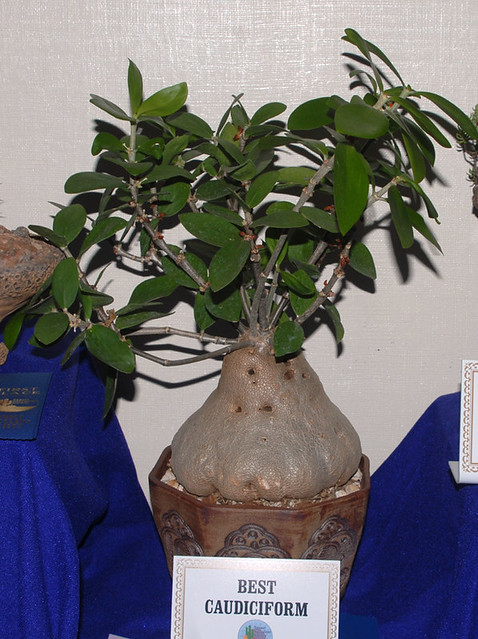

Hydnophytum formicarum


It's the first time that you've ever seen an ant-plant in a cactus and succulent show, or any show for that matter.  The name of the exhibitor is next to the plant but you don't know who she is.  If your valuation of her plant is $0.25 cents, are you going to track her down and give her a high-five?  Probably not.  But if you have a valuation form with you, and you would like to see more ant-plants in shows, then you might as well write down your valuation.  It's certainly easy enough to do.  Judging plants with money makes it easier for more people to give and receive more positive feedback.

What about negative feedback?  If I think that somebody's plant is incredibly boring, then I'm probably not going to tell them.  Especially if I don't know them.  It's certainly true that I wouldn't be able to write down a negative valuation on my form.   But if we all had the opportunity to use our money to judge the plants, then everybody would see everybody's valuations of the plants.  This means that we would all clearly see and know the disparity in value between all the plants...

Tillandsia australis: $10.75
Hydnophytum formicarum: $9.97
L. anceps x E. vitellina: $7.24
Microcoelia exilis: $1.32
Ficus phorobana: $0.55
Geranium: $0.15
Ivy: $0.01

Which is more important, the amounts in relative or absolute terms?  I can see that my M. exilis is relatively more valuable than my phorobana so I'd know that people are more interested in the leafless orchid.  In terms of absolute amounts, the $1.32 might be enough to encourage me to bring the leafless orchid the next year.  But because the phorobana is so much heavier, it's doubtful that the $0.55 would be enough to encourage me to bring it again.  In all cases the benefit should be greater than the cost.

Personally, I've only shown my plants once... or twice... several years ago.  I haven't done it since because it was too much work.  Which is the same thing as saying that the reward was too small.

My friend Scadoxus went to a Begonia show this past Saturday.  She said that it was pretty terrible.  She didn't enter any plants into the show because it was too much work (too small a reward).  However, she did see Norm there.  I don't know if he exhibited any plants, but he certainly sold some... including a few to Scadoxus.

Every plant show that I've ever attended has also included a plant sale.  The plants in the show area are judged by a small group of people.  The plants in the sales area are judged by a much larger group of people.  Are more judges better than less judges?

I accept that it's entirely possible that I'm overestimating the importance of phorobanas.  So if I'm the only judge, then my delusion will fully skew the results.  What if another judge is added?  He probably won't also overestimate the importance of phorobanas.  If he correctly estimates their importance then my delusion will only halfway skew the results.  If he underestimates their importance, then his delusion will diminish, or even cancel out, my own.

Therefore, more judges are always better than less judges.  The more judges there are, the less impact that delusions, misperceptions, craziness and biases will have on the results.  Filtering out more fantasy brings us closer to reality.

It's certainly possible though that everybody else underestimates the importance of phorobanas.  But this is hardly an argument for having less judges.  If I'm the only person who correctly estimates the importance of phorobanas, chances are slim that I'll be included in a small group of judges.  However, when everybody can be a judge, then at least my correct estimate will have some influence on the results.  My influence might be vanishingly small but that's still better than nothing.

In all cases more heads are better than less heads.  Voila!  Please use your head to judge the idea of allowing everybody to use their money to judge plants at shows.

Sunday, June 5, 2016

Prosthechea vitellina x Green Hornet

Post on Epiphyte Society of Southern California (ESSC) Facebook page

*******************************************

Next weekend (June 11, 12) is the Fern and Exotic Plant Show at the Los Angeles Arboretum.  Dan Asbell will be selling blooming size Prosthechea vitellina x Green Hornet orchids in 3" pots for $20 dollars.  Roberta Fox has been growing this cross near the coast and you can see a photo of it on her website...

http://orchidcentral.org/Images/Cattleya%20Tribe/Hybrid/4334_Enc%20(vitellina%20z%20Green%20Hornet).jpg

Prosthechea vitellina is a cooler grower while Green Hornet is a warmer grower.  Will the cross grow when it's cooler and when it's warmer?  If so, then it will be an especially good orchid for growing outdoors year around here in Southern California!

Besides being a cooler grower, Prosthechea vitellina is pollinated by hummingbirds.  Will the cross also be pollinated by hummingbirds?  Let's find out!

Also be sure and check out the Orchid Society of Southern California (OSSC) auction on June 11 at 2pm!


Monday, April 4, 2016

Hercuthermal Experiment


**********************************************

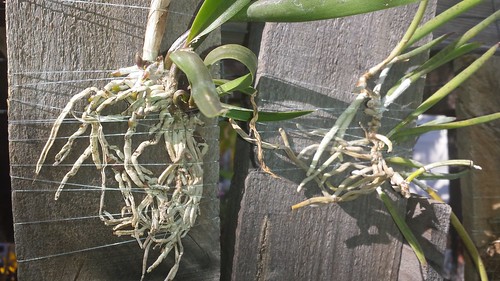
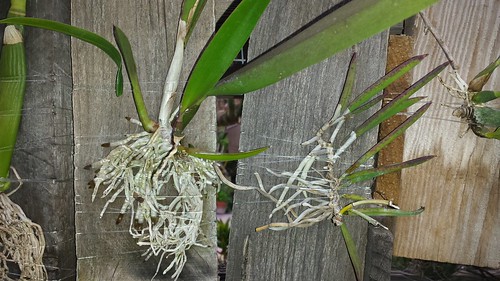
Last October I purchased a Bpl Golden Peacock (GP) from peaceriverwood... 


This cross was a great find for three reasons...

1. I suspected that it might be hercuthermal (wider temperature grow range)
2. Two of the species (milleri and vitellina) are pollinated by hummingbirds
3. The nodosa theoretically adds some drought tolerance

Here's why I suspected that GP might be a hercutherm...

1. nodosa = intermediate/warm grower
2. milleri = cool/intermediate/warm grower? 
3. vitellina = cool/intermediate grower 

The vendor that I purchased GP from is in Florida so this cross definitely grows when it's warm.  My question was... would it also grow when it's cool?!   Just in case you don't know... I live in Glendale (a few miles east of Los Angeles) and I grow all my orchids outside year around.   

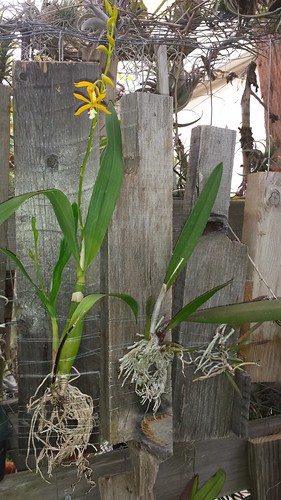
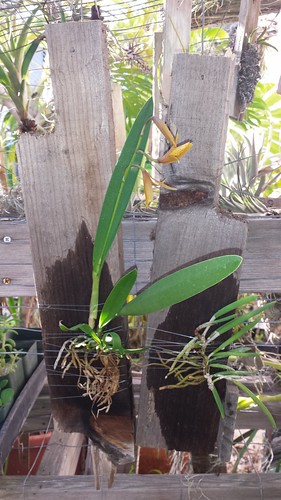
So I decided to perform a little experiment.  I took a piece of wood from a broken down pallet and sawed it in half.  On one half I attached the GP and on the other half I attached a straight nodosa.  I hung both mounts right next to each other and tried to regularly water them early in the day.  For the rest of my plants, minus a few other exceptions, I severely cut back on watering like I usually do when it starts to get cool.

I took a few photos to document the experiment... 

9 Oct 2015

Hercuthermal Experiment


2 Dec 2015

Hercuthermal Experiment


28 Mar 2016

Hercuthermal Experiment


As you can tell from the photos ... there was quite a large disparity in their growth!  The GP put out quite a few roots and a new shoot while the nodosa is just starting to put out its first new root.  I didn't fertilize either orchid but they did receive quite a bit of sun.  

It sure does seem like GP is more hercuthermal than nodosa but... perhaps there's another explanation for the disparity in their growth?  Maybe the GP somehow got more direct sun?  More sun means more heat.  Or maybe the nodosa had already entered into "hibernation" (aka rest mode)?  Or perhaps I talked to GP more than I talked to the nodosa?  

In any case, whether or not GP is truly more hercuthermal than nodosa... it seems clear that GP is willing to continue growing in cooler weather as long as it receives enough water.  For the gazillion previous years that I've grown orchids I was quite happy to severely reduce water when it started to get cool.  My orchids would take a break from growing and I would take a break from my orchids!  Plus, for lots of tropicalish plants... cool+wet = rot.  So, when it's cooler, it's safer to err on the side of a lot less watering and a lot better drainage.    

Aloe Hercules really forced me to reconsider this paradigm.  I don't water my succulents at all when it's even remotely cool but Hercules would keep growing anyways.  It seems logical that what allowed him to do so was... A. being hercuthermal and B. his ability to store water.  On rare occasions when it does rain here in Southern California... he really soaks up and stores the water and uses it to grow during the dry days.

If I hadn't regularly watered the GP would it have continued to grow?  It doesn't seem likely.  But it would have been nice to have been able to confirm this by having a "control" division of GP that didn't receive any supplemental water during the experiment.

Last year at the Santa Barbara Orchid Estate Fall Open House I purchased Epicattleya Carrot Top Katydid (Cattleya sanguiloba x Epidendrum longipetalum).  I wasn't interested in it for hercuthermal reasons... I was interested in it for hummingbird reasons...

8 Nov 2015 

Epicattleya Carrot Top Katydid

Carrot Top (CT) is a real sequential bloomer.  In fact, it's still blooming!  Five + months of blooming isn't too shabby!  Lots of blooms for my buck!

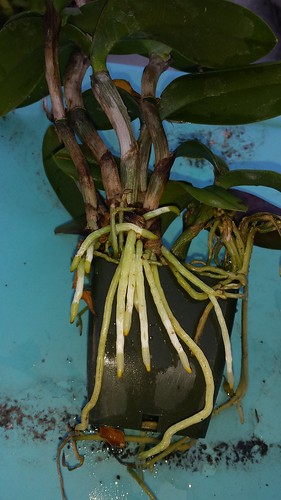
Back in January I noticed that CT's roots were still active.  It hadn't been receiving regular water like the GP and the nodosa... but... it was still potted SBOE style (pot in a pot with rocks).  Usually I mount orchids as soon as I get them... but in this case I had decided that perhaps it was adequately safe in such a well-drained medium.  If I had mounted it though... I wonder if its root tips still would have been active?  I'm guessing that, even though the rock medium was well-drained, it still provided more moisture than a mount without any moss would have.  So if I had mounted CT as soon as I got it... and didn't regularly water it... then I don't think that the roots would have continued to grow.

When I realized that CT was still actively growing... I decided to mount it.  Here's what I saw when I removed it from the outer pot... 

25 Jan 2016

Epicattleya Carrot Top Katydid

Lots of really happily active roots in the middle of winter!

According to the OrchidSpecies website, Cattleya sanguiloba is a cool grower and Epidendrum longipetalum is a cool to cold grower.  So CT is definitely a cool grower... and since it's from the SBOE... I'm guessing that it's also an intermediate grower as well.

In this case... there are two causes for CT's active roots in the middle of winter...

1. It's a cool/intermediate grower
2. It received enough water to grow

GP and Hercules are pretty much in the same boat.  The difference is that Hercules doesn't seem to need any supplemental water.

From my perspective... Hercules is the standard that all orchids should be measured against.  All orchid crosses should be made with Hercules in mind.   And hummingbirds.   Hummingbirds should be kept in mind as well!

So I've been keeping an eye out for other vitellina crosses and have managed to find a few others...


Here's a recent picture of the third one in bloom...


Hercuthermal Experiment


It would have had more flowers on it but I removed them to collect the pollen.

Out of the four orchids on that list, the last one (Laerianchea Orange Planet) is my most recent find and the one that I'm most excited about.  This is because this cross (OP) is closer to Hercules and hummingbirds than the other three are.  Guarianthe aurantiaca is pollinated by hummingbirds and Laelia rubescens is a warm grower and drought tolerant.  But is OP closer to the Hercules/hummingbird standard than GP is?

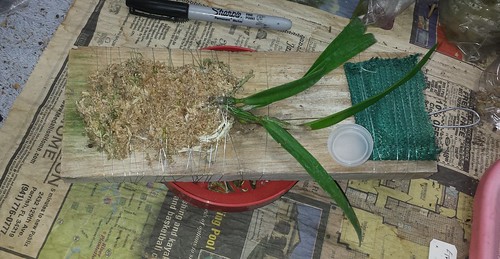
OP arrived in a small pot filled with New Zealand Sphagnum moss.  I placed the pot in a container of water to fully hydrate the orchid and the moss.  Then I carefully unpotted the orchid and used a tweezers to carefully remove all the moss that was near the new growth that was just starting to emerge.  I used fishing line and my patented (not really) slip knot technique to tightly attach the orchid and the moss to a mount (cut from a pallet)...

Laerianchea Orange Planet

OP is not yet blooming size and I'm particularly impatient for it to grow!  So I added a pouch to hold slow release fertilizer granules (Osmocote).  The pouch is made from shade cloth and I used a couple water bottle lids as placeholders.  This is my first time trying this technique but my friend Dave has had some really great results with it.  He uses little plastic baskets to hold the fertilizer pellets.  We both got the idea when we visited an orchid grower in Malibu.... but Dave actually decided to give it a try.

It's invariably the case that tightly attaching an orchid to a mount will wound the orchid to some degree.  These wounds are susceptible to pathogens/rot.  Usually it's not a problem though if the orchid is happy enough.  But since I'm super excited about OP I decided to play it really safe.  For the past three days I've kept the orchid completely dry in my garage under lights.  The weather is still a bit on the cooler side and I wanted to make sure that any wounds on OP are completely healed before I put it outside and give it a good soaking.

In addition to purchasing some vitellina crosses... I also purchased the species... which is just starting to bloom...

Prosthechea vitellina

I've wanted to purchase it for the longest time but the consensus seemed to be that it really isn't a fan of the heat.   So what changed?  The hummingbirds talked me into buying it.  I think I'm becoming more and more susceptible to their influence.  Hopefully I'll be able to keep vitellina alive!

Back in February I saw that another vendor on eBay was also selling GP at a reasonable price.  He even had 10 of them for sale.  So on Feb 26 I shared a link with the Epiphyte Society of Southern California on Facebook.   But the GPs didn't sell like hot cakes!  Well... the ESSC had less than 30 "likes" back then.  So on Mar 3 I shared the link with the Orchid Society of Southern California.   The OSSC has over 2000 likes... but the GPs still didn't sell like hot cakes!   Right now there are still 6 GPs for sale.

So here I am!   Making my case!  Showing some evidence!  Offering some logic!  Trying to increase the demand for hercuthermal orchids.  And hummingbird orchids.  And drought tolerant orchids.   And sequentially blooming orchids.   Orchids that are more like Hercules and better for hummingbirds really should sell like hot cakes!

Let's think about the long-term goal.  Here's a picture of my street...


Washingtonia robusta


None of these palms have orchids growing on them.   Should they all have orchids growing on them?  I sure think so!  The hummingbirds sure think so too!  Hopefully you will agree with us!

I suppose I could buy the six remaining GPs and then ask my closest neighbors for permission to attach them to their palms.   They might want to know who would be responsible for watering them.  Me?!  It's a given that my neighbors would be more inclined to give their permission if I offered to water the GPs.  And I suppose I could walk up and down my street with a super soaker in my hands and a couple more slung over my shoulders.  Or I could program a drone to water them for me?

The ideal orchid wouldn't require any supplemental water.  I could just go around my neighborhood attaching it to palm trees without ever having to worry about watering!  Each orchid that I attached to a palm would provide lots of color and interest for humans and lots of food for hummingbirds.

My experiment doesn't definitively prove that progress can be made in this direction.  But hopefully it will help generate interest in the possibility of progress!

What can you do if are interested in hercuthermal and/or hummingbird and/or sequential blooming and/or drought tolerant hybrids?

1. vote for these types of hybrids... HybridizeThis
2. dollar vote for these types of hybrids

Hybridizers aren't mind readers.  So if you want orchids that are substantially better, then you have to communicate your preferences to hybridizers.  You have to let them know that you want orchids that come as close as possible to meeting the Hercules/hummingbird (HH) standard.  The more hybridizers there are trying to meet the HH standard... the more fabulous outliers we will be able to grow.