Showing posts with label Aloe Hercules. Show all posts

Thursday, August 3, 2017

Better Treasure Maps

I really love plants. The first thing that I did when I moved into my house was replace the front lawn with a wide variety of super interesting drought tolerant plants.  Why should that space only have one plant when it can have many plants?!  In economic terms, the opportunity cost of the lawn was way too high.

The awesomeness of having more interesting plants in any given space is the basic premise of "phorobana".  A phorobana is any potted plant (ie bonsai) that has epiphytes growing on it.  For the sake of facilitating communication I took the liberty of creating the word "phorobana" (phorophyte + ikebana).  Plus, having a unique word for the idea makes it easier to search for and find relevant material.

It's a basic fact of life that space is always limited.  A larger house means a smaller garden.  More lawn means less biodiversity.  The beauty of phorobanas is that they facilitate biodiversity.  They put more treasure on a map.

There's usually quite a bit of treasure at plant shows.  However, just like gardens, shows have a limited amount of space.  Check out this photo that I took at a plant show...


Is this an Uncarina?  If you look closely to the right of it you can see a Dockrillia orchid mounted on a piece of cork.  Coincidentally, my friend recently shared a photo of his specimen Dockrillia linguiforme...
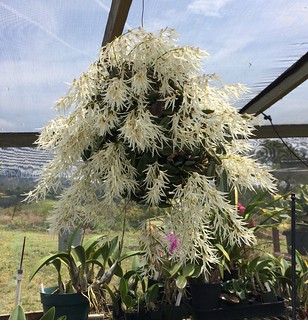


Dockrillia linguiforme


As you can see, the orchid is suspended in mid-air.  Taking advantage of vertical space frees up horizontal space for more treasure.

The Uncarina has vertical space that could be occupied by the Dockrillia.  If the same person already owned both plants, then adorning the Uncarina with the orchid would create room on the map for more treasure.  If, on the other hand, the orchid was purchased for this purpose, then more treasure would be added to the map without sacrificing any horizontal space.

The Uncarina and the Dockrillia are both great ideas.  Would combining these two great ideas result in an even greater idea?

Peanut butter is a great idea... so is jelly... and so is bread.  Most people would agree that the combination of these three ideas is greater than any of these ideas on their own.  The whole is greater than the sum of its parts.

With all the different ingredients in the world... the possibilities are endless.  This is just as true for phorobanas as it is for dishes.  The orchid family alone has more than 20,000 really diverse epiphytic species.  Not to mention all the hybrids.

How long will it take to find the phorobana equivalent of a peanut butter and jelly sandwich?  It's a numbers game.  Finding the lovely outliers in less time depends on more people creating more combinations of epiphytes and potted plants.  Progress depends on difference.  More difference means more progress.

Right now plant shows are the equivalent of eating peanut butter, jelly and bread separately.   These ingredients are good... but they are so much better together!  Yes, at ikebana shows there are arrangements that people can "taste".   Even though the arrangements can be aesthetically pleasing, they aren't sustainable or informative.  But imagine that you are at a phorobana show and you see a Dockrillia happily growing on an Uncarina.  If you're familiar with the orchid but unfamiliar with its host, then you can reasonably guess that their requirements are somewhat similar.  In this case the association would be informative.

Phorobana shows will be far more informative and interesting than regular plant shows.  To help support this conclusion I'll show you some of my epiphytically enhanced potted plants...


Phorobanas should be on everybody's treasure map!  Nobody should overlook this valuable idea!  The question is... just how valuable is it?  Does it matter?

In this video a street vendor is selling artwork by Banksy.  The artwork is priced far below market value... but the vendor doesn't inform anybody that it's original art by Banksy.  It's the closest thing you'll see to people walking past $100 dollars bills just sitting in the middle of the sidewalk.

Imagine the equivalent scenario with some hunters and gatherers. Of course they are hungry... yet they simply walk past some plants that are loaded with perfectly ripe squash.

In some of the older orchid articles there are accounts of workers in tropical orchards regularly removing the "parasites" growing on the trees.  They would rake the precious plants into huge piles and burn them.

Our behavior is far less beneficial when we don't know how valuable things are to other people.  In order to maximize beneficial behavior it's necessary to share and learn the value of things.

When we go to a plant show/sale we might find numerous plants that we'd be really happy to have.  We can tell a vendor... "I really love that plant!"  But usually the vendor doesn't just give it to us.  This is because talk is cheap.  It doesn't cost us anything to simply say that we really love something.  In order to prove that we truly love something, we have to be willing to spend our money on it.  If we are willing to pay the price for the plant then the vendor will be happy to give it to us.

Spending our money helps to improve the treasure maps of vendors.  The accuracy of their maps determines our benefit!  We sure don't benefit if vendors overlook plants that we value.  So we use our money to inform vendors which plants are more valuable/needed/wanted/important/relevant.  Plant sales give us the immensely wonderful opportunity to superficially ("I love that plant!") and substantially ("I'll buy that plant") participate in the prioritization process.  Because everyone is allowed to participate in this process, it makes it far more likely that any given shopper will be as happy as a kid in a candy store.

Perhaps this might seem pretty obvious... yet plant shows don't give everyone the opportunity to substantially participate in the prioritization process.  And neither do plant forums!  This forum is packed with products but we really don't substantially participate in the prioritization process.  Same thing on Flickr... and Youtube... and Netflix.  We're allowed to superficially participate in the prioritization process by commenting on and/or rating the different products... but we don't substantially participate.  In the absence of substantial participation... the true value of the products is unknown... which means...

1. we overlook valuable products
2. less valuable products are supplied
3. we're less happy in the candy store than we should be

For Netflix the solution is simple.  Subscribers should be given the option to earmark their fees to their favorite content.  They'd still have complete access to all the content but they'd also have the opportunity to substantially participate in the prioritization process.

A while back on Netflix I watched BBC's documentary "Wild Arabia".  In one episode I was quite surprised to see a branch that was covered in epiphytes...


The tree is in the Dhofar mountains in the country of Oman.  I really didn't know that Oman has epiphytes!  Did you?

Unfortunately, the scene was way too short.  I wanted to see and learn so much more about these epiphytes.  If Netflix had given me the opportunity to earmark my subscription dollars to specific scenes, then I definitely would have earmarked quite a few to this one.  I'm guessing that there wouldn't be too many other people in the same boat as me.  But how many subscription dollars would subscribers earmark to shows about plants?  I don't know.  Neither does Netflix.  It's easy enough to find out though.

This system of substantial and specific feedback is applicable to all organizations that have subscribers.  But the same system can also work with donors.

When the students in my friend's 4th grade class donate their pennies to their Book Dept, they can use them to help determine the order (relative importance) of their favorite books.  When they donate their pennies to their Communication Dept, they can use them to determine the order of their favorite blog entries.  This same system could be used for forum threads.

We'd all have the option to donate money to the forum in order to help determine the order of our favorite threads.  Not only would our donations support the forum, but they'd also bring the most valuable threads to each other's attention... "Hey!  Here's some treasure!  Please don't overlook it!"

For all intents and purposes... each member of this forum is in the same tribe!  :)   We probably don't have to worry about any of our members overlooking squash... but how many new books, articles, blog entries, threads, videos and events are there every day?  None of us has the time to read, watch and attend everything.  So it's way too easy to miss many valuable things.  This is why it's so important to appreciate that our tribe, as a group, can read, watch and attend far more things than any single member of the tribe can. Our tribe, as a group, has far more eyeballs, ears, hands and feet than any single member of the tribe has.  Most importantly... our tribe, as a group, has far more brains than any single member of the tribe has.  As a group, our tribe can cover far more ground and gather/process far more information than any single member of the tribe can.  But in order to realize the incredible potential of our collective body and brain... we need to use our money to improve each other's treasure maps.  When each member of our tribe has a far better treasure map, then every single one of us will make far more informed decisions which will improve our treasure maps even more.  Our tribe will be the smartest and most powerful and most influential tribe on the internet. We will win the internet. At least until other tribes figure out the secret to our success.

Think about it though... if it's beneficial for each and every member of our tribe to use our money to improve each other's treasure maps... then imagine how beneficial it will be when each and every member of the human race uses their money to improve each other's treasure maps. Then we will be the smartest and most powerful and most influential species in the universe. We will win the universe.

Admittedly, for all I know, some other species has already won the universe.  But I do know that phorobanas wonderfully illustrate the idea of a map having more treasure (epiphytic enrichment).

Here's a photo that I took earlier in the year of my very first phorobana...


The Dendrobium x delicatum was blooming.

Does my phorobana look crowded?  Well yeah, it's crowded with coolness!  This relatively small Moreton Bay Fig (Ficus macrophylla) is carrying way more than its fair share of precious biodiversity.  One very tiny passenger is Cleisostoma scolopendrifolium...
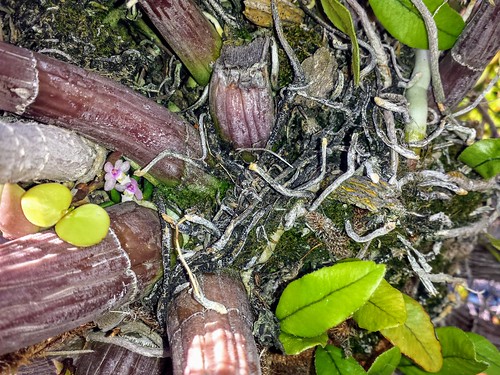

Cleisostoma scolopendrifolium


Epiphytic enrichment is nicely described in this passage about an aquarium...

The condensed reef's extraordinary hues and alien life forms cast a New Age vibe. To stand in front of this rectangular bottle is to stand on a harmonic node. Here are more varieties of living creatures crammed into a square meter than anywhere else on the planet. Life does not get any denser. The remarkable natural richness of the coral reef has been squeezed further into the hyper-natural richness of a synthetic reef. - Kevin Kelly, Out of Control  

Every little corner of the world should be packed with treasure.  Every space on every person's map should be packed with treasure.  Everybody should be surrounded by valuable opportunities.  Everybody should clearly recognize all the valuable opportunities that are available to them.  Therefore, everybody should use their money to help each other clearly see all the valuable opportunities.

Ok, so we've covered quite a bit of conceptual ground.  Next we can consider some of the practical aspects... such as sources for epiphytes/hosts and matching them.

My favorite sources for epiphytes here in Southern California are Andy's Orchids, Santa Barbara Orchid Estate, Sunset Valley Orchids and Kartuz Greenhouses.  Kartuz is also a great source for different potential hosts.  Zooming out... by far the single best source for epiphytes/hosts is eBay.

The endlessly fascinating challenge is matching epiphytes and hosts!   Logically they should have similar cultural requirements.  You probably don't want to attach a Dracula orchid to a Golden Barrel Cactus.  Maybe the easiest way to culturally match hosts and epiphytes is to learn which hosts epiphytes naturally grow on in nature.

Here's a photo of a Cabbage tree (Cussonia spicata) in nature with an orchid (Polystachya ottoniana) growing on it...


Here's my Polystachya ottoniana....


Here's Denise's Cussonia spicata...


Her C. spicata is missing a P. ottoniana and my P. ottoniana is missing a C. spicata!  Should she give me her Cussonia or should I give her my Polystachya? :D   Perhaps the rule is that ornaments are gifted to the owner of the Christmas tree.  :)

There are a few relevant cultural details to point out.  The bark on a relatively young Cussonia clearly doesn't have nearly as much texture as a mature tree.  Also, when the Polystachya grows on the Cussonia in nature, even though they get roughly the same amount of water... I'm guessing that it's a lot more humid there in South Africa than here in Southern California.  These two differences (texture, humidity) can be balanced out by giving the orchid some moss and/or more water.  If watering frequency is increased then the Cussonia's drainage also needs to be increased (ie more gravel/pumice).

What's rather fascinating about Polystachya ottoniana is its distribution...
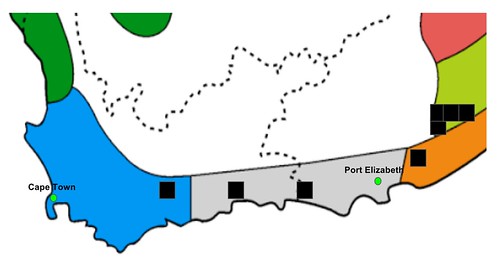

Mediterranean Climate Native Epiphytic Orchids?


This is a map of South Africa.  The blue area represents the Mediterranean climate and the black squares represent documented occurrences of Polystachya ottoniana.  As far as I know this is the closest that any epiphytic orchid species comes to being Mediterranean.  So maybe here in California it might actually take advantage of our winter rain and not be so bothered by somewhat less frequent watering in summer?  

It's pretty easy to match hosts and epiphytes based on their natural associations.  But you can also match hosts and epiphytes based on their natural habitats.  Since California is so dry I'm especially interested in epiphytes that occur in seasonally dry tropical forests.  On Flickr I created a gallery of orchids growing on cactus and other succulent plants.

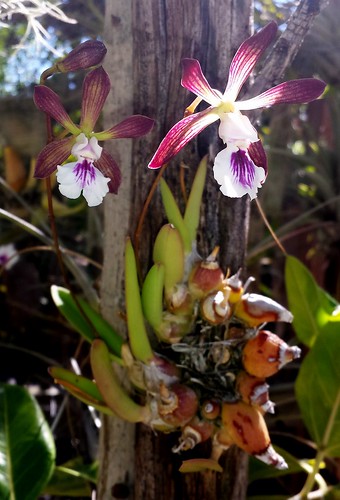
A couple of those photos are of Zelenkoa onusta growing on a cactus in the US Botanic Garden conservatory.  How cool is that?!   This small orchid naturally grows on cactus in Panama, Colombia, Ecuador and Peru.  Not only does it have nice yellow flowers but it also has really neat pseudobulbs...

Favorite pseudobulbs


Another really nice smaller orchid from a drier habitat is Laelia sincorana...


In bright light this orchid will have roundish pseudobulbs and short succulent leaves.  I refer to these type of orchids as teapot orchids (short and stout).  In its native country of Brazil, Laelia sincorana naturally grows on Vellozia species.  Vellozias are so very awesome!  Quite a few different epiphytes grow on arborescent Vellozias in nature because their fibrous branches are especially good at holding moisture.  It's a real shame that they are so scarce here in Southern California!

Encyclia pyriformis is another of my favorite teapot orchids...

Encyclia pyriformis


Nature makes the best ornaments!  Here are some pictures of potential hosts...


Not sure which plant this is... Dracaena draco or arborea?


Dracaena marginata is fairly common and can be grown from relatively large cuttings.  Here's a relevant passage about growing hosts from substantial cuttings...
In completely tropical climates, where the temperature never falls below 55F., the trees could be placed anywhere in the garden or patio. This assumes that severe winds or very dry desert air are not a factor. In such tropical settings, larger trees could also be used. In temperate climates both the trees and the orchids will require a greenhouse or its equivalent. Anyone with a large greenhouse could plant one or more trees directly in the ground. This can be seen, in a well-done fashion, at The Marie Selby Botanical Garden in Sarasota, Florida. There are several good-sized Crescentia trees covered with orchids in their display house. Most people will probably prefer to maintain semi-dwarf trees in large pots. These might be mounted on dollies for mobility, if desired. It may be necessary from time to time to air layer new trees as the old ones become too root-bound and lanky. Probably all of the trees listed will air layer rather easily. Most will also root easily as cuttings under mist. Some, such as Calliandra, Erythrina, Codiaeum, Acnistus, Tabebuia and Crescentia, will root without mist from large cuttings, even up to fence post size. Many of the trees have showy or fragrant flowers, some have attractive edible fruit and several have unusual foliage colors. Any can be grown from seed if it is available and you have the patience. - John Beckner, Host Trees for Cultivated Orchids
Here are some other plants that can be grown from substantial cuttings...

Aloes
Aralias
Bougainvilleas
Cordylines
Cup of Gold
Ficus
Grapes
Moringa
Pachiras
Plumerias
Pomegranate
Yuccas

My friend sent me a photo of this Ficus rubiginosa growing epiphytically...


Most likely this Ficus is going to be chopped off and thrown away.  A much better use for it would be for a phorobana.  So I told my friend that he should ask the owner for it.

From my perspective, the one group of plants with the greatest phorobana potential are the Aloes...


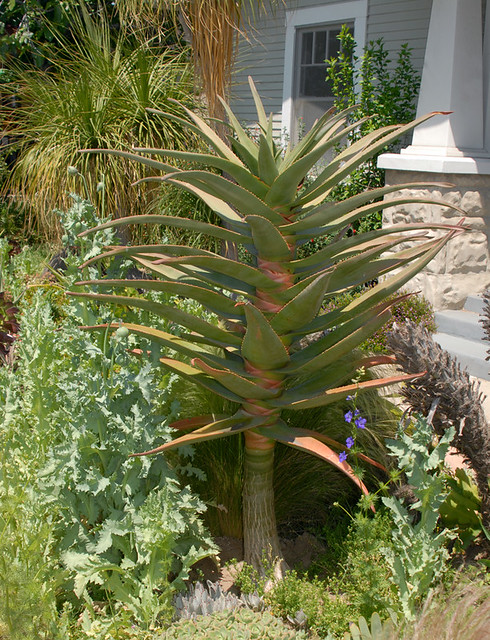
This is Aloe Hercules (barberae x dichotoma) in a SoCal nursery.  I have no idea how this one ended up with so many low branches.  But it would be awesome if all the branches were adorned with teapot orchids.

Hercules doesn't usually branch so frequently at a low height.  So it doesn't strike me as a particularly good candidate for phorobanas.  A cross with far more potential was made by Karen Zimmerman...


This is a cross between Aloe ramosissima and tongaensis.  Aloe ramosissima tends to have numerous low branches that are substantial enough for teapot orchids.  Unfortunately... it has a few issues.  It's a really slow grower, it doesn't grow so easily from cuttings and is fairly prone to rot.  Aloe tongaensis is somewhere in between barberae and ramosissima in terms of branch quantity and height.  It doesn't have the same issues as ramosissima and might be one of the best Aloe species for phorobanas.

The question is... is Karen's cross even better for phorobanas than tongaensis?  I'd sure love to find out.

One Aloe species that is rather interesting is Aloe tenuior.  It's a relatively fast grower that produces several upright stems that are around 2-3' tall.  It doesn't seem to have an issue with rot.  Plus, it grows easily from cuttings and when a stem is beheaded, it will produce one or more new heads.  The only real drawback is that the stems aren't substantial enough for teapot orchids.

A few years ago I pollinated my tenuior with pollen from a bunch of different tree Aloes. I didn't keep track of which pollen went into which flower. But now I have four Aloes from the cross.  They aren't quite blooming size but I'm pretty sure that at least three of them are hybrids. At first I guessed that they all had the same father but now I'm guessing otherwise.

Here's a photo that I took in November 2015 of one of the largest seedlings next to Aloe tenuior...


At this stage I started suspecting that this seedling and a few others might be hybrids rather than selfings.  Six months later I took this photo...


Aloe tenuior is in the back.  The seedlings all got taller and heftier... and then slowly flopped over.  It was like watching a slow motion trainwreck!  Earlier this year I potted three of them up and staked them...


The Aloe on the far right might be a cross between ramosissima and dichotoma.  It's substantial enough for teapot orchids but super slow.  Aloe tenuior is on the bottom right.

Here's a recent photo...


I should have used taller stakes!  The plant on the left is one of my hybrids.  It has a stem that is 2x as thick as tenuior's stem.  To the right of it is tenuior.  On its right is one of my hybrids that has a stem that is 4x as thick.  On the far right is my hybrid with a stem that is 3x as thick.  The tops of the stems are thicker than the bases.  I'm hoping that the bases will thicken with age and then they'll be able to support the weight of the stems.  In any case, the tops of the stems can be cut off and potted.  Hopefully the headless stems will produce new heads like tenuior does.

The hybrid on the left is by far the slowest.  The hybrid in the middle is by far the largest, which is interesting because it was the runt of the litter.  It was so small that I didn't even bother including it in the first two photos.  The hybrid on the right is by far the fastest.

What's fascinating is that the middle hybrid only has one basal shoot, the hybrid on the right has a gazillion and the hybrid on the left has several.  My tenuior produces a few basal shoots.  Here are all the potential fathers...

Aloe africana 
Aloe arborescens
Aloe dichotoma
Aloe Hercules
Aloe tongaensis
Aloe thraskii
Aloe vaombe

The only potential father that produces numerous basal shoots is arborescens.  I've read, and heard, that it tends to be dominant in its hybrids.  None of my hybrids resemble arborescens.  Honestly I was somewhat surprised that any of the fathers were compatible with tenuior.  They are superficially quite different.  Aloe tenuior and similar species have recently been moved into their own genus... Aloiampelos.  So all my crosses are intergeneric.

The other day I gave my friend Fernando cuttings of my two most prolific tenuior hybrids.  It was the first time that I've shared cuttings.  The offshoots are only now getting large enough to share.  It's interesting to participate in the very first dissemination of a new plant.  So far the hybrid with the least offshoots is spreading slower than the hybrids with more offshoots.  I'm guessing that this will continue to be the case.  It stands to reason that the shareability of a plant will significantly influence its proliferation.  Here in Southern California, Aloe arborescens is a contender for the most common Aloe.  It's probably not a coincidence that it produces abundant offshoots that can be easily cut and rooted.  Aloe vera might be more common and it does produce offshoots, but they have to be dug up.  Its prevalence is most likely the result of its medicinal properties.

I'm not sure how long it will take my hybrids to reach blooming size.  I'd definitely like to see their flowers... but I'm far more curious to see their mature form.  How much phorobana potential will they have?  There's always room for improvement.  It would be really cool to try and cross my hybrids with Karen's hybrids.

Hopefully more people will hybridize Aloes with the goal of creating varieties that make awesome phorobanas.  Kinda like people trying to build better birdhouses.

I'd sure love to see lots of Aloe phorobanas!  Wouldn't you?  Or would you love to see other things?  In all cases it's unfortunate when we overlook valuable things.  This is why it's so important for us to easily improve each other's treasure maps.

Monday, June 6, 2016

Echeveria Epiplus Orchid

Without trimmed bush...


With trimmed bush...


Uploaded for: Echeveria gibbiflora

My Echeveria gibbiflora is trying to win the Guinness World Book Record for tallest Echeveria. I'm guessing that it's around 8 years old because it blooms once a year and I counted around 8 bloomings.

A few years ago I attached a small division of Dendrobium discolor x canaliculatum to the Echeveria. So happy together? So how is the weather? Which orchid would you have chosen?

On the left you can see Kalanchoe beharensis epiplus Encyclia cordigera.

This is the first year that I've attached orchids to a few of my Aloes. I'm pretty sure that, out of all the succulents, Aloes have the most potential in terms of hybridizing to create some super awesome hosts for orchids. Right now there are some species and hybrids that are good hosts... but none of them are super awesome hosts. They are either too slow and/or don't have enough suitably sized and accessible branches. If I had to pick the best one it would probably be Aloe tongaensis. It's relatively fast but still not nearly fast enough.  And it's just a bit large for taking to shows.

A little while back I pollinated my Aloe tenuior with pollen from several different tree Aloes.  Aloe tenuior is a relatively fast grower that makes somewhat upright branches.  The branches are on the skinny side though so I tried crossing it with Aloes that have much thicker branches/trunks.  Pods formed and ripened, I sowed the seeds and now I have four seedlings.  From the getgo they looked stouter than tenuior but I couldn't be quite certain that they weren't selfings.  It's been kinda driving me nuts.  Their stoutness might just be a function of somewhat different culture (more sun, more water, fertilizer, etc.) but I'm leaning towards the idea that they are hybrids.  With what though?!  I didn't keep track of which pollen went in which flowers.

This last weekend my friend Michelle and I walked around my front yard comparing one of the seedlings with its potential pollen donors.  We narrowed the list down to these two Aloes...

Aloe dichotoma
Aloe Hercules

Woah!  It would be pretty wild if either of these two Aloes really was the pollen donor!  And normally I wouldn't jump the gun like this but I really want to encourage anybody and everybody to try and reduplicate these crossings in order to provide some evidence for, or against, the possibility of compatibility.  Of course with the main goal being to create/proliferate some super awesome hosts for orchids.

Wednesday, April 20, 2016

Creating The Perfect Orchid For Southern California

In an e-mail, u u (flickr, OB) said that creating the perfect epiphytic orchid for SoCal is a "Herculean" goal.  What's life without one, or two, or... a dozen... Herculean goals?!  But just how Herculean is this goal anyways?

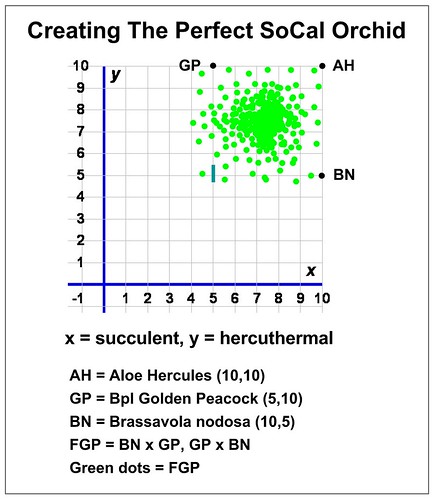
For those of you who haven't been following along at home... the perfect epiphytic orchid for SoCal would be a lot like Aloe Hercules (AH)...

- Hercules, Hercutherm, Hybridize This and Hercules
- Hercuthermal Experiment

Let's geek out a bit...


Creating The Perfect Orchid For Southern California


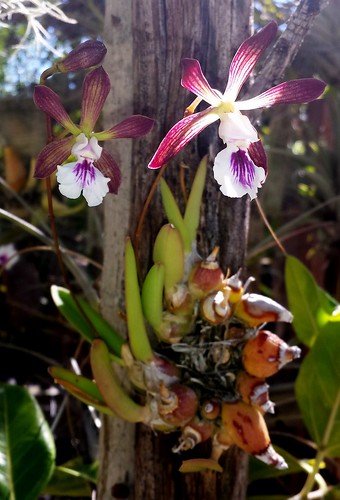
Brassavola nodosa (BN)

x = 10
y = 5

Golden Peacock (GP)

x = 5
y = 10

BN is twice as succulent as GP... but GP is twice as hercuthermal as BN.   BN only grows half the year here in SoCal while GP grows the entire year.  What we want is the best of both worlds!  We want an orchid that needs less water to grow the entire year.

So let's imagine that we crossed GP and BN.  This would give us a Fatter Golden Peacock (FGP).  Here are a few basic assumptions...

1. No two FGPs would be exactly alike
2. The more FGPs there are, the more variation there will be

We've all heard the expression about the apple not falling far from the tree.   It's a given that the more apples that fall from the tree... the greater the distances that some of the apples will fall from the tree.  This is what I've tried to illustrate in the x y graph.

In our case, we want the apple to fall far from the tree... but in the direction of AH.  The more FGPs that are produced... the greater the chances that we'll end up with a fabulous outlier.  This is known as the law of truly large numbers.

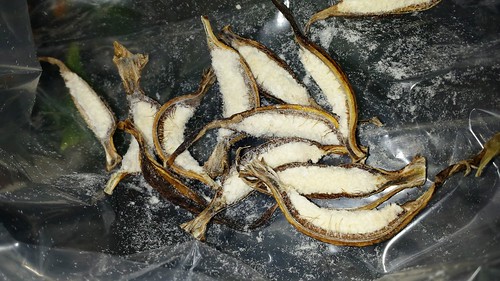
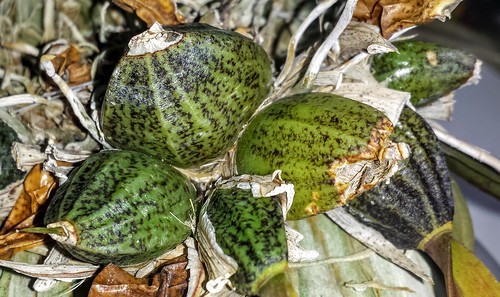
If there's one thing that orchids are really good at, it's producing a truly large number of seeds...


Cattleya Penny Kuroda Pods and Seeds

A single seed pod can contain a million seeds!  A million seeds is a truly large number of seeds.  I'm pretty sure that this goes a long way in explaining the success (diversity) of the orchid family.

Since orchids are exceptionally good at producing a large number of seeds, all else being equal, we should be able to make a lot more progress in a lot less time with orchids than we could make with coconuts.  An average size flask of orchids can contain around 30 seedlings.  But the same size flask wouldn't be large enough for even one coconut seedling.  Therefore, creating the perfect orchid for SoCal should be a less Herculean goal than creating the perfect coconut for SoCal.

So how many FGP seedlings would we need to grow in order to find the fabulous outlier?  A million seedlings?  Maybe 300,000 seedlings?  If so, that would be 10,000 flasks!  That's a lot of flasks!  If this is the case then...

Herculean = Expensive

In the x y graph I put AH and BN both as a 10 in terms of succulence.  Clearly, in absolute terms, AH is a lot more succulent than BN.  But in relative terms... perhaps they are reasonably equivalent.  For some evidence that this is roughly correct, check out this photo of a BN growing on a cactus in nature.

If you looked through that gallery of orchids growing on succulents/cactus... you would have noticed that BN isn't the only Cattleya alliance orchid that grows on cactus.  There are 100s of species in the Cattleya alliance that grow in seasonally dry forests and many of these orchids are happy to grow on the cactus that share the same habitat.

Here's a partial listing of some of the relatively drought tolerant species in the Cattleya alliance...

Barkeria (all)
Brassavola (all)
Broughtonia (all)
Cattleya nobilior
Cattleya walkeriana
Encyclia (all)
Laelia (Mexican... all)
Laelia sincorana
Myrmecophila (all)
Psychilis (all)
Rhyncholaelia (all)
Schomburgkia (all)
Sophronitis brevipedunculata
Tetramicra (all)

They all use different strategies to deal with drought.   Barkerias are the only ones that are deciduous.  Brassavolas are the only ones with entirely terete leaves... they also have very skinny pseudobulbs.   Tetramicras have canaliculate/fleshy leaves, skinny pseudobulbs and multiple leaves on each pseudobulb.  The pseudobulbs of the Rhyncholaelias aren't skinny or fat... but their leaves are relatively succulent.  Psychilis do not have very fat pseudobulbs either... but neither are their leaves relatively succulent.  Instead, their leaves are quite stiff (coriaceous).   Myrmecophilas are the only ones with hollow pseudobulbs (for the ants to live in).  Most of the others species have fat/succulent pseudobulbs but there's considerable variety in the size/shape of their pseudobulbs and in the quantity/size/shape of their leaves

One type of form that I find particularly appealing is the "teapot" form (short and stout).   Encyclia pyriformis is a good example...


Encyclia pyriformis

The plant is so short and stout!  And here's a good photo that illustrates how stout Cattleya walkeriana can be.

Given the number of...

A. species in the Cattleya alliance that occur in dry forests
B. crosses that have been made with these species

... what are the chances that BN is truly the most drought tolerant orchid in the Cattleya alliance?  Pretty slim!  So ideally we'd want to cross GP with both A and B in order to find the combination of traits that is closest to AH on the x y graph.

How long would it take us to test out all these different possible combinations?!  And how much money would it cost us to flask all the seeds?!  Clearly the answer depends on how many of "us" there are.

Recently a friend in Australia shared a photo of a nice tree in Perth.   As nice as the tree is... it has a pretty big problem.  It's naked!  The tree doesn't even have a single orchid growing on it.  Perth doesn't have any native epiphytic orchids.  And neither does Los Angeles.

Perth and Los Angeles have something else in common.  Both cities have many people who love growing orchids... Orchid Society of Western Australia (OSWA) and the Orchid Society of Southern California (OSSC).

As the saying goes... many hands make light work.  What if we collaborated with the OSWA to create the perfect orchid for... Southern California?  For Perth?  And what if we invited the members of the Cape Town Orchid Society to join us?

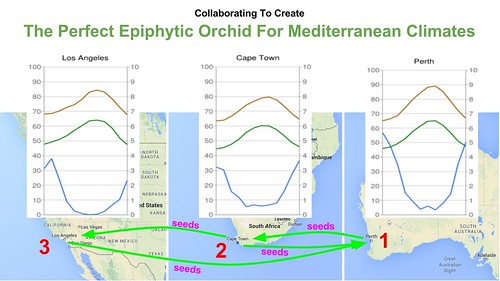
Here's how I've illustrated this...


Creating The Perfect Orchid For Mediterranean Climates

Even though each of these three cities has a Mediterranean climate... there's a considerable amount of variation in precipitation (mm/inches)...

1. Perth: 730.5 / 28.76
2. Cape Town: 515 / 20.28
3. Los Angeles: 379.2 / 14.93

Out of these three cities... the least Herculean goal would be to create the perfect epiphytic orchid for Perth.  This is because Perth receives a lot more rain than Cape Town... and twice as much rain as Los Angeles.

Participants in Los Angeles and Cape Town would make promising crosses and send the seeds to participants in Perth.  The participants in Perth would flask the seeds and allow their climate to select the most suitable individuals.  The survivors of this selection process would be crossed with other promising candidates (recombination) and eventually the perfect epiphytic orchid for Perth would be found.  Participants in Perth would send seeds of this cross to participants in Cape Town.  The same selection/recombination process would eventually yield the perfect epiphytic orchid for Cape Town.  The seeds of this orchid would be sent to Los Angeles and the same process would eventually yield the perfect epiphytic orchid for Southern California.

What would we call this system?   Trickle down epiphytics (TDE)?

Perth, Cape Town and Los Angeles aren't the only cities with Mediterranean climates.   There are quite a few other cities in the same boat.  So if we want to get the ball rolling as fast as possible (maximize the rate of progress)... then we should be as inclusive as possible...


For comparison, here are the climate graphs for Brassavola nodosa, Barkeria barkeriola and Laelia speciosa (source) ...


For even more comparison, here's the climate graph for Melbourne...


Porto gets so much rain!!!  *green with envy*  With as much rain as Porto gets... is there already some epiphytic orchid species or hybrid that could thrive, or at least survive, there without any supplemental watering?  I'm guessing that the answer is yes.  And maybe the orchid growers in Porto are already growing this orchid?

Personally, I don't know any orchid growers in Porto.  And I'm guessing that I'm the rule rather than the exception.  I do know an orchid grower in Rome... but I really can't say that I'm doing a very good job of networking with other orchid growers in Mediterranean climates.

Here's a partial listing of orchid societies located in Mediterranean climates...


Maybe we should create a Facebook page/group for orchid growers in Mediterranean climates?

Googling around I found this photo in Wikipedia commons....


Cordoaria


The photo was taken by Marcia Breia in Cordoaria Garden which is in Porto, Portugal.  The tree is the London plane tree (Platanus × acerifolia).   The truck is so big, fat and mossy!  It would be perfect for an orchid... or two.

We would certainly linger longer and be more inclined to take a photo of this tree if it had an orchid growing on it.  But not only would this specific space be more appealing, it would also be more diverse.

Regarding the value of diversity...

Biological diversity is a natural protection against surprises and shocks, climatic and otherwise. Among diverse species will be some adapted to prosper in a new landscape in new circumstances.  - Daniel J. Evans et al, Policy Implications of Greenhouse Warming: Mitigation, Adaptation, and the Science Base 
More genetic variety in a species or a population means a higher likelihood that some individuals will adapt to changing conditions.  Lower genetic variety results in uniformity of species, and ultimately translates into vulnerability. 
As an example, modern agricultural practices typically are monocultures - the practice of planting vast swathes of genetically identical plants.  This is an advantage when it comes to growing and harvesting crops, but it can be a problem when a disease or parasite attacks the field, as every plant in the field will be susceptible.  Monocultures are also unable to deal well with changing conditions, such as the changing percipitation and temperature regimes associated with climate change. - Sarah L. Burch, Sara E. Harris, Understanding Climate Change: Science, Policy, and Practice

Regarding our natural preference for orchid diversity...

One would think that man could find enough variation in the orchid family, as it occurs in nature, to more than satiate his taste for variety. Yet man's appetite for variety is never appeased. He has produced over two times as many hybrids, in the past 100 years that he has been engaged in orchid breeding, as nature has created species in her eons of evolutionary effort. - Calaway H. Dodson, Robert J. Gillespie, The Botany of Orchids

Regarding our natural preference for collecting/sharing...

The absence of [Dendrobium johannis var. semifuscum] from the mainland of the Northern Territory and its presence on Melville and Bathurst islands leads to the speculation that it might have been introduced to the islands by Macassamen (trepang fishermen) who were known to plant all manner of things on some of the places they visited during their travels. - A. W. Dockrill, Australian Indigenous Orchids 
People collect baseball cards and people collect plant seeds.  In reality, it is not all that surprising that as people move around they help preserve the genetic diversity of plants. - Norman C. Ellstrand,  Maize Germplasm Conservation in Southern California’s Urban Gardens: Introduced Diversity Beyond ex situ and in situ Management
A far less technical way of preserving a species is in gardens.  Although the managers of botanical gardens or arboreta are more self-conscious of their role, any gardener can help.  The wide cultivation of Bougainvillaea and the para rubber tree, for example, protects them from extinction in tropical America.  By collecting and breeding novel plants, nurserymen preserve biological diversity.  By selling novel plants, they diversify the places the plants are grown and so help preserve them. - Daniel J. Evans et al, Policy Implications of Greenhouse Warming: Mitigation, Adaptation, and the Science Base   

Regarding the virtuous cycle of diversity...

Thus, the total diversity of an area provides the pool of competitors for niches in developing ecosystems.  The larger the pool, the more likely it is that the system will evolve into a complex, highly interrelated system.  And complex, highly interrelated systems provide more niche opportunities for new species.  Over time, interspecific dependencies, both of predation and mutualism, will evolve.  Further, interspecific competition often aids in avoiding competitive exclusion, as predators concentrate on the competitively advantaged species on any given trophic level.  Thus, total diversity plays a key role in the development of ecosystem structure through ecological time.  That structure, in turn, provides opportunities for more species to survive and thereby increases total diversity further.  Therefore diversity augments diversity in a continuing upward spiral. - Bryan G. Norton, The Preservation of Species

Creating the perfect epiphytic orchids for Mediterranean climates would mean that lots of people would attach these orchids to trees.   Because, just like AH... they would require very little supplemental water to grow year around.  All these orchids on trees would create new niches for a wide variety of living things.  The logical and beneficial outcome would be more diversity.

Right now there are thousands and thousands of people growing millions of epiphytic orchids in Mediterranean climates.  All these epiphytic orchids require more supplemental water than AH requires.  And because people often don't have the time, or energy, to consistently and regularly water their epiphytic orchids... many epiphytic orchids are killed from dehydration.  Basically, people unintentionally help nature select for the most drought tolerant and hercuthermal epiphytic orchids.  This means that we will eventually end up with the perfect orchids for Mediterranean climates.  Personally, I'd love to have these orchids sooner rather than later!!!  It's really hard to imagine that I'm the only person in this boat!  So in theory, it shouldn't be a Herculean goal to encourage people to help create/buy/test/share epiphytic orchids that might be better suited for Mediterranean climates.

Monday, February 15, 2016

Tree Aloes Blooming In Southern California


I... sound... really...... awkward.  It's my first time narrating a video.  Clearly it's not my forte.  If you want more energy and enthusiasm... then... here you go...

https://www.youtube.com/user/PictureMaria1

She makes it look so easy.  For me it's easier to be enthusiastic in my writing...

I LOVE tree Aloes!   What's an Aloe good for?  Attaching orchids to!  If it isn't, then it's good for nothing.  I'm kidding... kinda.

Most of my tree Aloes aren't large enough to attach orchids to yet.  But, for some reason, most of them bloom at roughly the same time of year.  Why is that?  Is it a coincidence... or do the bulk of tree Aloes bloom at roughly the same time?  Or is it simply that... the bulk of tree Aloes that are commonly available in Southern California bloom at the same time?   Or do most Aloes in general bloom during winter?

I read somewhere that pollinating during winter is the best way to select for cold tolerance.  Hmmm... so... would this mean that winter bloomers proliferate faster?

As you can see from the video... my front yard, which is in Glendale, is full of drought tolerant and succulent plants.  Here's a photo of my front yard that I took 6 years ago...

https://www.flickr.com/photos/epiphyte78/4637338482

It was a lot neater back then.  Now my front yard is extremely messy with garden debris here, there and everywhere.  I prefer it this way!  There's nothing orderly about nature.  I decided a while back that I don't want a garden... I want a habitat... and the more complexity/biodiversity the better!  I want the most niches for my nature!   I want the most species for my space!  Tiger, the very old neighborhood tomcat, sure loves the yard.  You can see him briefly in the video.

Initially the front yard was nothing but grass.  That didn't last long!  If you're a TRUE nature lover... then the opportunity cost of lawn is infinitely high.  Only one of my plant friends still has a lawn... not going to mention any names... Steve... :D  Wait a second... Fernando too?  Sheesh...

My very first tree Aloe was the Aloe thraskii in the video.  It was a gift from a friend in the Orchid Society of Southern California (OSSC).   I think it was only around 2 to 3 feet tall... and I distinctly remember my friend telling me that it wasn't going to grow much taller.  Hah!  I'm happy that he was quite mistaken.  His thraskiis are also now quite taller than 2 to 3 feet!

Since then I've been really interested in tree Aloes and have acquired a decent collection of them.  None of my tree Aloes are spectacular specimens like the ones you'd see at the Huntington Botanical Garden or the LA Arboretum... but I sure do enjoy them.  The hummingbirds and bees are also big fans of the tree Aloes.  And I've also seen a few smaller birds awkwardly trying to get to the nectar.

As you might have noticed... I didn't mention the epiphytes in the video.  There are actually quite a few of them so it would have taken too long to mention all the plants.  Plus, most of the epiphytes are new additions... so they really haven't had a chance to fill in very much.  It's only just recently that the potential hosts in the front yard have gotten large enough to start attaching larger epiphytes to.

It might sound strange to grow orchids alongside Aloes and other succulent plants.  But the orchid family actually has more species of technically succulent (CAM) plants than any other family.  There are thousands of epiphytic orchid species that are found in dry/spiny tropical forests around the world.  Many, if not most, of these drought tolerant orchid species are more than happy to grow outdoors year around here in Southern California.

Here's a gallery that I created on flickr to showcase photos of orchids growing on cactus and other succulent plants...

https://www.flickr.com/photos/epiphyte78/galleries/72157649154617841/

Please let me know if you happen to find any other flickr photos that belong in the gallery!

Epiphytes are wonderful additions to yards in suitable climates because they provide additional color and interest.  They also help provide food and shelter for all sorts of creatures.

Ok... so here are some quick notes on the Aloes in this video....

Aloe bainesii: This species is the largest tree Aloe and a relatively fast grower.  It's really not "precocious" though.  Mine almost bloomed for the first time this year... but then decided to quit.

Aloe africana: A good grower and it has my favorite bloom.  Probably.  It definitely has the tallest flower spike.  Plus, it blooms twice a year.  I read somewhere that Aloe hybrids are more likely to bloom twice a year... so maybe my africana isn't the pure species.

Aloe arborescens (variegated):  At first I wasn't a fan of variegation... but then it started to grow on me.  Maybe someday I'll even catch up to Steve in terms of variegation appreciation.  Hah.  That would be impossible.  But I definitely would love to have a large tree Aloe that's variegated.  The problem is that they are not readily available...

http://spikyobsession.blogspot.com/2012/04/going-straight-to-top-of-my-wish-list.html

So I'm hoping that my variegated arborescens will cross with my other tree Aloes.  Unfortunately, for some reason, this year it finished blooming just before the rest of my Aloes started blooming.  In a month or two I plan on removing the offshoots, rooting them and planting them around the front yard.  Hopefully the disparity in locations will result in a disparity in blooming times.  I've noticed that this is generally the case with orchids (more shade = less heat = later blooming).

Aloe dichotoma:  The slow grower is actually the slowest grower.  I've had mine for years but it still hasn't bloomed.  It's a stupendous species though.  Here's my friend with his...

https://www.flickr.com/photos/32837203@N08/11810077954

Aloe ferox:  Not the happiest camper.  It bloomed a year or two ago... but then I failed to remove all the flowers that fell into its crown.  I guess the rain + detritus proved to be a good combination for some fungus/bacteria... so a bad combination for the Aloe.  I thought it was a goner but it seems to be outgrowing the problem.  But it's definitely never really thrived.

Aloe Hercules:  Is a cross between dichotoma and bainesii.  In my opinion it's the fastest grower.  You can see some earlier photos of it in this blog entry...

http://epiecon.blogspot.com/2014/11/hercules-hercutherm-hybridize-this-and.html

It bloomed for the first time last year.  But evidently it decided that blooming was overrated because it didn't bloom again this year.

Aloe marlothii:  Not the fastest grower... but definitely a trooper.  It was already pretty large when I planted the The Grevillea "Red Hooks" near it.  The Grevillea was in a one gallon pot and I guess I failed to read the label.  The label probably said something about Jack and the Beanstalk because the Grevillea skyrocketed right after I planted it.  

Aloe plicatilis:  A very distinct tree Aloe.  This species can potentially make a really great phorophyte for smaller epiphytes... but unfortunately it's a slow grower.

Aloe speciosa: I've heard quite a few people say that this species has the best bloom.  And I can definitely see why.  The form of the plant itself is also quite pleasing.  For some reason I'm a bit surprised that mine is splitting.  It's a perfect height to split... but I guess that most of the ones that I've seen have only had one head.  Well, as the saying goes, two heads are better than one!

Aloe striata:  ... I believe.  Not a tree Aloe!  Still... there's something about the leaves that are definitely appealing (pastel luminescence?).  Usually it starts blooming just as the rest of the Aloes finish blooming.  This year it's blooming at the same time.  It even has 3 spikes on it.  Hopefully some bees or hummingbirds will cross pollinate it with the tree Aloes.  I'd definitely love to see what the hybrid would look like!

Aloe thraskii: The plant itself has my favorite form.  It's very curvy.  The bloom is probably the least showy though.  However, it is by far the most consistently pollinated.  In fact, the weight of the seed pods usually breaks the flower stalk.  So far it's the only Aloe that's "volunteered".  I discovered a handful of seedlings near the base of its trunk the spring after we had far more rain than usual.

Aloe vaombe:  This species is from Madagascar.  "Vaombe" is an excellent word.  It's also an excellent Aloe.  The form and flowers are both really quite nice.

I'll probably have more Aloe seeds than I can sow.  Plus, in order to plant plenty of variegated Aloe arborescens around the front yard... I'm going to have to remove and/or cut back a bunch of other plants.  So please let me know if you live in the Glendale area and are interested in some drought tolerant plants/seeds.

Here are some links...

https://www.facebook.com/epiphytesociety/
https://www.facebook.com/epiphytessc/
https://www.facebook.com/orchidssc/
https://www.flickr.com/groups/orchidlandscape/
https://www.flickr.com/photos/epiphyte78/


Please let me know if you have any questions!

Sunday, November 30, 2014