********************************
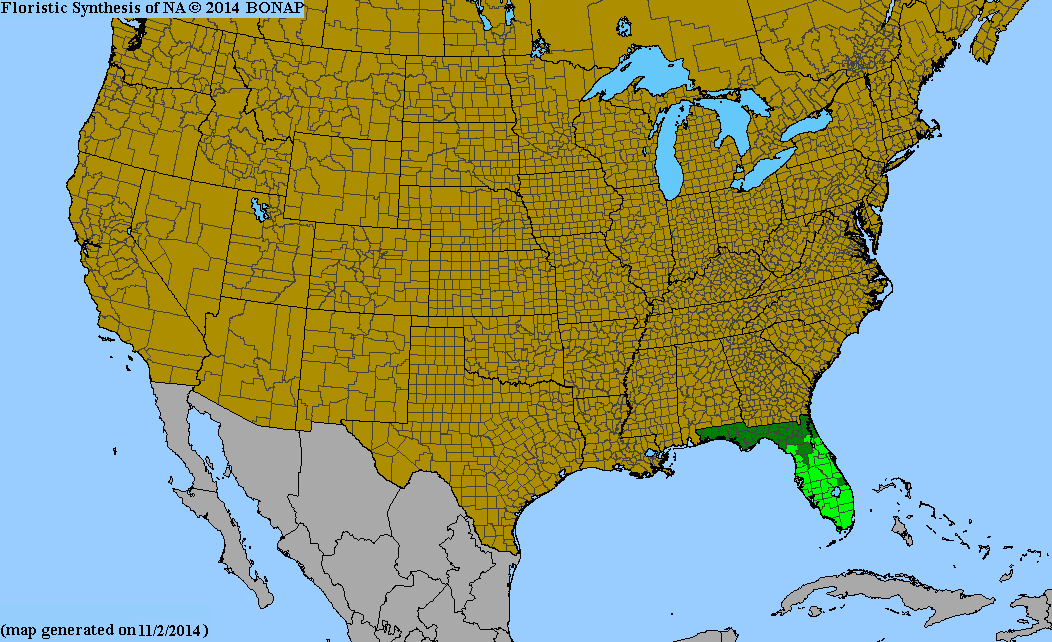
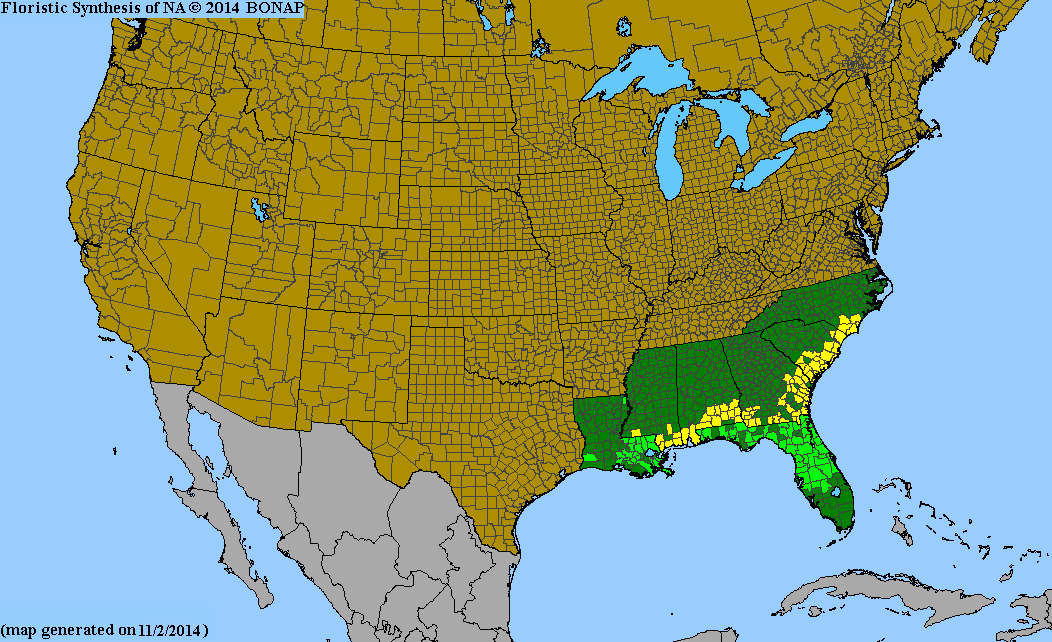
Here's a distribution map of Encyclia tampensis. It doesn't appear that there are any records for Alachua county. For comparison, here's the distribution map of Epidendrum conopseum.
If I was in your shoes, I'd definitely try and grow Encyclia tampensis. You're right on the border of its natural limit. But you'd have to expect that, every once in a while, a particularly bad freeze might wipe out your tampensis. But if you spend $10 dollars for a tampensis, and get 5 years of enjoyment from it, then that's not the worst investment. In comparison, you only get 15 minutes of enjoyment from a $10 dollar meal.
I definitely wouldn't buy very many tampensis though. Instead, I'd buy a lot of conopseum crosses. Eplc Butterfly Kisses (Lc Trick or Treat x Epi. conopseum) isn't too shabby (photo). There's actually one available on eBay. I think it looks better than tampensis. Another cross available on eBay is Epi. conopseum x C. purpurata.
You're super fortunate that there's a vendor on eBay, bluemossguy, who regularly offers crosses with conopseum. Right now he's selling a flask of Epidendrum conopseum x Brassavola nodosa for only $15 dollars. What a great cross! I bought 3 seedlings of this cross from him a couple years ago and am really happy with them. I wish that I had gotten an entire flask. I could still do so, but it's hard to justify the purchase when I already have three plants of this cross.
Getting a flask is a good idea because you can expect some drought/temperature tolerance variation among the seedlings. The larger the pool of seedlings, the more closely suited some of them will be to your conditions. With this logic in mind, it would be optimal to sow as many seeds on your trees, and the street trees, and your neighbors' trees, as possible. I've had some success with this technique here in dry, parched and thirsty Southern California. So you should have a lot more success in rainy, wet and humid Florida.
There's a limit though to how many flowers you can personally cross-pollinate. You'd end up with a lot more seed pods if you recruited the natural pollinators. Bees are cool, but hummingbirds are the coolest. I've witnessed my hummingbirds trying to make all sorts of crazy crosses (ie Echeveria x Aloe). I've seen them visiting orchid flowers as different as Dendrobium bigibbum and Dockrillia teretifolia. Both orchids have ended up with pods.
Hummingbirds like to pollinate reed-stem orchids. Sunset Valley Orchids (SVO) sold a cross between a reed-stem and conopseum...
(Epi. Pacific Eclipse x Epi. Pacific Canary) 'SVO Yellow Sun' x Epi. conopseum 'SVO'
Not sure if there are any still available. My friend bought one and let me borrow it to try and cross it. There are two pods on it but they kinda stalled out. It does have a really nice keiki on it. The plant itself is a lot more like a typical reed-stem. But it's more stout and succulent. I think it might actually make a pretty great epiphyte.
Another orchid that hummingbirds love to pollinate is Broughtonia sanguinea. It's a really awesome orchid. Coincidentally, today I just harvested a pod that was made by a hummingbird. The plant had finished blooming a while back but when I went to harvest the pod, I noticed that the spike was just starting to produce more flowers. So you don't want to cut off a spike that's still green. This species is relatively drought tolerant, but it isn't very cold tolerant.
Sophronitis cernua is another great orchid that the hummingbirds love to pollinate. Not sure if I remember correctly, but I thought that bluemossguy sold crosses of it with conopseum.
There are lots of really fun and exciting possibilities! You can choose from numerous really different orchids. When you make your choices and attach them to trees, then nature (conditions/pollinators) can choose among them. You can then choose among nature's choices. This virtuous cycle is a cross between artificial selection and natural selection. It's so much teamwork that we can think of it as collaborative selection. Or holistic selection. Or some better term.
Way back when I used to be a species guy, but then I decided that I cared more about results. For me whether an orchid was a species or hybrid was less important than whether it thrived on a tree. Then I realized that slugs sure don't care whether an orchid is a species or hybrid! Neither do hummingbirds. Or the weather.
Nature definitely doesn't care whether an orchid is a species or hybrid. What she cares about is the conquest of space. Nature abhors a vacuum. She wants to fill Canada with epiphytes sooner rather than later. We can, and should, give her a hand.
I'm guessing that your society's input might be a little different? Heh. Variety is the spice of life. Let me know what your society says. And please share updates on your project.
If I was in your shoes, I'd definitely try and grow Encyclia tampensis. You're right on the border of its natural limit. But you'd have to expect that, every once in a while, a particularly bad freeze might wipe out your tampensis. But if you spend $10 dollars for a tampensis, and get 5 years of enjoyment from it, then that's not the worst investment. In comparison, you only get 15 minutes of enjoyment from a $10 dollar meal.
I definitely wouldn't buy very many tampensis though. Instead, I'd buy a lot of conopseum crosses. Eplc Butterfly Kisses (Lc Trick or Treat x Epi. conopseum) isn't too shabby (photo). There's actually one available on eBay. I think it looks better than tampensis. Another cross available on eBay is Epi. conopseum x C. purpurata.
You're super fortunate that there's a vendor on eBay, bluemossguy, who regularly offers crosses with conopseum. Right now he's selling a flask of Epidendrum conopseum x Brassavola nodosa for only $15 dollars. What a great cross! I bought 3 seedlings of this cross from him a couple years ago and am really happy with them. I wish that I had gotten an entire flask. I could still do so, but it's hard to justify the purchase when I already have three plants of this cross.
Getting a flask is a good idea because you can expect some drought/temperature tolerance variation among the seedlings. The larger the pool of seedlings, the more closely suited some of them will be to your conditions. With this logic in mind, it would be optimal to sow as many seeds on your trees, and the street trees, and your neighbors' trees, as possible. I've had some success with this technique here in dry, parched and thirsty Southern California. So you should have a lot more success in rainy, wet and humid Florida.
There's a limit though to how many flowers you can personally cross-pollinate. You'd end up with a lot more seed pods if you recruited the natural pollinators. Bees are cool, but hummingbirds are the coolest. I've witnessed my hummingbirds trying to make all sorts of crazy crosses (ie Echeveria x Aloe). I've seen them visiting orchid flowers as different as Dendrobium bigibbum and Dockrillia teretifolia. Both orchids have ended up with pods.
Hummingbirds like to pollinate reed-stem orchids. Sunset Valley Orchids (SVO) sold a cross between a reed-stem and conopseum...
(Epi. Pacific Eclipse x Epi. Pacific Canary) 'SVO Yellow Sun' x Epi. conopseum 'SVO'
Not sure if there are any still available. My friend bought one and let me borrow it to try and cross it. There are two pods on it but they kinda stalled out. It does have a really nice keiki on it. The plant itself is a lot more like a typical reed-stem. But it's more stout and succulent. I think it might actually make a pretty great epiphyte.
Another orchid that hummingbirds love to pollinate is Broughtonia sanguinea. It's a really awesome orchid. Coincidentally, today I just harvested a pod that was made by a hummingbird. The plant had finished blooming a while back but when I went to harvest the pod, I noticed that the spike was just starting to produce more flowers. So you don't want to cut off a spike that's still green. This species is relatively drought tolerant, but it isn't very cold tolerant.
Sophronitis cernua is another great orchid that the hummingbirds love to pollinate. Not sure if I remember correctly, but I thought that bluemossguy sold crosses of it with conopseum.
There are lots of really fun and exciting possibilities! You can choose from numerous really different orchids. When you make your choices and attach them to trees, then nature (conditions/pollinators) can choose among them. You can then choose among nature's choices. This virtuous cycle is a cross between artificial selection and natural selection. It's so much teamwork that we can think of it as collaborative selection. Or holistic selection. Or some better term.
Way back when I used to be a species guy, but then I decided that I cared more about results. For me whether an orchid was a species or hybrid was less important than whether it thrived on a tree. Then I realized that slugs sure don't care whether an orchid is a species or hybrid! Neither do hummingbirds. Or the weather.
Nature definitely doesn't care whether an orchid is a species or hybrid. What she cares about is the conquest of space. Nature abhors a vacuum. She wants to fill Canada with epiphytes sooner rather than later. We can, and should, give her a hand.
I'm guessing that your society's input might be a little different? Heh. Variety is the spice of life. Let me know what your society says. And please share updates on your project.