This last weekend I attached some of my orchids to trees that aren't mine. No, I didn't do it guerrilla gardening style. :)
Last year my neighbors on both sides of me expressed interesting in having some orchids. My neighbor on my left... "Carol"... is from Costa Rica and my neighbor on my right... "Arthur".... is from the Philippines.
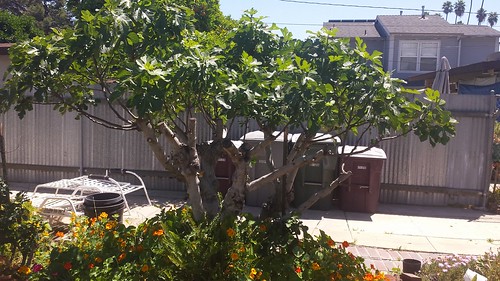
So on Saturday I went over to Carol's place and prepped the hosts. The main host was an old Ficus carica (common fig) that had been lopped in half. It had a myriad of smaller branches so I went through and removed lots of them. I'm hardly an expert at pruning but here are my general rules...
1. No redundant branches
2. No crossing branches
3. No backwards branches
I don't always strictly adhere to these rules. For example, in this case... I wanted to err on the side of more, rather than less, shade for the newly attached orchids. Plus, I kept a few "illegal" branches because they were thick enough to provide lots of surface area for some orchid roots.
Here was the result...
There are quite a few main branches.... which is nice... but they are a bit on the short side. Mounting the orchids low is good for appreciating them... but it makes them more accessible to the usual suspects.
After I prepped the Fig tree, I also prepped a pair of really old and overgrown Bougainvilleas. Ouch, my most of me.
Sunday morning I ate a breakfast of champions... one cold slice of leftover pizza and a warm bowl of oatmeal... and I gathered up a few of my extras...
- Oncidium maculatum
- Oncidium NOID
- Laelia anceps
- Brassavola nodosa
- Cattleya walkeriana
- Laeliocattleya Clayton Waglay = Laelia anceps x Cattleya Claesiana (intermedia x loddigesii)
- Myrmecolaelia Ruby Ray = Myrmecophila tibicinis x Laelia undulata
- Brassanthe Maikai = Brassavola nodosa x Guarianthe bowringiana
- Brassocatanthe Little Mermaid = Cattleya walkeriana x Brassanthe Maikai
- Encyvola Gordon Vickers = Brassavola nodosa x Encyclia tampensis
- Brassanthe Bill Worsley = Brassavola nodosa x Guarianthe aurantiaca
- Ascofinetia Twinkle = Neofinetia falcata x Ascocentrum miniatum
- Oncidium sphacelatum x obryzatoides
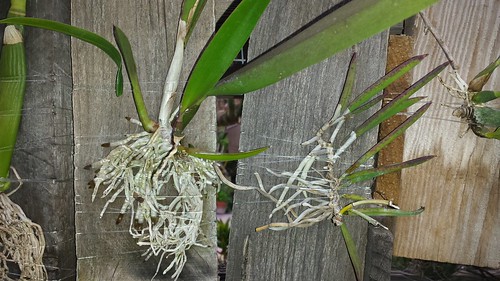
I attached the walkeriana, the nodosa and all the nodosa crosses to the two Bougainvilleas. The rest of the orchids I attached to the Fig tree. I used 30lb fishing line and the slip knot technique to make sure that the orchids were very firmly attached to the branches. I didn't include any moss.
When I finished attaching all the orchids I went over to Arthur's place and prepped his tree. It was also the common Fig tree. It had less main branches but they hadn't been lopped in half. After I removed lots of the smaller branches... I went and collected pretty much the same set of orchids...
In terms of instructions... I told Carol and Arthur to use the "shower" setting on their nozzle to thoroughly water the orchids Tuesdays and Saturdays in the evenings during the summer and less frequently and earlier in the day the rest of the year.
Unfortunately for me I can only grow temperate orchids outside year round. - chibae
Pretty much the saddest story ever... :( :( :( And there are no diminishing returns. Each time I hear this story it's just as sad as the last time I heard it.
I just looked at a map of the US. I guess North Carolina (NC) is a bit below the "mid-Atlantic coast"? Just in case you didn't know... NC is home to the Northernmost occurring epiphytic orchid in North America.... Epidendrum conopseum (EC). But, what are the chances that EC is the most cold tolerant epiphytic orchid in the world? Why should we suspect that EC is more cold tolerant than the Southernmost occurring epiphytic orchid in South America? Why should we suspect that EC is more cold tolerant than the Northernmost occurring epiphytic orchid in Asia? Why should we suspect that EC is more cold tolerant than the Southernmost occurring epiphytic orchid in... Down Under? National pride? "Our soccer team is better than your soccer team... and our epiphytic orchid is more cold tolerant than your epiphytic orchid!"
In another forum a fellow in Tampa was wondering what type of tree he should plant. While digging around for an answer I ran across these two things...
It is interesting to know that for a period of 46 years this orchid has evidently escaped collectors in North Carolina. In a conversation with Professor Oakes Ames last winter he expressed the opinion that the reason for this was perhaps due to the "Big Freeze" of 1888-89 which may have destroyed these plants this far north and thus temporarily moved the limits of its northern range farther south. It is also possible that the position of the orchid high up in the trees may have made it easily overlooked. - Donovan Correll, Epidendrum conopseum in North Carolina
In December 1989, a severe cold front passed through Florida; temperatures reached -5C, killing all the orchids. At other central Florida sites, mortality of Encyclia tampensis was high (>80%). - Ronald J. Larson, Population Dynamics of Encyclia tampensis in Florida
There's a line that marks the Northernmost distribution of EC. This line really isn't static! It's very dynamic. In exceptionally cold years... this line is moved South by many many miles. And maybe in exceptionally warm years... the line is moved North by many many miles. Where was this line 1000 years ago? Where is it 100,000 years ago? Wouldn't it be amazing to see an animation of this line over the past million years? Has EC even been around for that long?
It's a race to Canada! As far as tropical epiphytes are concerned... Pleopeltis polypodioides (PP) is in first place. I think it grows no problem outdoors year around in the mid-Atlantic coast? In second place is Tillandsia usneoides (TU). And in third place is EC.
PP cheats because it got a head start. TU also cheats because birds help carry it. So it's only fair that we (ie you!) help EC cheat. Just go around sowing a gazillion EC seeds in its favorite trees. If enough other people do the same thing then eventually I'll have no problem believing that EC is the most cold tolerant orchid in the world. I'll be swoll with national pride. Well... unless the other countries start doing the same thing.
I guess we'll need to start the orchid Olympics (OO)? Medals for most cold tolerant orchid? And most drought tolerant orchid? And orchid that's most attractive to hummingbirds? Poor Africa will never place in that last event! Well... they do have Disas... but there aren't any terrestrial orchids allowed in the OO!
Lots of accusations of doping? Testing for miracle grow? DNA testing for genetic purity?
What allows EC to make any real progress in the race to Canada? It's the fabulous outliers. Progress depends on difference. More difference means more progress.
Deng Xiaoping was fond of saying that it didn't matter whether the cat was black or white... what mattered was whether it caught mice. Lots of people will probably freak out if I suggest that we (ie you!) deliberately introduce hybrid ECs to the wilds of the mid-Atlantic coast. But nature doesn't care whether an orchid is a species or a hybrid. If nature cares about anything it's survival of the fittest.
Yes, change is the basic law of nature. But the changes wrought by the passage of time affects individuals and institutions in different ways. According to Darwin’s Origin of Species, it is not the most intellectual of the species that survives; it is not the strongest that survives; but the species that survives is the one that is able best to adapt and adjust to the changing environment in which it finds itself. Applying this theoretical concept to us as individuals, we can state that the civilization that is able to survive is the one that is able to adapt to the changing physical, social, political, moral, and spiritual environment in which it finds itself. - Leon C. Megginson
Plants don't have a crystal ball. They can't predict exactly how their environment is going to change. Plants can't predict global warming or cooling or drying or wetting. Orchids aren't an exception to this rule. What makes orchids exceptional is that they are really good at hedging their bets. Orchids are really good at producing lots of seeds. A single seed pod can contain a million seeds. Each seed is a different bet... so a million seeds is a lot of different bets. It's a given that all these different bets can't be equally good. Just like ideas can't all be equally good...
Individual decision making is closely connected to creativity not because all choices are excellent, but because they constitute a broad field out of which the best responses can emerge. If we wished to establish a connection to Darwinian ideas, we could say that the wide spectrum of decisions is similar to the field of the spontaneous variations of living things from which the pressure of natural selection preserves only the most apt. Without such experimental structures and behaviours, responses remain stagnant and life sinks under the weight of institutionalised routine. Freedom multiplies actions and ideas, some of which turn out to be brilliant and others fundamentally flawed. The important fact, however, is that few if any of them could have occurred under conditions of enforced conformity. To leave people alone with their projects is to permit - even to encourage - the exercise of private imaginations. - John Lachs
It's a bad idea to facilitate the hybridization of EC? Because EC's hybrids will be less adaptable to change? Or because they will be more adaptable to change?
Yeah, your story is truly sad. But there's no reason that it can't have a happy ending! There's no reason that there can't be a wide variety of epiphytic orchids that are happy to grow outdoors year around in the mid-Atlantic coast.
1. I suspected that it might be hercuthermal (wider temperature grow range)
2. Two of the species (milleri and vitellina) are pollinated by hummingbirds
3. The nodosa theoretically adds some drought tolerance
Here's why I suspected that GP might be a hercutherm...
1. nodosa = intermediate/warm grower
2. milleri = cool/intermediate/warm grower?
3. vitellina = cool/intermediate grower
The vendor that I purchased GP from is in Florida so this cross definitely grows when it's warm. My question was... would it also grow when it's cool?! Just in case you don't know... I live in Glendale (a few miles east of Los Angeles) and I grow all my orchids outside year around.
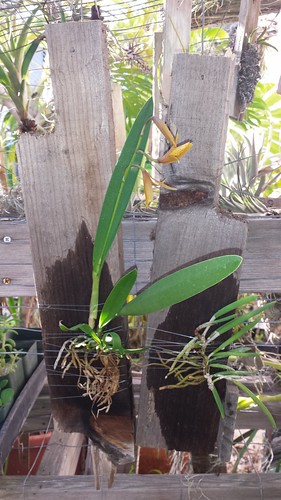
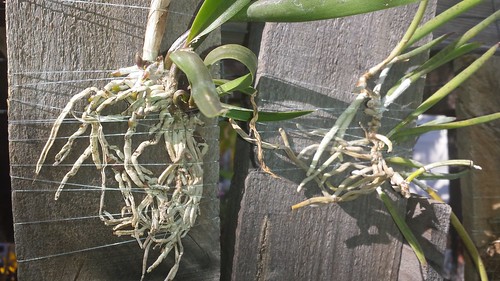
So I decided to perform a little experiment. I took a piece of wood from a broken down pallet and sawed it in half. On one half I attached the GP and on the other half I attached a straight nodosa. I hung both mounts right next to each other and tried to regularly water them early in the day. For the rest of my plants, minus a few other exceptions, I severely cut back on watering like I usually do when it starts to get cool.
I took a few photos to document the experiment...
9 Oct 2015
2 Dec 2015
28 Mar 2016
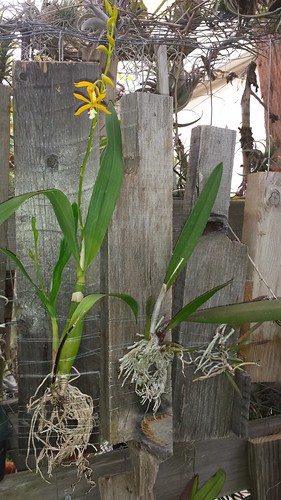
As you can tell from the photos ... there was quite a large disparity in their growth! The GP put out quite a few roots and a new shoot while the nodosa is just starting to put out its first new root. I didn't fertilize either orchid but they did receive quite a bit of sun.
It sure does seem like GP is more hercuthermal than nodosa but... perhaps there's another explanation for the disparity in their growth? Maybe the GP somehow got more direct sun? More sun means more heat. Or maybe the nodosa had already entered into "hibernation" (aka rest mode)? Or perhaps I talked to GP more than I talked to the nodosa?
In any case, whether or not GP is truly more hercuthermal than nodosa... it seems clear that GP is willing to continue growing in cooler weather as long as it receives enough water. For the gazillion previous years that I've grown orchids I was quite happy to severely reduce water when it started to get cool. My orchids would take a break from growing and I would take a break from my orchids! Plus, for lots of tropicalish plants... cool+wet = rot. So, when it's cooler, it's safer to err on the side of a lot less watering and a lot better drainage.
Aloe Hercules really forced me to reconsider this paradigm. I don't water my succulents at all when it's even remotely cool but Hercules would keep growing anyways. It seems logical that what allowed him to do so was... A. being hercuthermal and B. his ability to store water. On rare occasions when it does rain here in Southern California... he really soaks up and stores the water and uses it to grow during the dry days.
If I hadn't regularly watered the GP would it have continued to grow? It doesn't seem likely. But it would have been nice to have been able to confirm this by having a "control" division of GP that didn't receive any supplemental water during the experiment.
Carrot Top (CT) is a real sequential bloomer. In fact, it's still blooming! Five + months of blooming isn't too shabby! Lots of blooms for my buck!
Back in January I noticed that CT's roots were still active. It hadn't been receiving regular water like the GP and the nodosa... but... it was still potted SBOE style (pot in a pot with rocks). Usually I mount orchids as soon as I get them... but in this case I had decided that perhaps it was adequately safe in such a well-drained medium. If I had mounted it though... I wonder if its root tips still would have been active? I'm guessing that, even though the rock medium was well-drained, it still provided more moisture than a mount without any moss would have. So if I had mounted CT as soon as I got it... and didn't regularly water it... then I don't think that the roots would have continued to grow.
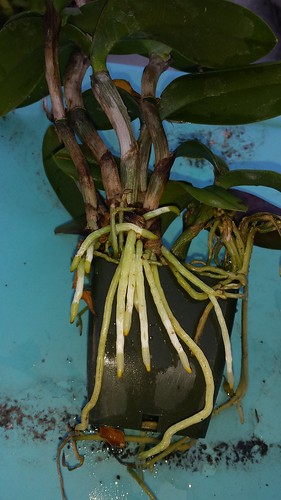
When I realized that CT was still actively growing... I decided to mount it. Here's what I saw when I removed it from the outer pot...
25 Jan 2016
Lots of really happily active roots in the middle of winter!
According to the OrchidSpecies website, Cattleya sanguiloba is a cool grower and Epidendrum longipetalum is a cool to cold grower. So CT is definitely a cool grower... and since it's from the SBOE... I'm guessing that it's also an intermediate grower as well.
In this case... there are two causes for CT's active roots in the middle of winter...
1. It's a cool/intermediate grower
2. It received enough water to grow
GP and Hercules are pretty much in the same boat. The difference is that Hercules doesn't seem to need any supplemental water.
From my perspective... Hercules is the standard that all orchids should be measured against. All orchid crosses should be made with Hercules in mind. And hummingbirds. Hummingbirds should be kept in mind as well!
So I've been keeping an eye out for other vitellina crosses and have managed to find a few others...
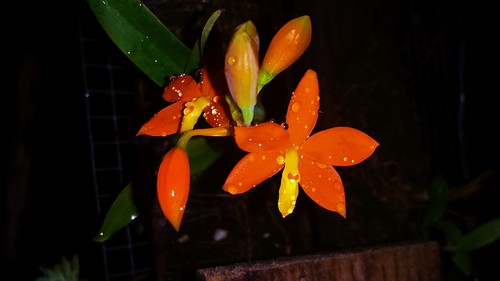
Here's a recent picture of the third one in bloom...
It would have had more flowers on it but I removed them to collect the pollen.
Out of the four orchids on that list, the last one (Laerianchea Orange Planet) is my most recent find and the one that I'm most excited about. This is because this cross (OP) is closer to Hercules and hummingbirds than the other three are. Guarianthe aurantiaca is pollinated by hummingbirds and Laelia rubescens is a warm grower and drought tolerant. But is OP closer to the Hercules/hummingbird standard than GP is?
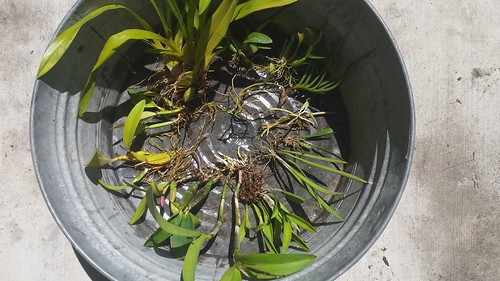
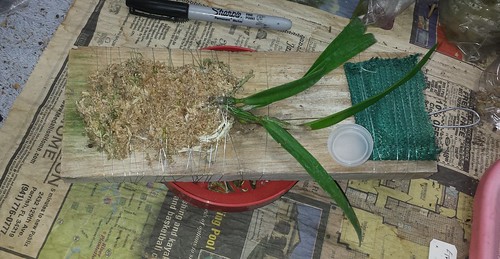
OP arrived in a small pot filled with New Zealand Sphagnum moss. I placed the pot in a container of water to fully hydrate the orchid and the moss. Then I carefully unpotted the orchid and used a tweezers to carefully remove all the moss that was near the new growth that was just starting to emerge. I used fishing line and my patented (not really) slip knot technique to tightly attach the orchid and the moss to a mount (cut from a pallet)...
OP is not yet blooming size and I'm particularly impatient for it to grow! So I added a pouch to hold slow release fertilizer granules (Osmocote). The pouch is made from shade cloth and I used a couple water bottle lids as placeholders. This is my first time trying this technique but my friend Dave has had some really great results with it. He uses little plastic baskets to hold the fertilizer pellets. We both got the idea when we visited an orchid grower in Malibu.... but Dave actually decided to give it a try.
It's invariably the case that tightly attaching an orchid to a mount will wound the orchid to some degree. These wounds are susceptible to pathogens/rot. Usually it's not a problem though if the orchid is happy enough. But since I'm super excited about OP I decided to play it really safe. For the past three days I've kept the orchid completely dry in my garage under lights. The weather is still a bit on the cooler side and I wanted to make sure that any wounds on OP are completely healed before I put it outside and give it a good soaking.
In addition to purchasing some vitellina crosses... I also purchased the species... which is just starting to bloom...
I've wanted to purchase it for the longest time but the consensus seemed to be that it really isn't a fan of the heat. So what changed? The hummingbirds talked me into buying it. I think I'm becoming more and more susceptible to their influence. Hopefully I'll be able to keep vitellina alive!
Back in February I saw that another vendor on eBay was also selling GP at a reasonable price. He even had 10 of them for sale. So on Feb 26 I shared a link with the Epiphyte Society of Southern California on Facebook. But the GPs didn't sell like hot cakes! Well... the ESSC had less than 30 "likes" back then. So on Mar 3 I shared the link with the Orchid Society of Southern California. The OSSC has over 2000 likes... but the GPs still didn't sell like hot cakes! Right now there are still 6 GPs for sale.
So here I am! Making my case! Showing some evidence! Offering some logic! Trying to increase the demand for hercuthermal orchids. And hummingbird orchids. And drought tolerant orchids. And sequentially blooming orchids. Orchids that are more like Hercules and better for hummingbirds really should sell like hot cakes!
Let's think about the long-term goal. Here's a picture of my street...
None of these palms have orchids growing on them. Should they all have orchids growing on them? I sure think so! The hummingbirds sure think so too! Hopefully you will agree with us!
I suppose I could buy the six remaining GPs and then ask my closest neighbors for permission to attach them to their palms. They might want to know who would be responsible for watering them. Me?! It's a given that my neighbors would be more inclined to give their permission if I offered to water the GPs. And I suppose I could walk up and down my street with a super soaker in my hands and a couple more slung over my shoulders. Or I could program a drone to water them for me?
The ideal orchid wouldn't require any supplemental water. I could just go around my neighborhood attaching it to palm trees without ever having to worry about watering! Each orchid that I attached to a palm would provide lots of color and interest for humans and lots of food for hummingbirds.
My experiment doesn't definitively prove that progress can be made in this direction. But hopefully it will help generate interest in the possibility of progress!
What can you do if are interested in hercuthermal and/or hummingbird and/or sequential blooming and/or drought tolerant hybrids?
1. vote for these types of hybrids... HybridizeThis
2. dollar vote for these types of hybrids
Hybridizers aren't mind readers. So if you want orchids that are substantially better, then you have to communicate your preferences to hybridizers. You have to let them know that you want orchids that come as close as possible to meeting the Hercules/hummingbird (HH) standard. The more hybridizers there are trying to meet the HH standard... the more fabulous outliers we will be able to grow.
It's a really exciting cross. A few months ago I bought some seedlings of this cross on eBay. The plants that Peter had for sale at the show were full grown and in full bloom. I was super tempted to buy one for myself but decided to buy one for my friend who drove us.
I was surprised that the LFAs weren't selling like hot cakes and I mentioned this to Peter. He said that people are idiots. Hah. No. That's not what he said. He said that most people don't know whether a cross is good or not. Or something along those lines.
It makes sense that most people aren't knowledgeable about crosses. And even people who are knowledgeable about crosses can't be knowledgeable about all crosses! There are just way too many crosses!
Ideally it would be really easy and quick for those who are knowledgeable about crosses to share their expertise with everybody else.
Your website allows people to review and rate the orchids for sale... which is great. But I'd like the opportunity to offer more substantial feedback on an orchid. And by "substantial" I mean monetary.
Rather than simply giving LFA 5 stars... I'd like to be able to give it 5 cents!
Above the review/rating section there would be a valuation section. In this section you'd display my username along with my valuation...
Epiphyte: $0.05
I would essentially be giving Peter 5 cents for helping to make this really great cross available. Plus, I would be publicly vouching for LFA.
The total valuation for this listing would be 25 cents.
Users would have the option to sort listings by their valuations. And you'd probably want to put the top 5 or 10 most valuable listings on your homepage. Users would essentially have the opportunity to use their pennies to help decide which listings were most worthy of being displayed on the homepage.
Also, it would be really awesome if I could click on Don's username and see all his valuations. I could sort them by date to see his most recent valuations and I could also sort them by value to see which listings he most values.
Right now I have the option to pick Don's brain. I can e-mail him and say, "Hey Don! Peter's selling 201 orchids on OrchidExchange. Which ones do you most highly recommend?" It's really wonderful to have easy access to Don's extensive outdoor growing orchid expertise. But it would be even better if everybody could know which of Peter's orchids that Don values the most.
With this system in mind... you would still want people to have the option to see and valuate sold listings. If Peter lists a Laelia speciosa cross and somebody buys it before I do... I'd still want to valuate the listing. I'd still want to give Peter some money for listing such a great cross. The more money this listing receives... the greater the incentive that Peter and other vendors would have to offer more Laelia speciosa crosses for sale.
It wouldn't be technically difficult to facilitate valuations. Members would use paypal to buy digital dollars. I'd give you $5 dollars and you would put $5 digital dollars into my "digital wallet". The digital wallet would simply be a column in the users table.
You would also need a many-to-many table. I'm guessing that you already have one for ratings? You would just need to create another one for valuations.
In the listings table you might want a column to keep track of the total valuations. That might make it faster to sort listings by their valuations.
While I'd certainly be happy to spend some money to promote/sponsor/support/encourage some really nice listings... I'm not sure how many other people would appreciate the opportunity to do so. One possible incentive would be to allow valuators to include a link to their personal website...
1. Reward Peter
2. Promote LFA
3. Advertise my website
If you did display the top 5 or 10 most valuable listings on your homepage then this could potentially drive some decent traffic to the websites of the top valuators of those listings.
In this case the motivation to valuate the listings wouldn't be purely altruistic.
Anyways, it's just an idea! But I'm pretty sure that crowd sponsored results are the future.
Web 2.0 made it stupid easy to share information. Voila! Here I am! Here we are! As a result... the internet has lots of information. Web 3.0 will make it stupid easy to share our valuations of the shared information. As a result...it will be stupid easy to find the most valuable information.
I... sound... really...... awkward. It's my first time narrating a video. Clearly it's not my forte. If you want more energy and enthusiasm... then... here you go...
She makes it look so easy. For me it's easier to be enthusiastic in my writing...
I LOVE tree Aloes! What's an Aloe good for? Attaching orchids to! If it isn't, then it's good for nothing. I'm kidding... kinda.
Most of my tree Aloes aren't large enough to attach orchids to yet. But, for some reason, most of them bloom at roughly the same time of year. Why is that? Is it a coincidence... or do the bulk of tree Aloes bloom at roughly the same time? Or is it simply that... the bulk of tree Aloes that are commonly available in Southern California bloom at the same time? Or do most Aloes in general bloom during winter?
I read somewhere that pollinating during winter is the best way to select for cold tolerance. Hmmm... so... would this mean that winter bloomers proliferate faster?
As you can see from the video... my front yard, which is in Glendale, is full of drought tolerant and succulent plants. Here's a photo of my front yard that I took 6 years ago...
It was a lot neater back then. Now my front yard is extremely messy with garden debris here, there and everywhere. I prefer it this way! There's nothing orderly about nature. I decided a while back that I don't want a garden... I want a habitat... and the more complexity/biodiversity the better! I want the most niches for my nature! I want the most species for my space! Tiger, the very old neighborhood tomcat, sure loves the yard. You can see him briefly in the video.
Initially the front yard was nothing but grass. That didn't last long! If you're a TRUE nature lover... then the opportunity cost of lawn is infinitely high. Only one of my plant friends still has a lawn... not going to mention any names... Steve... :D Wait a second... Fernando too? Sheesh...
My very first tree Aloe was the Aloe thraskii in the video. It was a gift from a friend in the Orchid Society of Southern California (OSSC). I think it was only around 2 to 3 feet tall... and I distinctly remember my friend telling me that it wasn't going to grow much taller. Hah! I'm happy that he was quite mistaken. His thraskiis are also now quite taller than 2 to 3 feet!
Since then I've been really interested in tree Aloes and have acquired a decent collection of them. None of my tree Aloes are spectacular specimens like the ones you'd see at the Huntington Botanical Garden or the LA Arboretum... but I sure do enjoy them. The hummingbirds and bees are also big fans of the tree Aloes. And I've also seen a few smaller birds awkwardly trying to get to the nectar.
As you might have noticed... I didn't mention the epiphytes in the video. There are actually quite a few of them so it would have taken too long to mention all the plants. Plus, most of the epiphytes are new additions... so they really haven't had a chance to fill in very much. It's only just recently that the potential hosts in the front yard have gotten large enough to start attaching larger epiphytes to.
It might sound strange to grow orchids alongside Aloes and other succulent plants. But the orchid family actually has more species of technically succulent (CAM) plants than any other family. There are thousands of epiphytic orchid species that are found in dry/spiny tropical forests around the world. Many, if not most, of these drought tolerant orchid species are more than happy to grow outdoors year around here in Southern California.
Here's a gallery that I created on flickr to showcase photos of orchids growing on cactus and other succulent plants...
Please let me know if you happen to find any other flickr photos that belong in the gallery!
Epiphytes are wonderful additions to yards in suitable climates because they provide additional color and interest. They also help provide food and shelter for all sorts of creatures.
Ok... so here are some quick notes on the Aloes in this video.... Aloe bainesii: This species is the largest tree Aloe and a relatively fast grower. It's really not "precocious" though. Mine almost bloomed for the first time this year... but then decided to quit.
Aloe africana: A good grower and it has my favorite bloom. Probably. It definitely has the tallest flower spike. Plus, it blooms twice a year. I read somewhere that Aloe hybrids are more likely to bloom twice a year... so maybe my africana isn't the pure species.
Aloe arborescens (variegated): At first I wasn't a fan of variegation... but then it started to grow on me. Maybe someday I'll even catch up to Steve in terms of variegation appreciation. Hah. That would be impossible. But I definitely would love to have a large tree Aloe that's variegated. The problem is that they are not readily available...
So I'm hoping that my variegated arborescens will cross with my other tree Aloes. Unfortunately, for some reason, this year it finished blooming just before the rest of my Aloes started blooming. In a month or two I plan on removing the offshoots, rooting them and planting them around the front yard. Hopefully the disparity in locations will result in a disparity in blooming times. I've noticed that this is generally the case with orchids (more shade = less heat = later blooming).
Aloe dichotoma: The slow grower is actually the slowest grower. I've had mine for years but it still hasn't bloomed. It's a stupendous species though. Here's my friend with his...
Aloe ferox: Not the happiest camper. It bloomed a year or two ago... but then I failed to remove all the flowers that fell into its crown. I guess the rain + detritus proved to be a good combination for some fungus/bacteria... so a bad combination for the Aloe. I thought it was a goner but it seems to be outgrowing the problem. But it's definitely never really thrived.
Aloe Hercules: Is a cross between dichotoma and bainesii. In my opinion it's the fastest grower. You can see some earlier photos of it in this blog entry...
It bloomed for the first time last year. But evidently it decided that blooming was overrated because it didn't bloom again this year.
Aloe marlothii: Not the fastest grower... but definitely a trooper. It was already pretty large when I planted the The Grevillea "Red Hooks" near it. The Grevillea was in a one gallon pot and I guess I failed to read the label. The label probably said something about Jack and the Beanstalk because the Grevillea skyrocketed right after I planted it.
Aloe plicatilis: A very distinct tree Aloe. This species can potentially make a really great phorophyte for smaller epiphytes... but unfortunately it's a slow grower.
Aloe speciosa: I've heard quite a few people say that this species has the best bloom. And I can definitely see why. The form of the plant itself is also quite pleasing. For some reason I'm a bit surprised that mine is splitting. It's a perfect height to split... but I guess that most of the ones that I've seen have only had one head. Well, as the saying goes, two heads are better than one!
Aloe striata: ... I believe. Not a tree Aloe! Still... there's something about the leaves that are definitely appealing (pastel luminescence?). Usually it starts blooming just as the rest of the Aloes finish blooming. This year it's blooming at the same time. It even has 3 spikes on it. Hopefully some bees or hummingbirds will cross pollinate it with the tree Aloes. I'd definitely love to see what the hybrid would look like!
Aloe thraskii: The plant itself has my favorite form. It's very curvy. The bloom is probably the least showy though. However, it is by far the most consistently pollinated. In fact, the weight of the seed pods usually breaks the flower stalk. So far it's the only Aloe that's "volunteered". I discovered a handful of seedlings near the base of its trunk the spring after we had far more rain than usual. Aloe vaombe: This species is from Madagascar. "Vaombe" is an excellent word. It's also an excellent Aloe. The form and flowers are both really quite nice.
I'll probably have more Aloe seeds than I can sow. Plus, in order to plant plenty of variegated Aloe arborescens around the front yard... I'm going to have to remove and/or cut back a bunch of other plants. So please let me know if you live in the Glendale area and are interested in some drought tolerant plants/seeds.
Last week my uncle randomly visited me here in Southern California. He lives in McAllen Texas. Not too long ago, some guy gave my uncle and his friend around 10 acres to farm. Knowing my uncle... it's probably a pretty informal arrangement. Right now their plan is to grow beets. Beets? Beets are boring! Plus... it doesn't seem like McAllen's hot and humid climate provides a comparative advantage in terms of beets. I told my uncle that the best strategy is to hedge his bets. So I gave him a bunch of Tillandsias, one Lemon Guava seedling, one small Apple Banana, one small Dwarf Brazilian Banana, four fresh Surinam Cherry seeds and two cuttings each of 5 different varieties of dragon fruit. These are crops that you probably won't find in Minnesota (one of the states where beets are commercially grown). I also told my uncle that he should grow coconuts as well! Unfortunately, I didn't have any coconut seedlings to give him.
Here's an idea. Feel free to let me know if it's too crazy. Let's all chip in to buy coconuts for my uncle to grow! Yay or nay?
Sure, you could all chip in to buy coconuts for me to grow... but I don't even have an acre and the success rate would be way too low. We could also chip in to buy coconuts for Cindy to grow in Puerto Rico. She's got lots of land and the success rate would be very high. Too high in fact!
When it comes to making progress with discovering/selecting/creating more cold tolerant coconuts... there's a Goldilocks zone where the success rate is not too high and not too low but just right. I should probably mention that I'm defining "success" as a coconut growing to maturity and producing coconuts. What do you think the optimal success rate would be? Maybe 5%? Or 10%? Or 25%? Higher? Generally speaking... around what latitude is the Goldilocks zone? McAllen's latitude is just above 26 degrees. Los Angeles, in comparison, is at 34 degrees.
I'd be surprised if my uncle's farm is exactly in the Goldilocks zone. If somebody has, or knows of, plenty of available land that's closer to the Goldilocks zone... then please chime in. But it isn't just a matter of available and optimally located land... there also needs to be somebody willing to do the work. Although, in theory, we could all chip in to pay somebody to grow the coconuts. That would be pretty neat! Heck, we could even chip in to buy some land! All the cool kids are doing it. For example, members of the Orchid Conservation Alliance chip in to purchase land. But perhaps, when it comes to growing/testing marginal crops, some training wheels would help.
When I told my uncle that he should grow coconuts he said that he would try. But I'm guessing that this doesn't equate to him going out and buying enough coconuts to fill up an entire acre with coconut palms. How many coconut palms would fit on an acre of land anyways? And how many coconuts would have to be purchased in order to fill up an entire acre with mature coconut palms in McAllen?
The real tough question is... how many coconuts would you be willing to sponsor? A coconut a year? A coconut a month? And, are there any plants that you'd be more willing to sponsor than coconuts? Starfruit? Lychee? Pineapple? Vanilla? Durian?
When I told my friend about my uncle's farm he asked whether mangosteens would grow there. I'm guessing that they probably wouldn't. But I might be willing to chip in to buy a mangosteen for my uncle to try and grow. Unless there's adequate evidence that they will not grow there.
The problem with the mangosteen is that it doesn't reproduce sexually. This means that there's not going to be much genetic variation/diversity.... which means negligible progress in terms of cold tolerance. Buying more mangosteens or growing them from seed would closely match Einstein's definition of insanity... doing the same thing over and over but expecting a different outcome. The apple has to fall at least some distance from the tree in order for any progress to be made. With this in mind, the best strategy for coconuts would be to try and grow the widest possible variety of coconuts. Assuming cross-pollination... the result would be numerous different combinations of traits... which would increase the chances of discovering/creating combinations that are better suited for growing in Southern Texas.
Coconuts are pretty much the opposite of orchids in terms of seed quantities. One orchid plant produces more seeds than 100 acres of coconuts. Is that right? A single orchid seed pod can contain around a million seeds... and a decent sized orchid can comfortably produce around 5 seed pods. How many acres of coconut palms would it take to make 5 million coconuts? Assuming 100 coconut palms on one acre... and assuming each coconut palm produces 100 coconuts per year.... that would be 10,000 coconuts per acre. So it would take 500 acres to produce 5 million coconuts. But it would only take a few square feet on a coconut palm for an orchid to produce 5 million seeds. So how many orchid seeds would be produced if every coconut palm in 500 acres had one orchid on it?
Progress is a numbers game. The more combinations that are tested, the more progress that will be made. So it's easier to make a lot more progress in a lot less time with orchids than with coconuts. With this in mind... progress with coconuts could be increased, generally speaking, by also selecting for seed quantity in addition to cold tolerance. Selecting for precociousness would also help more quickly increase the size of the gene pool. A larger gene pool in McAllen would decrease the time necessary to develop a larger gene pool in a coconut orchard an hour or two to the north.
Of course there's no reason that cold/drought tolerant orchids and coconuts couldn't be selected at the same time! A couple months ago I sent my uncle a few orchids. One of the orchids I sent him, Laelia anceps, can be found naturally growing on trees only a couple hours drive across the border. Why hasn't this orchid naturally crossed the border into Texas yet? Where's the bottleneck? Drought? Cold? Pollinator? What other species would L. anceps have to be crossed with in order to eliminate the bottleneck?
Brassavola nodosa naturally grows on coconut palms in nature. Unlike coconut palms though, B. nodosa grows quite well in Southern California. But I'm not quite sure how nodosa would do outdoors in McAllen. It would definitely thrive in the heat... but would it survive an average winter? I'd sure like to know!
I really love the idea of a coconut plantation with orchids, Tillandsias and dragon fruit all growing on the trunks of all the coconut palms. That's two ornamental crops plus two edible crops. More crops in less space. More bang for your buck. More awesome for your acre. Intercropping for the win! Not only would there be greater productivity per acre... but there would also be more cold tolerance selection per acre.
I do enjoy eating coconuts... but you can't eat your coconut and grow it too! From now on I'm going to be thinking about the opportunity cost of eating coconuts. Eating a coconut is a momentary pleasure. Growing a coconut in Southern Texas could yield a future benefit. Should we give up momentary pleasure for future benefit?
Generally speaking, the higher your latitude/altitude... the longer it will take you to reap the reward of chipping in for tolerance selection. If you live in Washington... then the benefit might be for your grandchildren... or great grandchildren. Do you really care if your great grandkids can grow coconuts? Maybe a few of you do. But generally speaking, the further away the benefit... the less likely it is that somebody will chip in. But the less people that chip in... the fewer coconuts that will be tested... and the longer it will take for the coconut belt to noticeably widen. Progress... will... be... oh... so... painfully... slow. I know that at least some of you out there would prefer faster, rather than slower, progress when it comes improving the cold tolerance of coconuts.
Most crowdfunding campaigns involve some form of perks. The more you chip in... the bigger the perk. What could some perks be for crowdfunding coconut tolerance trials?
One idea I like is to offer advertising as a perk. The more you donate...the more advertising you get on the PalmTalk.org website! And the more traffic your website receives from the PalmTalk website... the more money that you'd be willing to donate. Clearly this perk works better if you have a website that could benefit from having more visitors who are interested in plants. So go ahead and start a garden blog if you haven't already done so!
Coconuts could also be offered as a perk. Imagine if my uncle received enough money to buy 100 coconuts... but only one grew to maturity and produced coconuts. Clearly it would be a good idea for my uncle to grow most of these exceptional coconuts.... but perhaps a few of them could be offered to the biggest donors. I'm guessing that most of the biggest donors who wanted the coconuts would probably prefer to grow, rather than eat, them. So offering some coconuts as perks would also help us hedge our bets.
Coming up with good perks is important if we want faster progress. Incentives really do matter! I'm sure though that those of you who already live in the coconut belt would be more than happy to regularly send my uncle sprouted coconuts in exchange for nothing more than the warm glow feeling you get when you contribute to a good cause!
Hmmm... now I'm wondering whether it's better to send my uncle money or coconuts. My first thought was that money was obviously better. Then my uncle could simply go out and buy coconuts. Why would we needlessly pay for costly shipping? But if we all sent my uncle enough money to buy 100 coconuts.... then where would he get 100 coconuts from? From the same source? That would be a problem because progress depends on difference.
But if, on the other hand, 100 of us each send one coconut to my uncle... then chances are good that they'd be from a greater variety of sources. Which would mean more progress.
Also, I kinda struggle seeing my uncle going through the process outlined in the coconut germination Youtube videos with a 100 coconuts. Maybe it would make more sense for each of us to germinate a coconut and send it to him once the threat of frost has passed. Then he would simply have to plant 100 germinated coconuts. And it's not like they would arrive all at once.
Or, rather than germinating the coconuts ourselves, we could simply purchase coconut seedlings...
It's also a really great idea for my uncle to try and grow any coconuts that are locally produced. Fortunately for us, Southern Texas has somebody who is very knowledgeable, experiencedand enthusiastic about selecting coconuts for cold tolerance....Mr. Coconut Palm! A couple years backI sent Johnan e-mail and we brainstormed a bit about finding a suitable space in Southern Texas to grow and test lots of coconuts and epiphytes. So this really isn't a new idea for either of us! And now, thanks to my uncleacquiring 10 acres and randomly visiting me, the idea has become a lot more tangible.
Hopefully John can get his hands on some locally grown coconuts... and then he could work with my uncle to try and provide them, and all the other coconuts that we send, with the best possible care.
According to John.... Corpus Christi, where he lives, isn't as suitable an area as McAllen... which isn't as suitable as Brownsville. So Brownsville is perhaps the closest we get to the Goldilocks zone in Texas. But a bird in the hand is worth two in the bush! If somebody does happen to have a few acres in Brownsville that they'd be happy to dedicate to coconut palms and companion crops then please let us know.
I'm sure there's a better analogy... but what comes to mind are train stations. Brownsville could be a station in Texas where coconuts might grow the best. This is where the success rate might be the highest. Some of the coconuts produced at the Brownsville station could board the train and head to the next best station... McAllen. After they grew and produced coconuts there... then some of the coconuts would take the train to the Corpus Christi station. In this way the coconuts could systematically and quickly spread across the country. And of course there'd be room on the train for other tropical plants... such as exotic fruit trees, Anthuriums, orchids, bromeliads, gesneriads and so on. This would hopefully generate broader interest and more support in the tropical tolerance project. Tropical tolerance project? I'm sure there's a better name!
Now, to be clear, this process already kinda occurs. We've all purchased plants, and been given plants, and raised plants from seed... that we've selected for cold and/or drought tolerance. Personally I've spent lots of money and time testing orchids and other epiphytes for tolerance. Given how much money and time that I've spent... and how many plants were sacrificed in the testing process... I sure like to think that I've made some progress! And I also like to think that others will be able to benefit from my progress just like I've benefited from the progress made by countless other people. But I'm pretty sure that we could make a lot more progress in a lot less time if we, as a crowd, offered a lot more support to growers/testers in Goldilocks zones. The more coconuts we send to my uncle, or whoever, in McAllen or Brownsville or in equivalently marginal locations in Florida... then the more cold tolerance progress we'll make with coconuts.
To put it more succinctly... the main difference is a matter of scale. Rather than one or two coconuts growing in a few scattered and anonymous yards in Southern Texas... let's see if we can manage to fill up one entire acre in McAllen and/or Brownsville with coconut palms. If we're successful... then we can help establish similar farms in Goldilocks zones around the world... Chile, Argentina, Australia, China, India, South Africa, Spain and so on.
So what do you think? Is crowdfunding coconut cold tolerance a crazy idea? Or is it crazy that we haven't already tried it? If our grandparents had tried it... would most of us be growing coconut palms right now?
I used a Google chart app to create a few climate diagrams...
Every tree should have at least one orchid growing on it! Here in Southern California there are 1000s of different species of orchids that we can easily grow on our trees. But unfortunately... for some reason the word still hasn't gotten out. :( So I figure that sharing a terrible video is better than not sharing any video!
A couple days ago I shot this video of some orchids and other epiphytes blooming on my Cedar tree here in Southern California. I have enough orchids growing on my tree so that there's always at least one orchid in bloom.
Here's a listing of some of the epiphytes sorted by their appearance in the video...
Vanda tricolor/suavis about to bloom. Can't recommend this orchid enough! Hanging out with a Tillandsia ionontha in bloom.
Laelia anceps... not in bloom... and to the far right a Jumellea (arachnantha x comorensis) that wants to visit my neighbor.
A Dendrobium speciosum just finishing blooming. Another must have orchid for SoCal. A Tillandsia aeranthos is blooming next to it. Also in that frame is a Dendrobium bigibbum with a seed pod on it.
Higher up... on the other side of a tree is a cute little Tolumnia in bloom with cheery yellow flowers. Near the ladder is an Encyclia cordigera var rosea in spike. It's going to have striking and long lasting flowers.
Next is a NOID Tillandsia surrounded by a NOID Crassula.
In the next frames ... towards the left is a sad Dendrobium speciosum. I made a mistake of throwing too many succulents on top of it... now the new growths stays moist too long and rot. It has put out a keiki on the drier side though so I think it will escape just fine.
Above and to the right of the D. speciosum is another Vanda tricolor/suavis. The spike kind of went the wrong way but you can still appreciate the flowers. Now we can scratch our heads together and wonder why we don't see these growing on every tree here in SoCal!
Higher up there's a couple seed pods on Brassavola Jiminy Cricket (Rhyncholaelia (Brassavola) digbyana x Brassavola nodosa).
Next there's a Dendobium nobile type finishing blooming. To the left of it is Dendrobium 'Easter Parade' (kingianum x (bigibbum x canaliculatum)) also finishing blooming.
Moving up the tree you see more Tillandsias and then a more showy type of D. nobile in bloom. There's a happy Tillandsia heteromorpha keeping it company.
My neighbor's roof... some shaky footage... and then the delightful and wonderfully charming Kalanchoe uniflora. Not an orchid but it is an epiphyte! From Madagascar no less.
A terrible shot of Oncidium maculatum. I was holding my phone above my head! O. maculatum is nicely fragrant and I really should have attached it lower on the tree so other people wouldn't have to risk their necks to smell it.
Another Tillandsia aeranthos in bloom... followed by a not so great shot of a seed pod on Potinara Hoku Gem.
All these orchids are available locally (more or less) at the two very best orchid nurseries in the world...