Showing posts with label natural selection. Show all posts

Wednesday, September 6, 2017

How Adaptable Are Orchids?

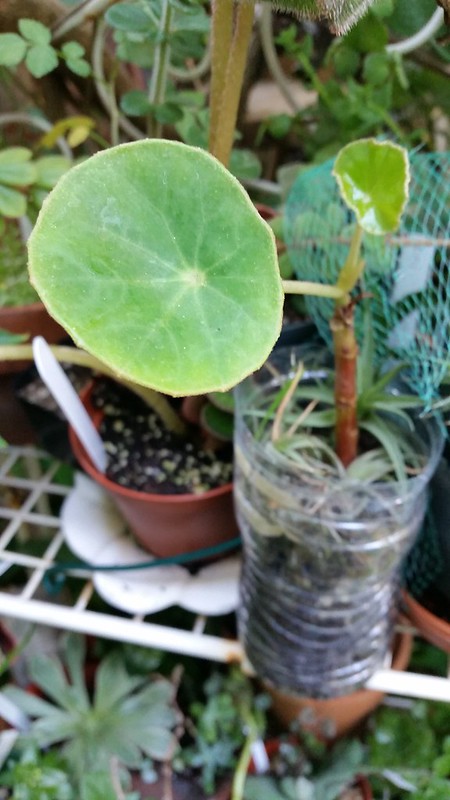
A few years back my best Brazilian friend sent me some seeds of a nice drought tolerant Begonia.  I ended up with around 50 seedlings, one of which I gave to my friend Scadoxus...

Carlos - Carlos = Michelle's Begonia


She said that it hasn't grown much since I gave it to her.  Which is interesting because mine have certainly grown.

Maybe my thumb is greener?  😁  Or maybe I fertilize more?  Perhaps it has something to do with the fact that my area gets warmer than her area.  We both live in SoCal but she's closer to the coast than I am.

It got me thinking.  What if she had sown all the seeds?   In theory, since her area is cooler, the coolest growing seeds would have had an advantage.  So the seedlings she ended up with would have been better adapted to her conditions.

Is this obvious?

Recently I sowed some seeds from two of my Echeveria roseas.  I grabbed 6 hanging baskets/pots that already had well draining medium in them, placed Sphagnum moss on top of the medium and sowed seeds of E. rosea, Columnea Elmer Lorenz, Anthurium scandens, a couple different Rhipsalis and a NOID Sinningia.  I also placed a few pieces of a NOID Peperomia, Pyrossia and Dischidia on top of the moss.  Then I put each basket/pot in a two gallon zip lock bag.  The hanger made a nice teepee with a hole in the top of the bag.  Lastly I put the baskets/pots in two rows of three on a table in the garage under grow lights near an open window.

The Rhipsalis started to germinate the next day, shortly followed by the Anthurium, and then the rest of the seeds started germinating a couple days after.  There was a significant disparity in the number of seeds that have germinated in the pots.  Here's a pot with a bunch of E. rosea seeds that look perfectly viable but haven't yet germinated...


You'll probably have to click on the picture in order to see the seeds.  Here's the pot with the most seedlings in it...


The two pots closest to the window have the most seedlings, the two pots furthest from the window have the least seedlings, and the two pots in the middle have an average amount of seedlings.  It might be a coincidence, but I'm guessing that it has to do with a difference in temperature.  It's marginally cooler closer to the window.  Right after I sowed the seeds it was over 100F each day for a week.  Even though the pots are right next to each other, they are in a small, but significant, continuum of temps.

According to this website, E. rosea is the best Echeveria for the UK.  This means that, not only is it cold tolerant, it's also cooler growing.  Temps over 100F certainly don't count as cool.  Here's where the plot thickens.  I had placed the two blooming roseas right next to other blooming Echeverias  (coccinea, gibbiflora) in order for the hummingbirds to cross pollinate them.  E. coccinea and gibbiflora are warmer growers than rosea.  So in warmer temps, the hybrid rosea seeds would have an advantage over the species rosea seeds.

Here's a pic of a rosea seed just starting to germinate...


You'll have to look closely to see it.

Right now my Epc Cerina 'Nadia' has a nice big seed pod on it…


Here’s what Cerina’s made of...

81.25% = Epi. cinnabarinum
6.25% = Epi. jamiesonis
6.25% = Epi. radicans
3.13% = C. guttata
3.13% = C. luteola

From what I've read, Epi cinnabarinum is a warmer grower with larger flowers.  So it was pretty popular for the reed-stem breeding that was done in Hawaii.  When I asked an Epi grower here in SoCal about Cerina he said that it has never rebloomed for him or produced keikis.  Fortunately, it has for me.  Here’s a pic of a couple of keikis…


Probably the main difference between the Epi grower and myself is that he is right on the coast.  So his conditions are a lot cooler than mine.  The disparity in Cerina’s performance provides some evidence that it does require a decent amount of heat.

Cerina’s flowers are significantly larger than the flowers of typical reed-stems.  Here’s the only pic that I have of them…
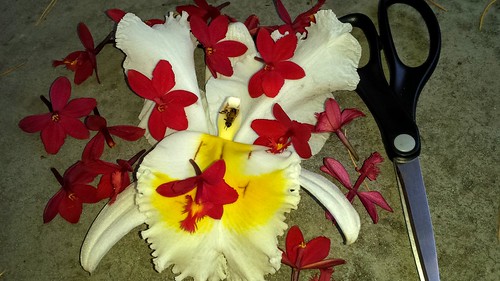

Carnivorous Cattleya


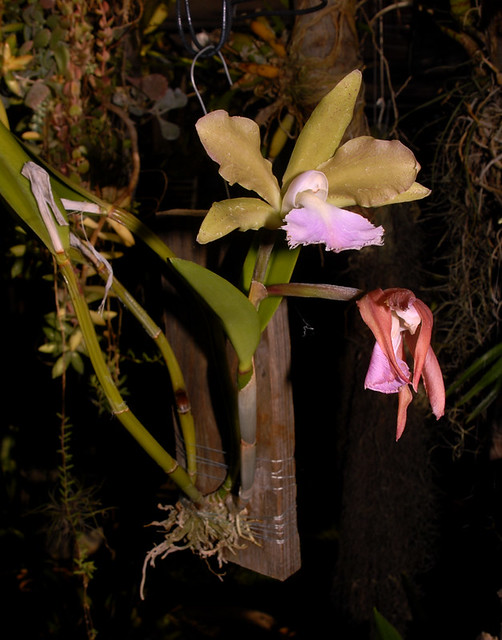
The reason that I removed Cerina’s flowers was to more comfortably/carefully extricate the pollen.  I put the pollen into a small zip lock bag and climbed my tree to pollinate the big floofy white Cattleya.  When I inspected the first flower, I discovered that somebody else had already tried to pollinate it, and had died in the attempt.  I pollinated a couple of other flowers and they developed very large pods.  Unfortunately, when I harvested them, they turned out to be completely empty.  The orchid and I were both tricked.

Cerina’s roots, canes and leaves are also larger than typical reed-stems.  Here’s a side by side comparison of the canes of Cerina and the canes of a typical reed-stem...


The pod that is currently developing on Cerina is hopefully the result of pollen from…

Epi (Pacific Eclipse x Pacific Canary) ‘Yellow Sun’ x Epi magnoliae

Scadoxus purchased it from Sunset Valley Orchids and let me borrow it for pollination.   Its yellow flowers are average sized.  The plant itself is more stocky than the typical reed-stem and the leaves are relatively succulent.  Right now it has a keiki on it with several thick roots.

Epi magnoliae is the Northernmost occurring epiphytic orchid in the Americas.  So it's certainly cold tolerant, but I'm not under the impression that it's a cooler grower.  Andy notes the Florida form as favoring warmer temps.  The other states in which it occurs also have hot summers.

Here's the breakdown for Epi. Pacific Eclipse...

46.88% = Epi. cinnabarinum
39.06% = Epi. radicans
14.06% = Epi. jamiesonis

And for Epi. Pacific Canary...

28.13% = Epi. cinnabarinum
25.0% = na (eh?)
23.44% = Epi. radicans
12.5% = Epi. secundum
10.94% = Epi. jamiesonis

Let's imagine that I split Cerina’s seed pod with Scadoxus.  Hopefully the seeds will be able to germinate without flasking or fungus.  My guess is that cinnabarinum would be pretty influential in the cross.  This should mean that more of my seeds would germinate.  However, this might not be the case if we sowed the seeds in the fall.  Even though my area is warmer than Scadoxus' area in the summer, our temps are more equal in the fall and spring, and my area is actually cooler than hers in the winter.

To keep things simple let's say that Scadoxus and myself each ended up with 50 seedlings out of 1000s and 1000s of seeds.  If we exchanged half our seedlings with each other then I'm guessing that, in my garden, my seedlings would grow faster than her seedlings.  In her garden, her seedlings would grow faster than my seedlings.

Is this obvious?

What really isn't obvious to me is the difference in speed.  I have absolutely no idea how much better my seedlings would do in my conditions compared to her seedlings.  Would the difference in performance be barely noticeable?  Or would it be somewhat noticeable?  Or would it be very noticeable?

To put it in terms of blooming... in my conditions how much sooner would my seedlings bloom than hers?  Would my seedlings bloom a week before hers?  Or a month?  Or a year?

The bigger the difference, the more adaptable the cross is.  The bigger the difference, the more rapidly the cross will conform to its conditions.  Right?

We should all know that orchids are adaptable.  But I've never heard of any experiment or study that has attempted to quantify how adaptable any given orchid is.  Well... maybe I have... Sem and Phylogenetic Analysis of Naturalized and Cultivated Epidendrum in Hawaii (PDF).  In Hawaii, cultivated Epis were compared to naturalized Epis.  It seems that there were some noticeable differences between the two groups.  This is interesting given how relatively short a time that the Epis have been naturalized in Hawaii.

Reed-stems naturalizing in Hawaii isn't a very huge feat.  It would be a very different story if reed-stems naturalized in California.  The time it takes for them to be capable of doing so largely depends on how adaptable they are.

Does it matter to us as orchid growers how adaptable orchids are?  The more adaptable an orchid is, the greater the benefit of growing it from seed yourself.

We've all heard the expression that the apple didn't fall far from the tree.  If orchid seeds don't fall far from their parents, then we can't expect that some seeds will be noticeably better suited to our conditions than other seeds.

Assuming that Cerina’s pod is full of seeds, what should I do with them?  Of course I’d be interested in splitting them with Scadoxus in order to try and measure how adaptable the cross is.  But I’ve also considered the idea of dividing them among the members of this forum.  If there are 10,000 members perhaps each one would receive 10 seeds.  Heh.  The more members that successfully germinated their seeds, the more adaptable the cross is?

In order to get the individuals that are best suited to my conditions, I should sow all the seeds myself.  It’s always better to select from a larger pool of trait combinations.  But what if I divide the seeds among 10 members?  On the one hand, a smaller pool means somewhat less well-adapted seedlings.  On the other hand, if 10 other members also grow the same cross, then… what?

My number one plant rule is to hedge my bets.  The other day, when I inspected one of the pots with E. rosea seedlings, I discovered half a dozen tiny bush snails.  I have no idea how they got in there… but it’s a good thing that I hedged my bets by sowing the seeds in 5 other pots, each in their own ziplock bag.  If I shared Cerina’s seeds with 10 other members, then hopefully I would be able to obtain some seedlings from these members if something happened to mine.  This alone is adequate justification for sharing the seeds.

In terms of making progress though, would there be any benefit to sharing the seeds?  Here’s how I personally define “progress” when it come orchids…

Drier growing (requiring less frequent watering)
Cooler and warmer growing (hercuthermal)

Let’s say that I give 10,000 seeds to my friend Orchid Dude.  If he keeps the seeds/seedlings in one of his greenhouses, then the perfect conditions won’t provide an advantage to the individuals that are exceptionally drier growing and/or hercuthermal.  So if he shares some of his seedlings with me, because something happened to mine, then I’d be glad that I hedged my bets.  But his seedlings probably wouldn’t be very “progressive”, for lack of a better term.

So in terms of maximizing progress, the seeds should be shared with the members whose conditions/culture will favor the most progressive individuals.  In other words, the seeds should be shared with the members who will provide optimally challenging conditions.  Except, the large majority of people with optimally challenging conditions probably aren't members of this forum.  So I'm leaning towards the idea of auctioning off the seeds to forum members in order to raise money to promote the thread dedicated to the project.

Friday, April 29, 2016

Stronger Bees And Smarter Raccoons

Reply to reply: What Are You Carrying?

*******************************************

The problem, as I see it, is that the ability to hold and carry multiple objects isn't limited to humans. - Quokkastan

But I've never argued that humans are the only animals with linvoid1.  I've argued that humans are the most linvoid1.

And humans aren't even necessarily the best at it. - Quokkastan

What animals are more linvoid1 than humans?


You've side-stepped the issue by saying that the mental faculties required to see value in multiple items, in holding on to them, and in combining them in creative ways, also counts.  But that essentially is human intelligence.  An enormous part of it in any case.
So what you're ultimately arguing is that human intelligence created human intelligence. - Quokkastan

I'm arguing that our exceptional intelligence is the result of linvoid3... which is the result of linvoid1.
Take a look at this photo...


Carnivorous Cattleya


The large white flower is from a Cattleya orchid that is growing on my tree.  A honey bee visited the flower and died as a result.  The Cattleya didn't intentionally kill the bee.  There aren't any carnivorous orchids.  The bee entered the flower and got stuck to the orchid's built in "glue".  The bee wasn't able to free itself and died.  If the bee had been able to free itself... then it would have continued deeper into the flower where it would have been rewarded with some nectar... or been tricked?  Some orchids are notoriously deceptive.  In any case, the bee would have turned around and, just as it was about to exit, the flower would have deposited its pollen onto the bee's gluey back.  When the bee entered into the next orchid flower... the pollen on its back would have gotten stuck exactly where the bee had gotten stuck to.

The bee essentially died during sex.  Well... it died while it was attempting to facilitate orchid sex.  The same thing could have been said for me if I had fallen out of the tree while attempting to pollinate the Cattleya.

Neither the orchid nor the bee are native to California or to the US.  The orchid is a hybrid but its ancestors are all native to the Americas.  The bee isn't even native to the Americas.

Maybe you find this story fascinating but you're wondering what it has to do with the evolution of human intelligence.  Well... the bee died because it wasn't strong enough to extricate itself from the flower's sticky part.  This is an example of selection pressure.  In this case... we're not talking about linvoid2 (selecting for intelligence)... we're talking about selecting for strength.  The bee was killed because it was too weak.  It wasn't strong enough to survive the orchid's "gauntlet".

Right now California doesn't have very many people who grow Cattleya orchids outdoors.  This means that the pressure that Cattleyas exert on California bees is vanishingly small.  It's imperceptible.  But we can imagine that... if more and more people in California started growing Cattleyas... the selection pressure would grow more and more perceptible.  More and more bees would be killed by Cattleyas.  If everybody in California had Cattleyas blooming on their trees... would this kill all the bees in California?  Probably... not.

It's a given that no two bees are equally strong.  Why is it a given?  Because "difference" is the very point of sexual reproduction.  "Difference" allows species to hedge their bets.   "Difference" helps species adjust to constantly changing conditions/circumstances.  More and more people growing Cattleyas is an example of changing conditions.  As more and more weaker bees are killed off... more and more exceptionally strong bees would survive to pass on their genetic material... and the population of bees in California would shift accordingly.

It might help to read this passage...

Sex responds instead to a different mandate, which I will call the mandate of genetic diversity.  Evolution requires imperfect reproduction. In simple organisms with extremely large populations, such as bacteria, genetic mutation supplies the necessary imperfection. In species with more limited populations, including most multicellular organisms, mutation does not occur rapidly enough to permit evolution to operate at high enough speeds to allow species to adapt effectively to changing environmental conditions (in particular, to quickly evolving viruses, bacteria, and other parasites). Here sex - the production of offspring through the mixing of genetic material - comes to the rescue. Populations of creatures that reproduce sexually will be far more genetically diverse than populations of similar size that reproduce without such genetic mixing.  When environmental conditions change, it is more likely that some portion of the sexually reproducing population will already carry the genes necessary to deal with that change. In other words, sex allows us to evolve to meet changing conditions more quickly. 
If genetic diversity is adaptive, we ought to observe the mandate of genetic diversity operating in our choice of mates. And we do. Despite sex, we could reproduce more perfectly, and thereby respond more effectively to the mandate of reproduction, by mating with our closest genetic kin - in other words, through incest. The mandate of genetic diversity, however, predicts the evolution of inhibitions to incest; and, indeed, we all carry such inhibitions, both genetic and learned. The mandate of genetic diversity also predicts that our mating choices will be somewhat random; and, indeed, we often fall in love with unexpected, sometimes even objectively unsuitable, partners. As Pascal observed: "Le coeur a ses raisons, que la raison ne connait point." ("The heart has its reasons, of which reason knows not.")  - Theodore P. Seto, Reframing Evil in Evolutionary and Game Theoretic Terms

If, in the future, California has exceptionally strong bees, then the cause would be the exceptional selection pressure that millions of Cattleyas put on the bees.  Are humans exceptionally strong?  Nope.  But we are exceptionally intelligent.  The cause of our exceptional intelligence was linvoid3 (exceptionally large amounts of linvoid2 (selection pressure on intelligence)).

In the example of the Cattleyas and the bees... the bees changed because their circumstances/conditions changed (more and more Cattleyas were grown in California).  But with our early ancestors... linvoid3 wasn't the result of changing conditions... it was the result of our ancestors themselves changing.  They became more and more bipedal.

With all of this in mind... let's take another look at your argument...

You've side-stepped the issue by saying that the mental faculties required to see value in multiple items, in holding on to them, and in combining them in creative ways, also counts.  But that essentially is human intelligence.  An enormous part of it in any case.
So what you're ultimately arguing is that human intelligence created human intelligence. - Quokkastan

We both agree that our ancestors became more and more bipedal.  We also both agree that this helped them to become more linvoid1.  Becoming bipedal freed up their hands and arms to simultaneously carry different resources (linvoid1).  You're under the impression that I'm arguing that our ancestors became more intelligent because they were more intelligent.  But, as you pointed out, this would be a circular reasoning.

What I'm actually arguing is that linvoid1 caused linvoid3.  Walking upright forced our ancestors to confront complex carrying choices.  How many different things would they have wanted to carry with them when they migrated?  Here are some pretty basic things...

- children
- food
- tools
- weapons

Being able to simultaneously carry more than one thing made this problem very complex.  It wasn't a relatively simple problem of children OR food OR tools OR weapons... it was a complex problem of children AND/OR food AND/OR tools AND/OR weapons.

The complexity of this problem resulted in linvoid3.   Whenever anybody went anywhere... they were confronted with a complex math problem.  Individuals that were exceptionally good at solving these complex math problems were more likely to survive and shift the population in the direction of more intelligence.

The complex math problem is, more specifically, a complex economic problem.  The problem is how to allocate resources in order to maximize benefit.

All organisms are confronted with the problem of how to allocate resources... even plants.  The Cattleya on my tree has to decide how to allocate its limited resources between growing and blooming (reproducing).  Insects can allocate more resources than plants can.  This means that insects are confronted with more complex economic problems than plants.  Mammals can allocate more resources than insects can... which means that mammals are confronted with more complex economic problems than insects.  Out of all the mammals... humans can allocate the most resources... which means that humans are confronted with the most complex economic problems.

The more complex the economic problems.... the more intelligence required to solve them.  Humans are the most intelligent animals... which reflects the fact that humans solve the most complex economic problems.  Our ability to solve the most complex problems reflects the fact that we can allocate the most resources.  And what, exactly, allows us to allocate the most resources?  Linvoid1.

In theory we could select for raccoons that are more and more bipedal.  Doing so would make them more linvoid1... which would result in linvoid3 and voila!  Raccoons would be just as intelligent as we are.  The first thing you saw when Seldon resurrected you would be a raccoon checking your vitals.

Tuesday, April 19, 2016

Epiphytic Trial By Neighbors

This last weekend I attached some of my orchids to trees that aren't mine.  No, I didn't do it guerrilla gardening style.  :)

Last year my neighbors on both sides of me expressed interesting in having some orchids.  My neighbor on my left... "Carol"... is from Costa Rica and my neighbor on my right... "Arthur".... is from the Philippines.

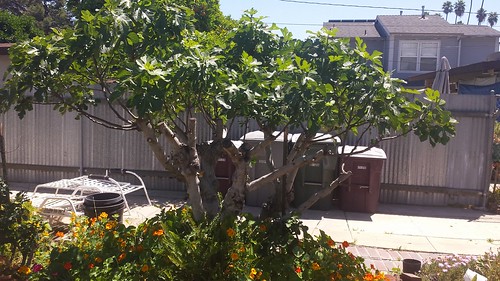
So on Saturday I went over to Carol's place and prepped the hosts.  The main host was an old Ficus carica (common fig) that had been lopped in half.  It had a myriad of smaller branches so I went through and removed lots of them.  I'm hardly an expert at pruning but here are my general rules...

1. No redundant branches
2. No crossing branches
3. No backwards branches

I don't always strictly adhere to these rules.  For example, in this case... I wanted to err on the side of more, rather than less, shade for the newly attached orchids.  Plus, I kept a few "illegal" branches because they were thick enough to provide lots of surface area for some orchid roots.

Here was the result...


Neighbor B's Ficus carica


There are quite a few main branches.... which is nice... but they are a bit on the short side.  Mounting the orchids low is good for appreciating them... but it makes them more accessible to the usual suspects.

After I prepped the Fig tree, I also prepped a pair of really old and overgrown Bougainvilleas.  Ouch, my most of me.

Sunday morning I ate a breakfast of champions... one cold slice of leftover pizza and a warm bowl of oatmeal... and I gathered up a few of my extras...


Epiphytic Trial By Neighbor B


- Oncidium maculatum
- Oncidium NOID
- Laelia anceps
- Brassavola nodosa
- Cattleya walkeriana
- Laeliocattleya Clayton Waglay = Laelia anceps x Cattleya Claesiana (intermedia x loddigesii)
- Myrmecolaelia Ruby Ray = Myrmecophila tibicinis x Laelia undulata
- Brassanthe Maikai = Brassavola nodosa x Guarianthe bowringiana
- Brassocatanthe Little Mermaid = Cattleya walkeriana x Brassanthe Maikai
- Encyvola Gordon Vickers = Brassavola nodosa x Encyclia tampensis
- Brassanthe Bill Worsley = Brassavola nodosa x Guarianthe aurantiaca
- Ascofinetia Twinkle =  Neofinetia falcata x Ascocentrum miniatum
- Oncidium sphacelatum x obryzatoides

I attached the walkeriana, the nodosa and all the nodosa crosses to the two Bougainvilleas.  The rest of the orchids I attached to the Fig tree.  I used 30lb fishing line and the slip knot technique to make sure that the orchids were very firmly attached to the branches.  I didn't include any moss.

When I finished attaching all the orchids I went over to Arthur's place and prepped his tree.  It was also the common Fig tree.  It had less main branches but they hadn't been lopped in half.  After I removed lots of the smaller branches... I went and collected pretty much the same set of orchids...


Epiphytic Trial By Neighbor A


Here were the differences...

- Cattleya walkeriana
- Laeliocattleya Clayton Waglay
+ Rhynchostylis gigantea
+ Vanda NOID

I attached them using the same method.

In terms of instructions... I told Carol and Arthur to use the "shower" setting on their nozzle to thoroughly water the orchids Tuesdays and Saturdays in the evenings during the summer and less frequently and earlier in the day the rest of the year.

Sunday, November 16, 2014

Substantive vs Superficial Selection

When it comes to selection...there seems to be only two categories to choose from...artificial or natural.  But what about when we select for traits that help organisms adapt to nature?  Would we say it's natural selection that's human assisted?  Or artificial selection that's nature assisted?

My comment on Uncommonly early blooming Laelia anceps

*************************************************

The first L. anceps to cross the finish line? What did this guy do for the rest of the year? Cheer on the slow pokes?

The "volunteer" L. anceps on my tree started to put out a second growth back in August...


Laelia anceps


Here's a recent photo...


Laelia anceps volunteer


Given that temps have cooled considerably...and I've reduced water accordingly...not sure how completely the new growth will mature.

My L. anceps was too young to allocate any energy to flowering...but it sure seems theoretically possible to select for a L. anceps that blooms twice a year. The trick would be to cross-pollinate the earliest blooming individuals...which are the fastest and/or the coolest growing individuals. In some cases though they might simply be the luckiest individuals...ie in the warmest and/or most nutritious micro-climates.

But I think it's definitely a good idea if we all feature our orchids that finish the "race" (complete their growth cycle) in record time. Not just with L. anceps but with all epiphytic orchids. For example, this NOID ugly duckling...


Cattleya NOID Early Bloomer Seed Pod Aug 28


...is one of my "fastest" Cattleya alliance orchids. I divided it this year which is why it finished later than usual. Noting which of our orchids are the "fastest" is basically highlighting the individuals that are better adapted to growing outdoors in Southern California. If we all exchange their pollen then we should be able to make much better progress in this area.