Next week, in the Los Angeles Craigslist, I plan to post the following...
******************************
Right now I have a plethora of plants and projects. My plan is to super decentralize them. What, exactly, do I mean by "decentralize"? Basically I want to spread my plants and projects among as many different people as possible. So rather than the plants being "mine"... they will be "ours". This comes with the expectation that, down the road, you will happily share divisions or cuttings or seeds with me if I ask for some.
There are several plants that I have many extras to share. I will primarily start with these. For example...
- Aloe cameronii
- Aloe arborescens variegated
- Epiphyllum oxypetalum (cuttings)
- Epiphyllum strictum (cuttings)
- Solandra maxima (cuttings)
- Tillandsia aeranthos
- Tillandsia tricolepsis
Everyone who visits can freely have any, or all, of these plants... while supplies last. After they are all shared then I'll transition to the plants with less duplicates. Naturally, given that these are fewer in number, I will have to prioritize who I share them with. Here are some of the factors that I will consider...
- Proximity
- Greenness of thumb
- Blogs about plants
- Posts plant photos on Flickr
- Uploads plant videos to Youtube
- Reads my EpiEcon blog
- Helps with the donate-to-vote project
- Shares plants with others
- Promotes growing plants epiphytically
- Likes the Epiphyte Society of Southern California (ESSC) Facebook page
- Likes the Orchid Society of Southern California (OSSC) Facebook page
- Participates in the ESSC Facebook group
- Participates in the SCARPA Facebook group
- Interested in creating phorobanas
- Grows plants from seed
These factors don't all carry the same weight and I will consider other factors as well. Please let me know if you have any questions and I look forward to cultivating many new plant friendships.
******************************
I wanted to post this here on my blog first in order to give any readers in the area an early opportunity to participate.
Showing posts with label hedging. Show all posts
Showing posts with label hedging. Show all posts
Tuesday, June 12, 2018

Monday, June 11, 2018
Please Introduce Me To Awesome Plants!!
Last Saturday I went to the Los Angeles Fern and Exotic Plant Show with my friend Scadoxus. Here are some of the plants that caught my attention...


Please remind me to remind Scadoxus to remind Fernando to harvest the seeds. The same goes for his Begonia thiemei.
Hopefully we should all agree that we need to do the best possible job of introducing each other to awesome plants. Right now I'm thinking that this vital task can be most efficiently and effectively accomplished by using donation voting (DV). Fortunately for us, there are already websites that can facilitate this. For example...
https://www.360photocontest.com/
Organizations, like a local humane society, can create a contest for participants to submit and sort photos...
https://my.360photocontest.com/catwelfare2019calendarcontest/photos?order=Rank
Those photos are sorted by DV ($1 donation = 1 vote). Here are a couple other similar websites...
https://www.gogophotocontest.com/
http://mulabula.com/
Members of various plant societies and forums could submit photos of their favorite plants and we could use DV to rank/sort/order/prioritize them. Naturally in this case it wouldn't be possible to use our donations to criticize the worst plants. Instead, we'd use our donations to help highlight the very best plants. All the money raised would be spent to help promote the results. We would essentially be pooling our money to introduce the most people to the most awesome plants in the least amount of time.

Platycerium alcicorne type
Personally I have a penchant for pendant plants so I tend to prefer Playceriums that match my pendulous preference... such as certain varieties of Platycerium willinckii. The Staghorn in the above picture is the least pendant Platy that I've ever seen. It definitely caught my attention and I have to admit that I kinda like it.

Hoya revolubilis - The Kunming Kina of Southern China
This is easily one of my top five favorite Hoyas. The leaves are relatively succulent and it's a good epiphytic grower. A while back I attached a piece of this and a piece of the somewhat similar, and far more common, Hoya shepherdii to a board covered in New Zealand Sphagnum moss. Both Hoyas established fairly quickly but revolubilis won the competition by a mile. The shepherdii was on its last leg when I took pity on it and moved the mount to the area that I water most frequently.
The revolubilis in the photo is a very impressive specimen. We all like impressive specimens... but... the Epiphyte Society of Southern California (ESSC) has a rule about specimens. Members of the ESSC are allowed to have specimens as long as they have already shared cuttings with all the other members. Share, then specimen. This rule is beneficial in several different ways. First, it helps the plant. No plant wants to have all its eggs in too few baskets. Plants are all about colonization (location diversification). Second, it helps the grower hedge their bets. We have all lost plants for all sorts of reasons so it's really good to have many backups (plant insurance). Third, it helps us learn about our plants faster. The members of the ESSC all live in somewhat different climates, and have thumbs that are different shades of green, and employ different growing techniques. It is very informative and useful to see how the same plant performs in a wide range of conditions. Lastly, we should regularly introduce each other to awesome plants.

Camellia edithae
It's fuzzy! At first glance I guessed that it was an epiphytic blueberry. But I was wrong. I'm generally not so interested in Camellias, although they might be a good host for some orchids. In the case of this Camellia though I might be happy to have one.

Tillandsia flabellata rubra
Hummingbirds love reddish Tillandsias and so do I!

Tillandsia Hybrid
I want this! Even if it's monocarpic? Well... I hate monocarpic plants. But there might be one or two exceptions to this rule. Due to illegible writing I'm not exactly sure about the name of this Tillandsia. It's a hybrid and its name starts with a B.

Lemmaphyllum microphyllum
This isn't the best picture of this enchanting and endearing little epiphytic fern from Japan. As you can see, it's very happily growing in a terrarium. The fern was put in there by the terrarium genius Don DeLano. He's very knowledgeable about plants and he gives great talks at society meetings. At the show I asked him if he's ever tried growing this fern outside. He said that he had but it got killed when the temps dropped below freezing. Given that it's from Japan I was somewhat surprised. Turns out that he was growing it in a pot. My guess is that, here in Southern California where it rains during the winter, epiphytic plants handle the winter cold better when they are mounted, because of the excellent drainage. In my Cedar Tree Epiphytes blog entry I shared this photo of L. microphyllum growing over two stories high on my tree...

Lemmaphyllum microphyllum
It's mounted on several very healthy handfuls of New Zealand Sphagnum moss. When I mounted it I also included a few other plants such as a cutting of Columnea Elmer Lorenz. The fern has done really well but, unlike Microgramma vacciniifolia, it doesn't seem to be able to "escape" its moss island/prison. Even though L. microphyllum isn't an escape artist it is definitely one of my very favorite ferns. Here's another favorite...

Niphidium crassifolium
This epiphytic fern has very long fronds and does quite well outside here in SoCal. Perhaps through no fault of its own I didn't manage to get it established on my Cedar tree, but I do have it growing on a tree fern and on a Pygmy Date Palm. Microsorum punctatum is another strap-leaved epiphytic fern with somewhat shorter fronds which might be more drought tolerant. I do have it growing on my Cedar tree.
At the show I met ESSC member Gumbii for the first time. He has a Youtube channel about plants. While we, along with Scadoxus, were looking at the entries I mentioned that we really should do a video of them. From my perspective even a quick video would be better than nothing. Perhaps we could just highlight our 10 favorite plants in the show. Or, I joked, we could criticize the 10 worst plants in the show. Scadoxus chimed in that at one bromeliad society meeting some guy very badly criticized a plant that a member had brought in for others to appreciate. When the critic asked whose plant it was, the owner didn't even want to admit that it was their plant. Yikes!
After the show Scadoxus and I drove to Fernando's garden in West Covina. While on the way there I was telling her about how I had learned of some new terms for an idea that I've discussed with her many times before. The idea, and one of its terms, is voting with donations. I explained that this is most commonly associated with using donations to decide who will have to kiss a pig, or get pied in the face, or get dunked into a tank of water. Sometimes zoos use this method to name an animal. That's when Scadoxus said something like, "Oh yeah, San Diego Zoo does that. Around 15 years ago I was there with my niece and we made a donation to help name a panda." I responded, "What in the world? Seriously? We've been talking about this idea for so many years (maybe like two) and you're only now just sharing this information with me?!" "You didn't ask me about it," she replied, "...better late than never." Ugh.
When we got to Fernando's place I started to carefully inspect his very impressive collection. From the corner of my eye I spotted a small flash of color. I looked more closely and saw what appeared to be a Pelargonium flower just randomly floating in mid-air...

Pelargonium tetragonum?
It was a nearly leafless pendulous Pelargonium that was growing epiphytically! What?! Have you heard of such a plant? I sure hadn't. So I asked Fernando about it and he said that he's had it for around a decade. What?! How come he hadn't introduced me to this plant? Ugh.
We've all failed, albeit unequally so, to introduce each other to awesome plants. I personally feel like I've failed to introduce enough people to the epiphytic fern Aglamorpha coronans. Here's my attempt to try and solve this problem...
It's so very neat that Aglamorpha coronans has wrapped itself nearly all the way around Fernando's palm tree! The video really doesn't do this fern justice, but I hope that it's better than nothing.
There's actually another Aglamorpha species that's even more impressive than coronans... Aglaomorpha heraclea. It has really huge fronds. I tried to grow it once but it wasn't a fan of our winter. While talking to Darla Harris, the president of the Texas Gulf Coast Fern Society, I mentioned that it would be really awesome if heraclea was crossed with coronans. When the president of the Tree Fern Society, Dan Yansura, joined the conversation, I brought up a few other crosses that should be attempted...
Davallia canariensis x Davallia fejeensis
Nephrolepis pendula x Nephrolepis cordifolia
Not sure how compatible these species are, but ferns are relatively easy to grow from spore. I've personally had good success simply sowing the spore directly on wet floral foam that's in a pot in a zip lock bag. Darla hadn't heard of this method before. Hopefully she'll give it a try.
Fernando had the largest Sinningia that I had ever personally seen...
There's actually another Aglamorpha species that's even more impressive than coronans... Aglaomorpha heraclea. It has really huge fronds. I tried to grow it once but it wasn't a fan of our winter. While talking to Darla Harris, the president of the Texas Gulf Coast Fern Society, I mentioned that it would be really awesome if heraclea was crossed with coronans. When the president of the Tree Fern Society, Dan Yansura, joined the conversation, I brought up a few other crosses that should be attempted...
Davallia canariensis x Davallia fejeensis
Nephrolepis pendula x Nephrolepis cordifolia
Not sure how compatible these species are, but ferns are relatively easy to grow from spore. I've personally had good success simply sowing the spore directly on wet floral foam that's in a pot in a zip lock bag. Darla hadn't heard of this method before. Hopefully she'll give it a try.
Fernando had the largest Sinningia that I had ever personally seen...

Please remind me to remind Scadoxus to remind Fernando to harvest the seeds. The same goes for his Begonia thiemei.
Hopefully we should all agree that we need to do the best possible job of introducing each other to awesome plants. Right now I'm thinking that this vital task can be most efficiently and effectively accomplished by using donation voting (DV). Fortunately for us, there are already websites that can facilitate this. For example...
https://www.360photocontest.com/
Organizations, like a local humane society, can create a contest for participants to submit and sort photos...
https://my.360photocontest.com/catwelfare2019calendarcontest/photos?order=Rank
Those photos are sorted by DV ($1 donation = 1 vote). Here are a couple other similar websites...
https://www.gogophotocontest.com/
http://mulabula.com/
Members of various plant societies and forums could submit photos of their favorite plants and we could use DV to rank/sort/order/prioritize them. Naturally in this case it wouldn't be possible to use our donations to criticize the worst plants. Instead, we'd use our donations to help highlight the very best plants. All the money raised would be spent to help promote the results. We would essentially be pooling our money to introduce the most people to the most awesome plants in the least amount of time.
Wednesday, December 21, 2016
The Number One Plant Rule
My comment on Tom's blog entry: The staghorn fern, Platycerium bifurcatum, a cold hardy subtropical fern
My comment has a bit of spoiler so I recommend reading his entry first!
********************
Wow! Really excellent story! Great info and pics! It was very interesting and entertaining to read about your Platycerium's successes and setbacks. I kept thinking that the "reveal" would be that your Platy was finally killed by an exceptionally cold winter. So the suspense had me sitting on the edge of my seat.
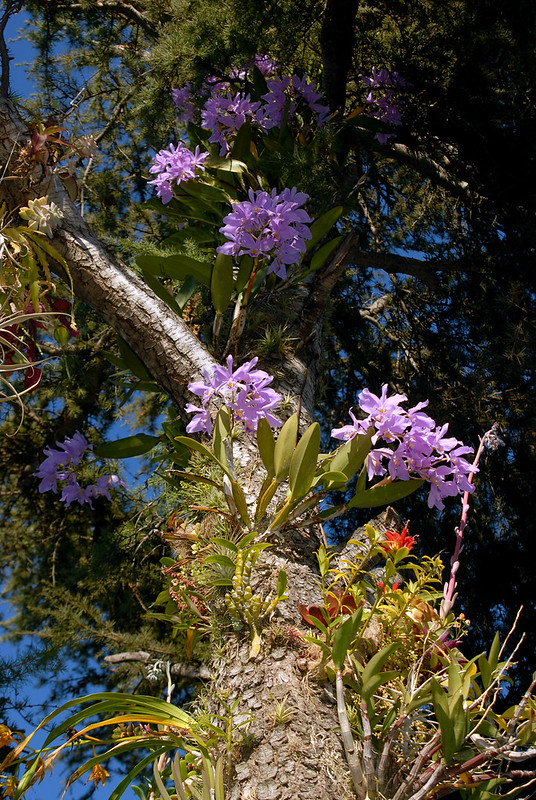
Several years back, thanks to Craigslist, I got a really great deal on an overgrown NOID Cattleya. I divided it and ended up putting divisions on around a dozen different trees. All the divisions quickly established and grew quite well. Each year they all flowered. Then a few years later... my garden got hit by a freeze and around half of the divisions were killed. Some of the causalities were only a foot away from survivors.
This exceptionally cold event confirmed my number plant rule... don't keep all my eggs in one basket. Hedge my bets! No two locations in any garden are going to provide the same exact amount of protection. Every garden has an incredible variety of microhabitats. So if it's a plant that I'd be sad to lose, then I endeavor to maximize my chances of success by hedging my bets.
With this in mind, whenever I share divisions of cherished plants with friends... I be sure to let them know that I'm not being nice or generous or altruistic... I'm simply insuring my plant!
Sharing is caring? Sharing is insuring! So it's a good idea to cultivate a network of strategically situated plant friends! Heh.
Of course for plenty of plant enthusiasts a primary goal is to have an impressive specimen. Which is fine... if the plant has already been adequately insured. But with plenty of plants it's easy enough to propagate them from seed/spore. Just sprinkle some Platy spore on some wet floral foam in a pot... place the pot in a zip lock bag, set it by a window and voila! Your Platy's insured!
The benefit of propagating from seed/spore is that the apple might fall far from the tree in the direction of greater cold tolerance. Progress is a function of difference.
Here's a pic of the Cattleyas a few years ago...
And a relevant quote from the father of modern economics...
My comment has a bit of spoiler so I recommend reading his entry first!
********************
Wow! Really excellent story! Great info and pics! It was very interesting and entertaining to read about your Platycerium's successes and setbacks. I kept thinking that the "reveal" would be that your Platy was finally killed by an exceptionally cold winter. So the suspense had me sitting on the edge of my seat.
Several years back, thanks to Craigslist, I got a really great deal on an overgrown NOID Cattleya. I divided it and ended up putting divisions on around a dozen different trees. All the divisions quickly established and grew quite well. Each year they all flowered. Then a few years later... my garden got hit by a freeze and around half of the divisions were killed. Some of the causalities were only a foot away from survivors.
This exceptionally cold event confirmed my number plant rule... don't keep all my eggs in one basket. Hedge my bets! No two locations in any garden are going to provide the same exact amount of protection. Every garden has an incredible variety of microhabitats. So if it's a plant that I'd be sad to lose, then I endeavor to maximize my chances of success by hedging my bets.
With this in mind, whenever I share divisions of cherished plants with friends... I be sure to let them know that I'm not being nice or generous or altruistic... I'm simply insuring my plant!
Sharing is caring? Sharing is insuring! So it's a good idea to cultivate a network of strategically situated plant friends! Heh.
Of course for plenty of plant enthusiasts a primary goal is to have an impressive specimen. Which is fine... if the plant has already been adequately insured. But with plenty of plants it's easy enough to propagate them from seed/spore. Just sprinkle some Platy spore on some wet floral foam in a pot... place the pot in a zip lock bag, set it by a window and voila! Your Platy's insured!
The benefit of propagating from seed/spore is that the apple might fall far from the tree in the direction of greater cold tolerance. Progress is a function of difference.
Here's a pic of the Cattleyas a few years ago...
And a relevant quote from the father of modern economics...
When a great company, or even a great merchant, has twenty or thirty ships at sea, they may, as it were, insure one another. The premium saved upon them all, may more than compensate such losses as they are likely to meet with in the common course of chances. - Adam Smith, Wealth of Nations
Tuesday, April 19, 2016
Epiphytic Trial By Neighbors
This last weekend I attached some of my orchids to trees that aren't mine. No, I didn't do it guerrilla gardening style. :)
Last year my neighbors on both sides of me expressed interesting in having some orchids. My neighbor on my left... "Carol"... is from Costa Rica and my neighbor on my right... "Arthur".... is from the Philippines.
So on Saturday I went over to Carol's place and prepped the hosts. The main host was an old Ficus carica (common fig) that had been lopped in half. It had a myriad of smaller branches so I went through and removed lots of them. I'm hardly an expert at pruning but here are my general rules...
1. No redundant branches
2. No crossing branches
3. No backwards branches
I don't always strictly adhere to these rules. For example, in this case... I wanted to err on the side of more, rather than less, shade for the newly attached orchids. Plus, I kept a few "illegal" branches because they were thick enough to provide lots of surface area for some orchid roots.
Here was the result...
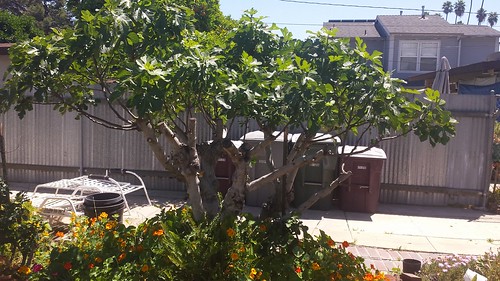
There are quite a few main branches.... which is nice... but they are a bit on the short side. Mounting the orchids low is good for appreciating them... but it makes them more accessible to the usual suspects.
After I prepped the Fig tree, I also prepped a pair of really old and overgrown Bougainvilleas. Ouch, my most of me.
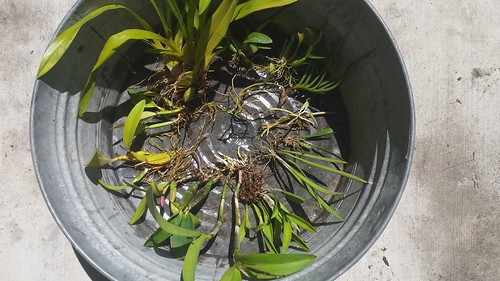
Sunday morning I ate a breakfast of champions... one cold slice of leftover pizza and a warm bowl of oatmeal... and I gathered up a few of my extras...
- Oncidium maculatum
- Oncidium NOID
- Laelia anceps
- Brassavola nodosa
- Cattleya walkeriana
- Laeliocattleya Clayton Waglay = Laelia anceps x Cattleya Claesiana (intermedia x loddigesii)
- Myrmecolaelia Ruby Ray = Myrmecophila tibicinis x Laelia undulata
- Brassanthe Maikai = Brassavola nodosa x Guarianthe bowringiana
- Brassocatanthe Little Mermaid = Cattleya walkeriana x Brassanthe Maikai
- Encyvola Gordon Vickers = Brassavola nodosa x Encyclia tampensis
- Brassanthe Bill Worsley = Brassavola nodosa x Guarianthe aurantiaca
- Ascofinetia Twinkle = Neofinetia falcata x Ascocentrum miniatum
- Oncidium sphacelatum x obryzatoides
I attached the walkeriana, the nodosa and all the nodosa crosses to the two Bougainvilleas. The rest of the orchids I attached to the Fig tree. I used 30lb fishing line and the slip knot technique to make sure that the orchids were very firmly attached to the branches. I didn't include any moss.
When I finished attaching all the orchids I went over to Arthur's place and prepped his tree. It was also the common Fig tree. It had less main branches but they hadn't been lopped in half. After I removed lots of the smaller branches... I went and collected pretty much the same set of orchids...

Here were the differences...
- Cattleya walkeriana
- Laeliocattleya Clayton Waglay
+ Rhynchostylis gigantea
+ Vanda NOID
I attached them using the same method.
In terms of instructions... I told Carol and Arthur to use the "shower" setting on their nozzle to thoroughly water the orchids Tuesdays and Saturdays in the evenings during the summer and less frequently and earlier in the day the rest of the year.
Last year my neighbors on both sides of me expressed interesting in having some orchids. My neighbor on my left... "Carol"... is from Costa Rica and my neighbor on my right... "Arthur".... is from the Philippines.
So on Saturday I went over to Carol's place and prepped the hosts. The main host was an old Ficus carica (common fig) that had been lopped in half. It had a myriad of smaller branches so I went through and removed lots of them. I'm hardly an expert at pruning but here are my general rules...
1. No redundant branches
2. No crossing branches
3. No backwards branches
I don't always strictly adhere to these rules. For example, in this case... I wanted to err on the side of more, rather than less, shade for the newly attached orchids. Plus, I kept a few "illegal" branches because they were thick enough to provide lots of surface area for some orchid roots.
Here was the result...
There are quite a few main branches.... which is nice... but they are a bit on the short side. Mounting the orchids low is good for appreciating them... but it makes them more accessible to the usual suspects.
After I prepped the Fig tree, I also prepped a pair of really old and overgrown Bougainvilleas. Ouch, my most of me.
Sunday morning I ate a breakfast of champions... one cold slice of leftover pizza and a warm bowl of oatmeal... and I gathered up a few of my extras...
- Oncidium maculatum
- Oncidium NOID
- Laelia anceps
- Brassavola nodosa
- Cattleya walkeriana
- Laeliocattleya Clayton Waglay = Laelia anceps x Cattleya Claesiana (intermedia x loddigesii)
- Myrmecolaelia Ruby Ray = Myrmecophila tibicinis x Laelia undulata
- Brassanthe Maikai = Brassavola nodosa x Guarianthe bowringiana
- Brassocatanthe Little Mermaid = Cattleya walkeriana x Brassanthe Maikai
- Encyvola Gordon Vickers = Brassavola nodosa x Encyclia tampensis
- Brassanthe Bill Worsley = Brassavola nodosa x Guarianthe aurantiaca
- Ascofinetia Twinkle = Neofinetia falcata x Ascocentrum miniatum
- Oncidium sphacelatum x obryzatoides
I attached the walkeriana, the nodosa and all the nodosa crosses to the two Bougainvilleas. The rest of the orchids I attached to the Fig tree. I used 30lb fishing line and the slip knot technique to make sure that the orchids were very firmly attached to the branches. I didn't include any moss.
When I finished attaching all the orchids I went over to Arthur's place and prepped his tree. It was also the common Fig tree. It had less main branches but they hadn't been lopped in half. After I removed lots of the smaller branches... I went and collected pretty much the same set of orchids...
Here were the differences...
- Cattleya walkeriana
- Laeliocattleya Clayton Waglay
+ Rhynchostylis gigantea
+ Vanda NOID
I attached them using the same method.
In terms of instructions... I told Carol and Arthur to use the "shower" setting on their nozzle to thoroughly water the orchids Tuesdays and Saturdays in the evenings during the summer and less frequently and earlier in the day the rest of the year.
Saturday, April 9, 2016
Orchid Olympics
Reply to reply: Cool Growers x Warm Growers
***********************************************
Pretty much the saddest story ever... :( :( :( And there are no diminishing returns. Each time I hear this story it's just as sad as the last time I heard it.
I just looked at a map of the US. I guess North Carolina (NC) is a bit below the "mid-Atlantic coast"? Just in case you didn't know... NC is home to the Northernmost occurring epiphytic orchid in North America.... Epidendrum conopseum (EC). But, what are the chances that EC is the most cold tolerant epiphytic orchid in the world? Why should we suspect that EC is more cold tolerant than the Southernmost occurring epiphytic orchid in South America? Why should we suspect that EC is more cold tolerant than the Northernmost occurring epiphytic orchid in Asia? Why should we suspect that EC is more cold tolerant than the Southernmost occurring epiphytic orchid in... Down Under? National pride? "Our soccer team is better than your soccer team... and our epiphytic orchid is more cold tolerant than your epiphytic orchid!"
In another forum a fellow in Tampa was wondering what type of tree he should plant. While digging around for an answer I ran across these two things...
There's a line that marks the Northernmost distribution of EC. This line really isn't static! It's very dynamic. In exceptionally cold years... this line is moved South by many many miles. And maybe in exceptionally warm years... the line is moved North by many many miles. Where was this line 1000 years ago? Where is it 100,000 years ago? Wouldn't it be amazing to see an animation of this line over the past million years? Has EC even been around for that long?
It's a race to Canada! As far as tropical epiphytes are concerned... Pleopeltis polypodioides (PP) is in first place. I think it grows no problem outdoors year around in the mid-Atlantic coast? In second place is Tillandsia usneoides (TU). And in third place is EC.
PP cheats because it got a head start. TU also cheats because birds help carry it. So it's only fair that we (ie you!) help EC cheat. Just go around sowing a gazillion EC seeds in its favorite trees. If enough other people do the same thing then eventually I'll have no problem believing that EC is the most cold tolerant orchid in the world. I'll be swoll with national pride. Well... unless the other countries start doing the same thing.
I guess we'll need to start the orchid Olympics (OO)? Medals for most cold tolerant orchid? And most drought tolerant orchid? And orchid that's most attractive to hummingbirds? Poor Africa will never place in that last event! Well... they do have Disas... but there aren't any terrestrial orchids allowed in the OO!
Lots of accusations of doping? Testing for miracle grow? DNA testing for genetic purity?
Genetic purity is overrated?
What allows EC to make any real progress in the race to Canada? It's the fabulous outliers. Progress depends on difference. More difference means more progress.
Deng Xiaoping was fond of saying that it didn't matter whether the cat was black or white... what mattered was whether it caught mice. Lots of people will probably freak out if I suggest that we (ie you!) deliberately introduce hybrid ECs to the wilds of the mid-Atlantic coast. But nature doesn't care whether an orchid is a species or a hybrid. If nature cares about anything it's survival of the fittest.
Plants don't have a crystal ball. They can't predict exactly how their environment is going to change. Plants can't predict global warming or cooling or drying or wetting. Orchids aren't an exception to this rule. What makes orchids exceptional is that they are really good at hedging their bets. Orchids are really good at producing lots of seeds. A single seed pod can contain a million seeds. Each seed is a different bet... so a million seeds is a lot of different bets. It's a given that all these different bets can't be equally good. Just like ideas can't all be equally good...
It's a bad idea to facilitate the hybridization of EC? Because EC's hybrids will be less adaptable to change? Or because they will be more adaptable to change?
Yeah, your story is truly sad. But there's no reason that it can't have a happy ending! There's no reason that there can't be a wide variety of epiphytic orchids that are happy to grow outdoors year around in the mid-Atlantic coast.
***********************************************
Unfortunately for me I can only grow temperate orchids outside year round. - chibae
Pretty much the saddest story ever... :( :( :( And there are no diminishing returns. Each time I hear this story it's just as sad as the last time I heard it.
I just looked at a map of the US. I guess North Carolina (NC) is a bit below the "mid-Atlantic coast"? Just in case you didn't know... NC is home to the Northernmost occurring epiphytic orchid in North America.... Epidendrum conopseum (EC). But, what are the chances that EC is the most cold tolerant epiphytic orchid in the world? Why should we suspect that EC is more cold tolerant than the Southernmost occurring epiphytic orchid in South America? Why should we suspect that EC is more cold tolerant than the Northernmost occurring epiphytic orchid in Asia? Why should we suspect that EC is more cold tolerant than the Southernmost occurring epiphytic orchid in... Down Under? National pride? "Our soccer team is better than your soccer team... and our epiphytic orchid is more cold tolerant than your epiphytic orchid!"
In another forum a fellow in Tampa was wondering what type of tree he should plant. While digging around for an answer I ran across these two things...
It is interesting to know that for a period of 46 years this orchid has evidently escaped collectors in North Carolina. In a conversation with Professor Oakes Ames last winter he expressed the opinion that the reason for this was perhaps due to the "Big Freeze" of 1888-89 which may have destroyed these plants this far north and thus temporarily moved the limits of its northern range farther south. It is also possible that the position of the orchid high up in the trees may have made it easily overlooked. - Donovan Correll, Epidendrum conopseum in North Carolina
In December 1989, a severe cold front passed through Florida; temperatures reached -5C, killing all the orchids. At other central Florida sites, mortality of Encyclia tampensis was high (>80%). - Ronald J. Larson, Population Dynamics of Encyclia tampensis in Florida
There's a line that marks the Northernmost distribution of EC. This line really isn't static! It's very dynamic. In exceptionally cold years... this line is moved South by many many miles. And maybe in exceptionally warm years... the line is moved North by many many miles. Where was this line 1000 years ago? Where is it 100,000 years ago? Wouldn't it be amazing to see an animation of this line over the past million years? Has EC even been around for that long?
It's a race to Canada! As far as tropical epiphytes are concerned... Pleopeltis polypodioides (PP) is in first place. I think it grows no problem outdoors year around in the mid-Atlantic coast? In second place is Tillandsia usneoides (TU). And in third place is EC.
PP cheats because it got a head start. TU also cheats because birds help carry it. So it's only fair that we (ie you!) help EC cheat. Just go around sowing a gazillion EC seeds in its favorite trees. If enough other people do the same thing then eventually I'll have no problem believing that EC is the most cold tolerant orchid in the world. I'll be swoll with national pride. Well... unless the other countries start doing the same thing.
I guess we'll need to start the orchid Olympics (OO)? Medals for most cold tolerant orchid? And most drought tolerant orchid? And orchid that's most attractive to hummingbirds? Poor Africa will never place in that last event! Well... they do have Disas... but there aren't any terrestrial orchids allowed in the OO!
Lots of accusations of doping? Testing for miracle grow? DNA testing for genetic purity?
Genetic purity is overrated?
As interspecific gene flow is frequent and the new lineages were able to backcross, species cohesion is difficult to accept in orchids. Wherever lays the definition of species boundaries, it is no doubt questionable in orchids making it difficult to establish natural entities. - Yesenia Vega, Isabel Marques , Sílvia Castro, João Loureiro, Outcomes of Extensive Hybridization and Introgression in Epidendrum (Orchidaceae): Can We Rely on Species Boundaries?
What allows EC to make any real progress in the race to Canada? It's the fabulous outliers. Progress depends on difference. More difference means more progress.
Deng Xiaoping was fond of saying that it didn't matter whether the cat was black or white... what mattered was whether it caught mice. Lots of people will probably freak out if I suggest that we (ie you!) deliberately introduce hybrid ECs to the wilds of the mid-Atlantic coast. But nature doesn't care whether an orchid is a species or a hybrid. If nature cares about anything it's survival of the fittest.
Yes, change is the basic law of nature. But the changes wrought by the passage of time affects individuals and institutions in different ways. According to Darwin’s Origin of Species, it is not the most intellectual of the species that survives; it is not the strongest that survives; but the species that survives is the one that is able best to adapt and adjust to the changing environment in which it finds itself. Applying this theoretical concept to us as individuals, we can state that the civilization that is able to survive is the one that is able to adapt to the changing physical, social, political, moral, and spiritual environment in which it finds itself. - Leon C. Megginson
Plants don't have a crystal ball. They can't predict exactly how their environment is going to change. Plants can't predict global warming or cooling or drying or wetting. Orchids aren't an exception to this rule. What makes orchids exceptional is that they are really good at hedging their bets. Orchids are really good at producing lots of seeds. A single seed pod can contain a million seeds. Each seed is a different bet... so a million seeds is a lot of different bets. It's a given that all these different bets can't be equally good. Just like ideas can't all be equally good...
Individual decision making is closely connected to creativity not because all choices are excellent, but because they constitute a broad field out of which the best responses can emerge. If we wished to establish a connection to Darwinian ideas, we could say that the wide spectrum of decisions is similar to the field of the spontaneous variations of living things from which the pressure of natural selection preserves only the most apt. Without such experimental structures and behaviours, responses remain stagnant and life sinks under the weight of institutionalised routine. Freedom multiplies actions and ideas, some of which turn out to be brilliant and others fundamentally flawed. The important fact, however, is that few if any of them could have occurred under conditions of enforced conformity. To leave people alone with their projects is to permit - even to encourage - the exercise of private imaginations. - John Lachs
It's a bad idea to facilitate the hybridization of EC? Because EC's hybrids will be less adaptable to change? Or because they will be more adaptable to change?
Yeah, your story is truly sad. But there's no reason that it can't have a happy ending! There's no reason that there can't be a wide variety of epiphytic orchids that are happy to grow outdoors year around in the mid-Atlantic coast.
Saturday, December 13, 2014
Herclivation
Backstory: The Ghost Orchid, Dendrophylax lindenii, is an endangered orchid that grows on trees in the Florida Everglades (plants that grow on trees are epiphytes). I've been fleshing out a theoretical, process based approach... "herclivation"...that could potentially facilitate this orchid's adaptive radiation into different (micro)habitats. This approach would involve introducing its hybrids (ie Gripp's Ghost) and/or closely related species into Southern Florida. Again, this is simply a theory. Let me make it very clear...I do not advocate or support the illegal introduction of plants or animals outside of their native habitats. My hope here is to facilitate constructive feedback, expert or otherwise, on why this plan might not be feasible. Given enough eyeballs, all bugs are shallow (Linus's Law).
This blog entry is a reply to a couple replies in this forum thread... A Different Way To Protect The Ghost Orchid
*********************************************************
lotis146, good lord is right! You're on the 7th page? This is only the second page for me. Either you like clicking page numbers and waiting for pages to load...or nobody told you that you that you can change your settings in order to view more posts per page.
This blog entry is a reply to a couple replies in this forum thread... A Different Way To Protect The Ghost Orchid
*********************************************************
lotis146, good lord is right! You're on the 7th page? This is only the second page for me. Either you like clicking page numbers and waiting for pages to load...or nobody told you that you that you can change your settings in order to view more posts per page.
Monday, December 8, 2014
A Controversial Approach To Protecting Florida's Ghost Orchid
Reply to Hybrid Wish List
If you'd like Dendrophylax lindenii x funalis to be more readily available then please vote here... Dendrophylax lindenii x Dendrophylax funalis (more tolerant Ghost Orchid)
**********************************************
Catt Mandu, you added me to your ignore list and in return I'm going to...not add you to my ignore list. For some reason I don't think that I'd be doing myself any favors by ignoring people who I disagree with. Perhaps it's because I've studied fallibilism enough to accept the fact that it's entirely possible that I'm wrong about most things.
Even though you're not going to see my reply (unless you log out and view this thread)...I'm going to reply to you anyways. You brought up some points and I'm going to attempt to adequately address the relevant ones. This being a public forum and all.
Is it far-fetched that introduced pythons would unintentionally crush Florida's Ghost Orchid (Dendrophylax lindenii) into extinction? Perhaps a bit. But I don't think it's far fetched that the introduction of a new predator could somehow indirectly harm (or benefit) the Ghost Orchid. If you bothered to read and were able to understand the passage* by Darwin that I shared earlier, then you wouldn't think it's far fetched either.
Of course you could argue that pythons should never have been introduced in the first place. Just like you could argue that humans should never have caused global warming. But extinctions occurred long before us humans appeared on the scene and they will continue to occur long after we're gone. Change is a constant...it benefits some and harms others.
Generally speaking, the narrower an organism's environmental parameters...the more likely it is to be adversely impacted by change. And as I, and many others, can personally attest to... the Ghost Orchid is, relatively speaking, very easy to kill. Dendrophylax funalis, by comparison, is much more tolerant of a wider range of conditions. It will happily grow outdoors year around in warmer parts of Southern California.
Let me break this argument down...
Premise 1: Species with narrower parameters are more likely to be harmed by change.
Premise 2: The Ghost Orchid has very narrow parameters.
Conclusion: The Ghost Orchid is more likely to be harmed by change (ie climate).
In order to help protect the Ghost Orchid...assuming that this is something that we want to do...there are two possible approaches...
Either the mountain goes to Mohammed, or Mohammed goes to the mountain.
The current approach to conservation is to try and undo some of the damage that we've done to the planet. The problem is that we're all responsible for the damage but only a very small group of people are genuinely and actively concerned with undoing the damage. In order for significant progress to be made there would have to be a massive mobilization of significant resources. And these resources, like all resources, could be put to other uses. Maybe even more valuable uses. This is the fundamentally important economic concept known as "opportunity cost".
From my perspective, it would behoove us to seriously consider the merits of the internal approach. With the internal approach we would acknowledge that it's dangerous for overly specialized epiphytic orchids to be adapted to conditions which no longer exist. The Florida that the Ghost Orchid is adapted to no longer exists and will never exist again. If we want this orchid to continue to survive, then we should seriously consider helping it to adapt to the conditions that do exist.
Early in this thread I acknowledged that this approach isn't "conservation" as we know it. The best term that I've been able to come up with for this internal approach is "herclivation". Of course anybody is welcome to come up with a better term. "Herclivation" is loosely derived from "Heraclitus"...the Greek philosopher who argued that change is the one constant... "no man ever steps in the same river twice".
Herclivation of the Ghost Orchid would involve introducing a cross between D. lindenii and funalis into the wild. Out of curiosity I looked this cross up on the RHS website and found it... Polyphylax Gripp's Ghost. It took a couple tries to find it because the RHS has "Polyradicion" listed as the genus for lindenii rather than "Dendrophylax".
Here's a very brief breakdown of their habitat preferences...
D. lindenii prefers more humidity/shade while D. funalis prefers less humidity/shade. The differences in their preferences could result in hybrids with a continuum of humidity/shade preferences. This general situation was briefly considered in the book, "The Botany of Orchids"...
Given that both lindenii and funalis occur in Jamaica, this exact situation might happen on its own. Or maybe their populations are too small and far apart for it to happen naturally. (Not sure what led me to believe that lindenii also occurs in Jamaica). Or maybe they have different pollinators.
The Ghost Orchid is pollinated by the Giant Sphinx moth (Cocytius antaeus) but I wasn't able to learn whether or not it also pollinates funalis. Funalis has a shorter spur than lindenii. It stands to reason though that a moth with a long proboscis (straw) would have no problem drinking nectar from an orchid with a short spur (cup).
It's a given that there's some variation in spur and straw length. Both the moth and the Ghost Orchid probably didn't simultaneously and independently develop their long appendages over night. Most likely moths with longer straws had greater fitness because they could drink from a greater range of cup sizes.
Does Gripp's Ghost have an intermediately sized spur? It's not that easy to discern, but in this picture of Gripp's Ghost it does appear that the spur is somewhat intermediate in length. I'm sure that some of the seedlings from that cross had longer or shorter spurs... depending on which parent they inherited the relevant traits from.
If we introduced a "highly variable hybrid swarm" of Gripp's Ghost to Florida then this would increase the chances of finding variations that match some of the available environmental conditions.
Hopefully there would be a variation for the half a million acres of Florida orange groves. This variation would have to combine lindenii's preference for shade and funalis' tolerance of dryness. Maybe a slightly different variation would be suitable for Florida Christmas tree farms. How awesome would that be to purchase a Christmas tree with live orchids growing on it? It would be really hard top the Ghost Orchid as an ornament. Talk about value added. Errrr... well... Jack Skellington would certainly approve. And maybe Charles Dickens as well.
Florida's Ghost Orchid, as it is, already has some degree of variation. But do we really want to gamble its existence on the slim chance that it has enough variation to succeed in modern Florida? Why not hedge our bets by greatly increasing the amount of variation that it has?
Rather than just having one Ghost Orchid...Florida could have a wide variety of them. We could give them labels based on their niche type. The original/current ghost orchid would be the Shady Cypress Ghost Orchid...then there would be the Sunny Cypress Ghost Orchid...and the Orange Ghost Orchid...and the Christmas Ghost Orchid...and the Limestone Ghost Orchid...and so on.
Would it matter to some kid in Florida two hundred years from now that the Ghost Orchid he discovered flowering on the mango tree in his backyard was different than the Ghost Orchid that was adapted to prehistoric Florida? I really don't think so. And neither would whichever moth benefited from the orchid's nectar. Both the moth and the kid would linger longer in the garden as a direct result of the Ghost Orchid blooming on the mango tree. Perhaps with newfangled video technology the kid could easily and professionally document the moth pollinating the orchid. Not sure though if his video would be as high quality as my video of a hummingbird hawk-moth pollinating phlox in Afghanistan...
Like I stated in the beginning, it's entirely possible that I'm wrong. Maybe herclivation isn't the best approach. But it's based on the fundamentally sound principle that we should avoid putting too many eggs in one basket...
Right now the Ghost Orchid is intwo baskets (Florida and Jamaica) three baskets (Florida, Cuba and the Bahamas) which means that it's safer than if it was just in one basket. By this same basic principle...it would be safer if it grew in a wider range of habitat types. This could be accomplished by crossing it with D. funalis and other closely related species. Introducing a "highly variable hybrid swarm" into suitable habitats in Florida would help us hedge our bets against unforeseen changes.
Again, I'm not saying that herclivation is the right answer...I'm just saying that it deserves serious consideration.
**********************************************
*plants and animals, most remote in the scale of nature, are bound together by a web of complex relations. [...] I have [...] reason to believe that humble-bees are indispensable to the fertilisation of the heartsease (Viola tricolor), for other bees do not visit this flower. From experiments which I have tried, I have found that the visits of bees, if not indispensable, are at least highly beneficial to the fertilisation of our clovers; but humble-bees alone visit the common red clover (Trifolium pratense), as other bees cannot reach the nectar. Hence I have very little doubt, that if the whole genus of humble-bees became extinct or very rare in England, the heartsease and red clover would become very rare, or wholly disappear. The number of humble-bees in any district depends in a great degree on the number of field-mice, which destroy their combs and nests; and Mr. H. Newman, who has long attended to the habits of humble-bees, believes that 'more than two thirds of them are thus destroyed all over England.' Now the number of mice is largely dependent, as every one knows, on the number of cats; and Mr. Newman says, 'Near villages and small towns I have found the nests of humble-bees more numerous than elsewhere, which I attribute to the number of cats that destroy the mice.' Hence it is quite credible that the presence of a feline animal in large numbers in a district might determine, through the intervention first of mice and then of bees, the frequency of certain flowers in that district! - Charles Darwin, The Origin of Species
If you'd like Dendrophylax lindenii x funalis to be more readily available then please vote here... Dendrophylax lindenii x Dendrophylax funalis (more tolerant Ghost Orchid)
**********************************************
Catt Mandu, you added me to your ignore list and in return I'm going to...not add you to my ignore list. For some reason I don't think that I'd be doing myself any favors by ignoring people who I disagree with. Perhaps it's because I've studied fallibilism enough to accept the fact that it's entirely possible that I'm wrong about most things.
Even though you're not going to see my reply (unless you log out and view this thread)...I'm going to reply to you anyways. You brought up some points and I'm going to attempt to adequately address the relevant ones. This being a public forum and all.
Is it far-fetched that introduced pythons would unintentionally crush Florida's Ghost Orchid (Dendrophylax lindenii) into extinction? Perhaps a bit. But I don't think it's far fetched that the introduction of a new predator could somehow indirectly harm (or benefit) the Ghost Orchid. If you bothered to read and were able to understand the passage* by Darwin that I shared earlier, then you wouldn't think it's far fetched either.
Of course you could argue that pythons should never have been introduced in the first place. Just like you could argue that humans should never have caused global warming. But extinctions occurred long before us humans appeared on the scene and they will continue to occur long after we're gone. Change is a constant...it benefits some and harms others.
Generally speaking, the narrower an organism's environmental parameters...the more likely it is to be adversely impacted by change. And as I, and many others, can personally attest to... the Ghost Orchid is, relatively speaking, very easy to kill. Dendrophylax funalis, by comparison, is much more tolerant of a wider range of conditions. It will happily grow outdoors year around in warmer parts of Southern California.
Let me break this argument down...
Premise 1: Species with narrower parameters are more likely to be harmed by change.
Premise 2: The Ghost Orchid has very narrow parameters.
Conclusion: The Ghost Orchid is more likely to be harmed by change (ie climate).
In order to help protect the Ghost Orchid...assuming that this is something that we want to do...there are two possible approaches...
- Change the conditions to match the Ghost Orchid's preferences.
- Change the Ghost Orchid's preferences to match the conditions.
Either the mountain goes to Mohammed, or Mohammed goes to the mountain.
The current approach to conservation is to try and undo some of the damage that we've done to the planet. The problem is that we're all responsible for the damage but only a very small group of people are genuinely and actively concerned with undoing the damage. In order for significant progress to be made there would have to be a massive mobilization of significant resources. And these resources, like all resources, could be put to other uses. Maybe even more valuable uses. This is the fundamentally important economic concept known as "opportunity cost".
From my perspective, it would behoove us to seriously consider the merits of the internal approach. With the internal approach we would acknowledge that it's dangerous for overly specialized epiphytic orchids to be adapted to conditions which no longer exist. The Florida that the Ghost Orchid is adapted to no longer exists and will never exist again. If we want this orchid to continue to survive, then we should seriously consider helping it to adapt to the conditions that do exist.
Early in this thread I acknowledged that this approach isn't "conservation" as we know it. The best term that I've been able to come up with for this internal approach is "herclivation". Of course anybody is welcome to come up with a better term. "Herclivation" is loosely derived from "Heraclitus"...the Greek philosopher who argued that change is the one constant... "no man ever steps in the same river twice".
Herclivation of the Ghost Orchid would involve introducing a cross between D. lindenii and funalis into the wild. Out of curiosity I looked this cross up on the RHS website and found it... Polyphylax Gripp's Ghost. It took a couple tries to find it because the RHS has "Polyradicion" listed as the genus for lindenii rather than "Dendrophylax".
Here's a very brief breakdown of their habitat preferences...
Species of Dendrophylax occur from sea level to about 1600m (D. macrocarpus (Dod) Carlsward & Whitten). Many are found in shaded sites with high humidity on tree trunks (D. lindenii) but may also be found in xeric habitats of shrubs or small trees (D. porrectus) or on limestone rocks (D. funalis). - Alec M. Pridgeon, Phillip J. Cribb, Mark W. Chase, Genera Orchidacearum Volume 6: Epidendroideae
D. lindenii prefers more humidity/shade while D. funalis prefers less humidity/shade. The differences in their preferences could result in hybrids with a continuum of humidity/shade preferences. This general situation was briefly considered in the book, "The Botany of Orchids"...
Cutting of forests and the planting of tree crops in the tropics may provide intermediate habitats which permit the survival of hybrids between orchid species which grow in distinct niches. An example would be that of populations of plants which grow in sun and others which grow in shade and are thereby ecologically isolated. Filtered sun in agricultural plantings might support intermediate hybrids. The hybrids may backcross with the parental types and may cross among themselves. The result would be a highly variable hybrid swarm. Recombination types might be more successful than either of the previous species. - Calaway H. Dodson, Robert J. Gillespie, The Botany of Orchids
The Ghost Orchid is pollinated by the Giant Sphinx moth (Cocytius antaeus) but I wasn't able to learn whether or not it also pollinates funalis. Funalis has a shorter spur than lindenii. It stands to reason though that a moth with a long proboscis (straw) would have no problem drinking nectar from an orchid with a short spur (cup).
It's a given that there's some variation in spur and straw length. Both the moth and the Ghost Orchid probably didn't simultaneously and independently develop their long appendages over night. Most likely moths with longer straws had greater fitness because they could drink from a greater range of cup sizes.
Does Gripp's Ghost have an intermediately sized spur? It's not that easy to discern, but in this picture of Gripp's Ghost it does appear that the spur is somewhat intermediate in length. I'm sure that some of the seedlings from that cross had longer or shorter spurs... depending on which parent they inherited the relevant traits from.
If we introduced a "highly variable hybrid swarm" of Gripp's Ghost to Florida then this would increase the chances of finding variations that match some of the available environmental conditions.
Hopefully there would be a variation for the half a million acres of Florida orange groves. This variation would have to combine lindenii's preference for shade and funalis' tolerance of dryness. Maybe a slightly different variation would be suitable for Florida Christmas tree farms. How awesome would that be to purchase a Christmas tree with live orchids growing on it? It would be really hard top the Ghost Orchid as an ornament. Talk about value added. Errrr... well... Jack Skellington would certainly approve. And maybe Charles Dickens as well.
Florida's Ghost Orchid, as it is, already has some degree of variation. But do we really want to gamble its existence on the slim chance that it has enough variation to succeed in modern Florida? Why not hedge our bets by greatly increasing the amount of variation that it has?
Rather than just having one Ghost Orchid...Florida could have a wide variety of them. We could give them labels based on their niche type. The original/current ghost orchid would be the Shady Cypress Ghost Orchid...then there would be the Sunny Cypress Ghost Orchid...and the Orange Ghost Orchid...and the Christmas Ghost Orchid...and the Limestone Ghost Orchid...and so on.
Would it matter to some kid in Florida two hundred years from now that the Ghost Orchid he discovered flowering on the mango tree in his backyard was different than the Ghost Orchid that was adapted to prehistoric Florida? I really don't think so. And neither would whichever moth benefited from the orchid's nectar. Both the moth and the kid would linger longer in the garden as a direct result of the Ghost Orchid blooming on the mango tree. Perhaps with newfangled video technology the kid could easily and professionally document the moth pollinating the orchid. Not sure though if his video would be as high quality as my video of a hummingbird hawk-moth pollinating phlox in Afghanistan...
Like I stated in the beginning, it's entirely possible that I'm wrong. Maybe herclivation isn't the best approach. But it's based on the fundamentally sound principle that we should avoid putting too many eggs in one basket...
First, diversity often enhances the robustness of complex systems. By robustness, I mean the ability to maintain functionality (Jen 2005) rather than analytic stability. Systems that lack diversity can lose functionality. History has many examples of failure through lack of diversity, the potato famine being among the most notable. The potato must be counted among the most precious of gifts introduced into Europe during the age of exploration. Of the thousands of varieties of potato grown in Central and South America at their disposal, the Europeans imported primarily two. This lack of genetic variation presented a huge target for parasites. When the potato blight hit, it found field up field of genetically similar potatoes. Though nearly a million Irish perished, even more relocated to America. Diversity at the community level - America had a different mix of crops from Ireland - minimized the global impact of the blight. Had every country been subsisting on potatoes as Ireland had, the famine would have been an even worse calamity.
Second, diversity drives innovation and productivity. In biology, the forces of mutation and recombination are well known to be primary sources of innovation. In economies, variation and experimentation also lead to innovation, and, as Arthur (2009) convincingly shows, so does recombination. In fact, recombination may be the biggest driver of economic and scientific innovation. As for productivity, I've covered some of this terrain in an earlier book (Page 2007a), but it's worth repeating. Whether one looks at ecosystems, empires, or cities, greater diversity for the most part correlates with greater productivity. Cities that are more diverse are more productive and more innovative. - Scott E. Page, Diversity and Complexity
Luckily, tens of thousands of pioneers wouldn't have to be housed all in one starship. Spreading people out among multiple ships also spreads out the risk. Modular ships could dock together for trade and social gatherings, but travel separately so that disaster for one wouldn't spell disaster for all, says Smith.
When 10,000 people are housed in one starship, there's a potential for a giant catastrophe to wipe out almost everyone onboard. But when 10,000 people are spread out over five ships of 2000 apiece, the damage is limited. - Sarah Fecht, How Many People Does It Take to Colonize Another Star System?
When a great company, or even a great merchant, has twenty or thirty ships at sea, they may, as it were, insure one another. The premium saved upon them all, may more than compensate such losses as they are likely to meet with in the common course of chances. - Adam Smith, Wealth of Nations
Farming is inherently risky. Weather, insects and disease, over which you have limited control or none at all, can wipe you out. One of the ways farmers manage risk is to plant variety. Okay, powdery mildew got your strawberries, but the broccoli’s going gangbusters. For farmers, crops that are given guaranteed protection from both losses and price drops are lower-risk propositions. - Brian Stauffer, Farm bill: Why don’t taxpayers subsidize the foods that are better for us?
Right now the Ghost Orchid is in
Again, I'm not saying that herclivation is the right answer...I'm just saying that it deserves serious consideration.
**********************************************
*plants and animals, most remote in the scale of nature, are bound together by a web of complex relations. [...] I have [...] reason to believe that humble-bees are indispensable to the fertilisation of the heartsease (Viola tricolor), for other bees do not visit this flower. From experiments which I have tried, I have found that the visits of bees, if not indispensable, are at least highly beneficial to the fertilisation of our clovers; but humble-bees alone visit the common red clover (Trifolium pratense), as other bees cannot reach the nectar. Hence I have very little doubt, that if the whole genus of humble-bees became extinct or very rare in England, the heartsease and red clover would become very rare, or wholly disappear. The number of humble-bees in any district depends in a great degree on the number of field-mice, which destroy their combs and nests; and Mr. H. Newman, who has long attended to the habits of humble-bees, believes that 'more than two thirds of them are thus destroyed all over England.' Now the number of mice is largely dependent, as every one knows, on the number of cats; and Mr. Newman says, 'Near villages and small towns I have found the nests of humble-bees more numerous than elsewhere, which I attribute to the number of cats that destroy the mice.' Hence it is quite credible that the presence of a feline animal in large numbers in a district might determine, through the intervention first of mice and then of bees, the frequency of certain flowers in that district! - Charles Darwin, The Origin of Species
Sunday, September 28, 2014
Orchid Seeds Available For Flasking
A few years ago I sowed various orchid seeds on my tree. Much to my pleasant surprise some of them actually germinated. Right now there are around half a dozen seedlings left...down from around two dozen. The largest seedling looks a lot like Laelia anceps...and I'm guessing that's what the rest are as well.
Seeing the tiny green blobs on my tree motivated me to try and pollinate more orchids. Unfortunately I haven't noticed any new protocorms on the tree. Not sure why that is. It might be because the year the seeds germinated we received more than twice the usual amount of rain. Perhaps the extra rain created a fungus feeding frenzy. Or maybe it's because I haven't sown any L. anceps seeds since then. Last year I failed to adequately hedge my bets so none of the L. anceps flowers that I pollinated developed pods. But I've also sown a few other orchid seeds in baskets/mounts and some have germinated.
This year I've been especially consistent with pollination and as a result there are quite a few pods in various stages of development. But because symbiotic germination hasn't been consistent...I'd like to hedge my bets by sharing orchid seeds with anybody interested in flasking them. Bet hedging, from my perspective, is by far the most important plant lesson.
My primary breeding goal is to make progress in terms of drought tolerance. It would be wonderful if there were more and more orchids that could thrive with less and less water. This is especially relevant here in parched Southern California. So over the past several years my primary purchasing criteria has been drought tolerance.
How much progress can be made in terms of drought tolerance? Not exactly sure...but I do know that there's always room for improvement. The orchid family's success is the direct result of each seed pod containing a multitude of chances to discover where there's room for improvement. In other words...orchids are really good at hedging their bets.
My secondary breeding goal is to make progress in terms of temperature tolerance. Most drought tolerant orchids are warm growers. I plan on crossing them with my early growers. The result will hopefully be drought tolerant orchids with a wider range of growing temps.
Basically, my overall goal is to select for orchids that are better suited to Southern California. This means selecting for individuals that are more Mediterranean. I'm pretty sure that the orchid family's gene pool is large enough to develop an epiphytic orchid that can thrive here without any supplemental water. When will this orchid be developed? That depends on the quantity of different trait combinations that are thrown at Southern California. More combinations mean less time.
Here are some pods that are available or will be available...starting with those that have been pollinated with pollen from Psychilis krugii...which is many of them.
Besides being drought tolerant (growing on a cactus)...P. krugii blooms all summer long. It successively/sequentially blooms on the same spike. As soon as one flower starts to fade...another starts to open. Having an extended blooming period is another example of bet hedging. It increases the chances that some seeds will be dispersed when conditions are sufficiently suitable. Personally, I really enjoy having an orchid that stays in bloom for so long. The flowers aren't very showy though...so it would be nice if some of the crosses were also successive bloomers but had larger and/or more colorful flowers.
I'm guessing though that the sequential blooming trait will not be dominant...especially since P. krugii isn't the pod parent. So the first generation will probably have to be crossed back onto P. krugii in order for the successive blooming trait to express itself in some of the second generation crosses.
Here are some of the orchids that I've pollinated with P. krugii pollen...
Bc Maikai?
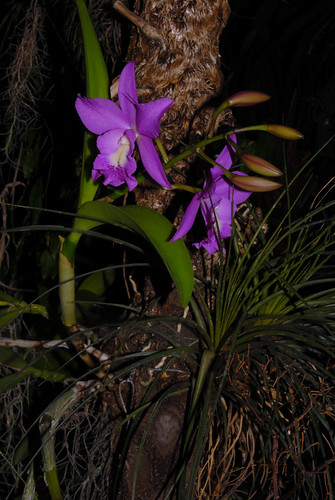
Pollinated Sept 2
Pod Sept 13
Brassavola Jiminy Cricket (Rhyncholaelia digbyana x Brassavola nodosa)
Pollinated Aug 19
Pod Aug 26
Brassavola nodosa
Pod Aug 26
Cat NOID Early Grower
Pollinated Aug 26
Flower and Pod Aug 28
Pod Sept 13
Anybody recognize this NOID Cattleya? I bought it out-of-bloom for cheap. When I saw the flowers for the first time I was a bit disappointed. They are kinda homely. But then it dawned on me that this Cattleya is one of my very first orchids to complete its growth cycle. This earned it more than a few points and TLC. I divided it this past spring which is why it bloomed later than it usually does. What happens when this C-I-W grower is crossed with a successively blooming warm grower? Perhaps future generations will have a longer blooming period than P. krugii does? Can we eventually select for an orchid that's always in bloom?
Cattleytonia Why Not 'Roundabout' (Guarianthe aurantiaca x Broughtonia sanguinea)
Pod Aug 26
Pod Sept 10 (harvested same day)
Lc Clayton Waglay var alba (Laelia anceps x C. Claesiana (C. intermedia x C. loddigesii))
Pod Aug 26
Pod Sept 13
The three orchids that make up Lc Clayton Waglay...the one Mexican Laelia and two Brazilian Bifoliate Cattleyas...are some of the very best orchids for Southern California. It shouldn't be a surprise that Clayton Waglay is a really strong grower here. Hopefully adding P. krugii to the mix will result in an even stronger grower.
Potinara Hoku Gem
Pollinated Aug 19
Pod and flower Aug 26
Pod Sept 13
Failed pods...
Caulocattleya Chantilly Lace 'Hildos' (Cattleya El Dorado Splash x Caularthron bicornutum)
Pollinated Aug 19
Pod Aug 28
Aborted Sept 2
Encyclia NOID
Pollinated Aug 11
Pod Aug 28
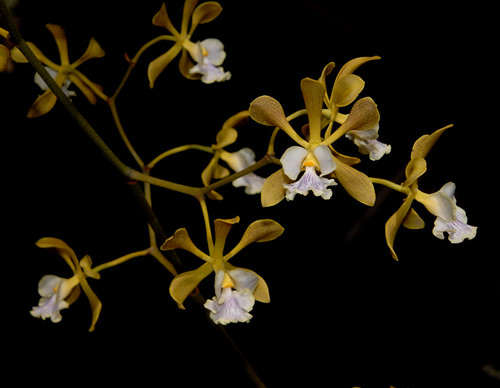
Anybody recognize this Encyclia? Context...
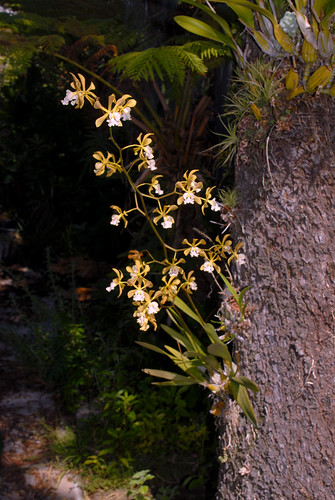
Close up...
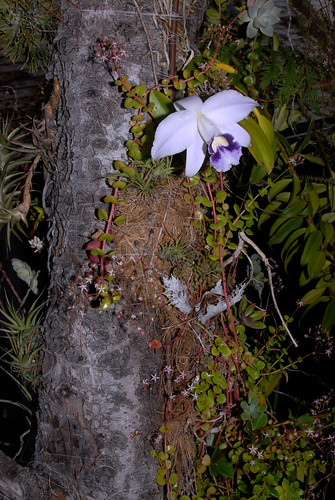
Laelia pumila coerulea
Pollinated Aug 26
Pod Sept 13
Aborted Oct 1
Rhyncholaelia digbyana
Pod Aug 26
Pod Sept 13
Harvested Sept 25
Why the really long pod? It must have lengthened after I pollinated it...right? But why? And when exactly did it start lengthening? It doesn't make much sense for the Rhyncholaelia to waste energy increasing the distance of the race course after somebody has already reached the finish line. It makes more sense to increase the course distance before anybody has reached the finish line. Making the selection process even more difficult would help ensure that the winner was fit enough...at least in terms of endurance. Given that this pod didn't have any seeds...perhaps none of the P. krugii pollen managed to reach the finish line.
Other pods...
Aerides? NOID
Pods Aug 28
Harvested Sept 17
Pretty sure that the Hummingbird pollinated it. No other monopodials were blooming at the same time...so definitely a self.
Angraecum Longiscott (longicalcar x scottianum)
1st flower - Angraecum calceolus and Vanda suavis - Aug 11
2nd flower - Cyrtorchis chailluana - Aug 19
3rd flower - N. falcata and Aerangis mystacidii - Sept 4
The first two flowers didn't develop pods...but the third has. Another example of hedging.
Pod Sept 13
Bc Maikai? x Brassavola nodosa
Pollinated Aug 27
Pod Sept 13
Brassavola nodosa x Cattleya harrisoniae
Pod Aug 26
Brassavola Jiminy Cricket x Bc Maikai?
Pollinated Sept 2
Cattleya harrisoniae x (B. nodosa and P. krugii)
Pod Sept 13
Cattleya Penny Kuroda x (Mexican Laelias, Lc Clayton Waglay var alba, P. krugii)
Pods Group A Context Aug 26
Pods Group A Aug 26
Pods Group A Sept 13
Pods Group B Aug 26
Pods Group B Sept 13
There were two pseudobulbs that had around a dozen flowers each. I pollinated around half the flowers on each spike and half of those have developed.
Dendrobium phaleonopsis? x Dendrobium Gatton Sunray (pulchellum x Illustre (chrysotoxum x pulchellum))
Context
Pod Aug 26
Dendrobium phaleonopsis? x Dendrobium hercoglossum
See above
Dendrobium phaleonopsis? x Dendrobium moschatum
See above
Epidendrum radicans spontaneous
A friend of mine has quite a few different colored Reed Stem Epidendrums. Last week, with his permission, I harvested a dozen ripe seed pods.
Lc Clayton Waglay var alba x Cattleya Penny Kuroda
Pod Aug 26
Pod Sept 13
Neofinetia falcata x _______
This N. falcata had one spike with four flowers. One Sept 4 I pollinated all of the flowers...one flower with fresh Angraecum Longiscott pollen, one flower with fresh Aerangis mystacidii pollen, one flower with not-so-fresh Mystacidium capense pollen and one flower with old Phalaenopsis pollen. Another example of hedging.
Here's a photo of the flowers on Sept 13. As you can see, only one flower developed a pod. Which of the four donors would you prefer to be responsible for the pod? Can you guess who is actually responsible for the pod?
Psychilis krugii spontaneous
My P. krugii isn't very large...so I prefer it to channel its energy into producing pollen rather than seeds. But I guess it was the hummingbird that thought differently. I could have removed the pod before it developed...but I decided not to step on the hummingbird's tiny toes. The pod might not be a self because around a foot away an Encyclia spontaneously developed a pod at around the same time.
Failed pods...
Encyclia NOID x Brassavola nodosa
Pod Aug 28
Pod Sept 13
Encyclia NOID x (Mexican Laelias, Cattleyas)
Three Pods Sept 13
On Aug 27 I pollinated nearly every flower with a mix of pollen from Mexican Laelias and Cattleyas. Given that only three pods took...I'm guessing that the Mexican Laelias pollen was too old. And given that the Cattleya pollen largely consisted of relatively fresh Penny Kuroda pollen...I wouldn't be surprised if that is who is responsible for these three pods. Unfortunately all three pods recently aborted.
For some reason it seems like I haven't had very much success with Encyclia intergeneric pollination. Earlier in the year I had two very nice Encyclia cordigera var roseas bloom. If I remember correctly I tried crossing them with Mexican Laelia pollen but pods didn't even form. Same thing with Encyclia Orchid Jungle, Encyclia fowliei and a few others. It's pretty good incentive to keep better track of pollination efforts. That way I can avoid wasting good pollen on the wrong orchids.
A recent pollination...
Epidendrum viviparum x Epidendrum secundum
Pollinated Sept 19
There are also quite a few spiking orchids that I plan to pollinate...
Hopefully my consistent pollination streak will continue and I'll have pods for days.
Anybody interested in some seeds? If so, just private message me your e-mail and I'll add it to a notification list. Whenever I harvest a pod I'll send an e-mail to the list. If you'd like to flask the seeds then you'd simply reply to the e-mail. Should demand exceed supply...priority will be based on the following criteria...
Seeing the tiny green blobs on my tree motivated me to try and pollinate more orchids. Unfortunately I haven't noticed any new protocorms on the tree. Not sure why that is. It might be because the year the seeds germinated we received more than twice the usual amount of rain. Perhaps the extra rain created a fungus feeding frenzy. Or maybe it's because I haven't sown any L. anceps seeds since then. Last year I failed to adequately hedge my bets so none of the L. anceps flowers that I pollinated developed pods. But I've also sown a few other orchid seeds in baskets/mounts and some have germinated.
This year I've been especially consistent with pollination and as a result there are quite a few pods in various stages of development. But because symbiotic germination hasn't been consistent...I'd like to hedge my bets by sharing orchid seeds with anybody interested in flasking them. Bet hedging, from my perspective, is by far the most important plant lesson.
My primary breeding goal is to make progress in terms of drought tolerance. It would be wonderful if there were more and more orchids that could thrive with less and less water. This is especially relevant here in parched Southern California. So over the past several years my primary purchasing criteria has been drought tolerance.
How much progress can be made in terms of drought tolerance? Not exactly sure...but I do know that there's always room for improvement. The orchid family's success is the direct result of each seed pod containing a multitude of chances to discover where there's room for improvement. In other words...orchids are really good at hedging their bets.
My secondary breeding goal is to make progress in terms of temperature tolerance. Most drought tolerant orchids are warm growers. I plan on crossing them with my early growers. The result will hopefully be drought tolerant orchids with a wider range of growing temps.
Basically, my overall goal is to select for orchids that are better suited to Southern California. This means selecting for individuals that are more Mediterranean. I'm pretty sure that the orchid family's gene pool is large enough to develop an epiphytic orchid that can thrive here without any supplemental water. When will this orchid be developed? That depends on the quantity of different trait combinations that are thrown at Southern California. More combinations mean less time.
Here are some pods that are available or will be available...starting with those that have been pollinated with pollen from Psychilis krugii...which is many of them.
Besides being drought tolerant (growing on a cactus)...P. krugii blooms all summer long. It successively/sequentially blooms on the same spike. As soon as one flower starts to fade...another starts to open. Having an extended blooming period is another example of bet hedging. It increases the chances that some seeds will be dispersed when conditions are sufficiently suitable. Personally, I really enjoy having an orchid that stays in bloom for so long. The flowers aren't very showy though...so it would be nice if some of the crosses were also successive bloomers but had larger and/or more colorful flowers.
I'm guessing though that the sequential blooming trait will not be dominant...especially since P. krugii isn't the pod parent. So the first generation will probably have to be crossed back onto P. krugii in order for the successive blooming trait to express itself in some of the second generation crosses.
Here are some of the orchids that I've pollinated with P. krugii pollen...
Bc Maikai?
Pollinated Sept 2
Pod Sept 13
Brassavola Jiminy Cricket (Rhyncholaelia digbyana x Brassavola nodosa)
Pollinated Aug 19
Pod Aug 26
Brassavola nodosa
Pod Aug 26
Cat NOID Early Grower
Pollinated Aug 26
Flower and Pod Aug 28
Pod Sept 13
Anybody recognize this NOID Cattleya? I bought it out-of-bloom for cheap. When I saw the flowers for the first time I was a bit disappointed. They are kinda homely. But then it dawned on me that this Cattleya is one of my very first orchids to complete its growth cycle. This earned it more than a few points and TLC. I divided it this past spring which is why it bloomed later than it usually does. What happens when this C-I-W grower is crossed with a successively blooming warm grower? Perhaps future generations will have a longer blooming period than P. krugii does? Can we eventually select for an orchid that's always in bloom?
Cattleytonia Why Not 'Roundabout' (Guarianthe aurantiaca x Broughtonia sanguinea)
Pod Aug 26
Pod Sept 10 (harvested same day)
Lc Clayton Waglay var alba (Laelia anceps x C. Claesiana (C. intermedia x C. loddigesii))
Pod Aug 26
Pod Sept 13
The three orchids that make up Lc Clayton Waglay...the one Mexican Laelia and two Brazilian Bifoliate Cattleyas...are some of the very best orchids for Southern California. It shouldn't be a surprise that Clayton Waglay is a really strong grower here. Hopefully adding P. krugii to the mix will result in an even stronger grower.
Potinara Hoku Gem
Pollinated Aug 19
Pod and flower Aug 26
Pod Sept 13
Failed pods...
Caulocattleya Chantilly Lace 'Hildos' (Cattleya El Dorado Splash x Caularthron bicornutum)
Pollinated Aug 19
Pod Aug 28
Aborted Sept 2
Encyclia NOID
Pollinated Aug 11
Pod Aug 28
Anybody recognize this Encyclia? Context...
Close up...
Laelia pumila coerulea
Pollinated Aug 26
Pod Sept 13
Aborted Oct 1
Rhyncholaelia digbyana
Pod Aug 26
Pod Sept 13
Harvested Sept 25
Why the really long pod? It must have lengthened after I pollinated it...right? But why? And when exactly did it start lengthening? It doesn't make much sense for the Rhyncholaelia to waste energy increasing the distance of the race course after somebody has already reached the finish line. It makes more sense to increase the course distance before anybody has reached the finish line. Making the selection process even more difficult would help ensure that the winner was fit enough...at least in terms of endurance. Given that this pod didn't have any seeds...perhaps none of the P. krugii pollen managed to reach the finish line.
Other pods...
Aerides? NOID
Pods Aug 28
Harvested Sept 17
Pretty sure that the Hummingbird pollinated it. No other monopodials were blooming at the same time...so definitely a self.
Angraecum Longiscott (longicalcar x scottianum)
1st flower - Angraecum calceolus and Vanda suavis - Aug 11
2nd flower - Cyrtorchis chailluana - Aug 19
3rd flower - N. falcata and Aerangis mystacidii - Sept 4
The first two flowers didn't develop pods...but the third has. Another example of hedging.
Pod Sept 13
Bc Maikai? x Brassavola nodosa
Pollinated Aug 27
Pod Sept 13
Brassavola nodosa x Cattleya harrisoniae
Pod Aug 26
Brassavola Jiminy Cricket x Bc Maikai?
Pollinated Sept 2
Cattleya harrisoniae x (B. nodosa and P. krugii)
Pod Sept 13
Cattleya Penny Kuroda x (Mexican Laelias, Lc Clayton Waglay var alba, P. krugii)
Pods Group A Context Aug 26
Pods Group A Aug 26
Pods Group A Sept 13
Pods Group B Aug 26
Pods Group B Sept 13
There were two pseudobulbs that had around a dozen flowers each. I pollinated around half the flowers on each spike and half of those have developed.
Dendrobium phaleonopsis? x Dendrobium Gatton Sunray (pulchellum x Illustre (chrysotoxum x pulchellum))
Context
Pod Aug 26
Dendrobium phaleonopsis? x Dendrobium hercoglossum
See above
Dendrobium phaleonopsis? x Dendrobium moschatum
See above
Epidendrum radicans spontaneous
A friend of mine has quite a few different colored Reed Stem Epidendrums. Last week, with his permission, I harvested a dozen ripe seed pods.
Lc Clayton Waglay var alba x Cattleya Penny Kuroda
Pod Aug 26
Pod Sept 13
Neofinetia falcata x _______
This N. falcata had one spike with four flowers. One Sept 4 I pollinated all of the flowers...one flower with fresh Angraecum Longiscott pollen, one flower with fresh Aerangis mystacidii pollen, one flower with not-so-fresh Mystacidium capense pollen and one flower with old Phalaenopsis pollen. Another example of hedging.
Here's a photo of the flowers on Sept 13. As you can see, only one flower developed a pod. Which of the four donors would you prefer to be responsible for the pod? Can you guess who is actually responsible for the pod?
Psychilis krugii spontaneous
My P. krugii isn't very large...so I prefer it to channel its energy into producing pollen rather than seeds. But I guess it was the hummingbird that thought differently. I could have removed the pod before it developed...but I decided not to step on the hummingbird's tiny toes. The pod might not be a self because around a foot away an Encyclia spontaneously developed a pod at around the same time.
Failed pods...
Encyclia NOID x Brassavola nodosa
Pod Aug 28
Pod Sept 13
Encyclia NOID x (Mexican Laelias, Cattleyas)
Three Pods Sept 13
On Aug 27 I pollinated nearly every flower with a mix of pollen from Mexican Laelias and Cattleyas. Given that only three pods took...I'm guessing that the Mexican Laelias pollen was too old. And given that the Cattleya pollen largely consisted of relatively fresh Penny Kuroda pollen...I wouldn't be surprised if that is who is responsible for these three pods. Unfortunately all three pods recently aborted.
For some reason it seems like I haven't had very much success with Encyclia intergeneric pollination. Earlier in the year I had two very nice Encyclia cordigera var roseas bloom. If I remember correctly I tried crossing them with Mexican Laelia pollen but pods didn't even form. Same thing with Encyclia Orchid Jungle, Encyclia fowliei and a few others. It's pretty good incentive to keep better track of pollination efforts. That way I can avoid wasting good pollen on the wrong orchids.
A recent pollination...
Epidendrum viviparum x Epidendrum secundum
Pollinated Sept 19
There are also quite a few spiking orchids that I plan to pollinate...
- Aerangis somalensis
- Ascofinetia Twinkle?
- Barkeria lindleyana
- Cattleya Portia coerulea
- Dendrobium bigibbums
- Dendrobium canaliculatum hybrid
- Encyclia pyriformis
- Laelia anceps
- Lc. Bowri-albida (Cattleya bowringiana x Laelia albida)
- Microcoelia exilis
- Neostylis?
- Schomburgkia splendida v cauca
Hopefully my consistent pollination streak will continue and I'll have pods for days.
Anybody interested in some seeds? If so, just private message me your e-mail and I'll add it to a notification list. Whenever I harvest a pod I'll send an e-mail to the list. If you'd like to flask the seeds then you'd simply reply to the e-mail. Should demand exceed supply...priority will be based on the following criteria...
- Return on Investment (ROI). Not unlike the Parable of the Talents.
- Bribes. There are numerous drought tolerant epiphytic orchids that I don't have.
- Public documentation. Blogging and/or posting in forums about your flasking technique will earn you points.
- Flasking experience.
- SoCal residents.
- Outdoor growers.
- Members of the Epiphyte Society, ESSC or OSSC.
Any questions? Let me try and guess a couple...
Can you buy seeds? Sure, everything has a price.
Can you have the seeds professionally flasked? Yup.
Subscribe to:
Posts (Atom)