Sunday, November 30, 2014

Monday, November 24, 2014

Natural Orchid Hosts (Phorophytes)

Every once in a while I'll run across a reference to an orchid species growing on a certain species of tree or shrub in nature.  I've recently started to enter these associations into a database.  Wish I had started earlier but...better late than never!

I figured that I might as well share this list on my blog.   It's a little rough around the edges and it's probably always going to be a work in progress.  But I'm hoping that sharing it publicly will help generate interest and help facilitate contributions.   If you happen to run across a natural association that isn't listed here...please share it in a comment.  Given enough eyeballs all associations can be found.

There are three types of natural associations that I'm especially interested in...
  1. Associations of the most commonly grown orchid species...such as Dendrobium nobile, Laelia anceps, Vanda coerulea, etc. 
  2. Associations of the most commonly grown trees here in Southern California...Jacaranda, Camphor, Floss silk, etc.
  3. Associations that occur in drier habitats

Ideally, this list will help people decide which trees to plant.  Whether or not a tree is a good orchid host should be the number one consideration.  Then again, I might be a little biased.

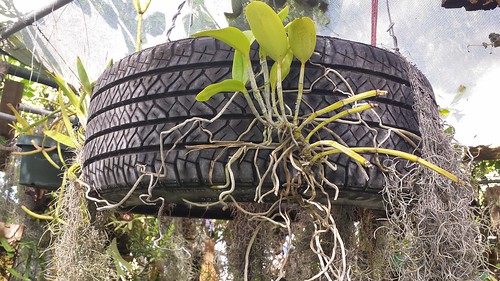
To be clear, this list is exclusively for natural associations.  In cultivation, orchids can be attached to and will grow on a wide range of hosts that they wouldn't necessarily choose in nature.  For example, here's a photo of a Cattleya orchid that's been growing on a tire for several years...


Cattleya Orchid Mounted On Tire


I'm pretty sure that this Cattleya would prefer to grow on some of the phorophytes listed here.

Documenting natural associations is important because it indicates which hosts orchid seeds were able to germinate on.  So not only are these hosts suitable for orchids...they are also suitable for the fungi that the orchid seeds need to germinate.

If we plant plenty of preferred phorophytes, then we can help ensure an abundance of orchids and their fungal partners.  Kinda like selecting plants in order to attract bees, butterflies and hummingbirds.  You would just plant the phorophyte and swoosh...orchids would quickly swarm it like brilliant butterflies.   Are there any phorophytes that will attract both orchids and butterflies?    Are there any orchids that attract butterflies?

As many of us know all too well...there's a wide range of animals that love to eat orchids.  So planting the best phorophytes won't only lead to an abundance of orchids...it will also lead to an abundance of animals that eat the orchids.  Not to mention the animals that pollinate the orchids or use them for shelter.  This in turn will lead to an abundance of the animals that eat the animals that associate with the orchids that grow on the phorophytes that you planted.  Basically, the best phorophytes will have a large multiplier effect on biodiversity.  The most relevant technical term is "facilitation cascade".  My term for this is "linger longer".  Visitors to your garden will have more subjects to photograph.

Another relevant technical term that I also recently learned from the New Zealand Epiphyte Network blog is "synanthrophic" (or... "synanthropic"?).  It refers to plants and animals that benefit from human environments.  Kirby's blog entry highlighted a study that found that mistletoes in Poland preferred growing on non-native city trees.  While googling around for "syanthropic" I found this entry... Synanthropic Habitats.  According to the Expanded Environment's website... it's a non-profit organization...
...devoted to demonstrating alternate ways of responsibly and synthetically integrating biological and ecological agents into the built world. Its goal is to assist governments, municipalities, provinces, organizations, businesses, and individuals to understand, appreciate and envision a more productive relationship between architectural and biological systems for a better and more sustainable world.
What an awesome mission!  Promoting the proliferation of preferred phorophytes should be right up their alley.

Unfortunately, many of these phorophytes aren't readily available in cultivation.  Hopefully we can work together to try and help remedy this problem.  If you grow any of these phorophytes then please share cuttings and/or seeds with others.


********************************************

Wednesday, November 19, 2014

Epiphyte Forum?

My thread over at the ant plant forum... Temperature Tolerant Epiphytic Ant Plants

*****************************************************

My first post!  I'm going to attach a few epiphytes (topics) to this branch (thread).

I found out about this forum a few months ago on ebay.  I probably did a search for "Myrmecodia" but I can't remember exactly which vendor it was that mentioned this forum in the item's description.

Epiphytic ant plants are awesome so it was pretty great to learn about this place.  I immediately added it to my long list of plant forum bookmarks and every once in a while I lurked around.  It's been on my "to do" list to register and I finally got around to it.

A little bit about me... I live in Glendale, Southern California and I LOVE epiphytes!  I grow a wide variety of epiphytes outdoors year around.  Last year I posted a short blog entry on some of my ant plants... Epiphytic Ant Plants Outdoors in Southern California?  

I think it would be really helpful if there was a comprehensive list of epiphytic ant plants (EAPs) that could be grown outdoors year around in places like Southern California.  How many EAPs don't require a greenhouse in SoCal?  Is it a long list?  If this list was compiled and widely disseminated... then more people would grow EAPs.  Wouldn't you like to walk around SoCal and see EAPs growing on lots of trees?  I know I would!

Now, like I said, I think this forum is great...but there's not much activity.  I'm definitely biased but maybe a better strategy would have been to start an epiphyte forum instead?  Then you could have had a category dedicated to APs.  I'm pretty sure that many of you grow other epiphytes besides APs...right?  Any of you grow any epiphytic blueberries...aka "Ericas"?

I sure wouldn't be surprised if my friend Dave started a forum dedicated to Ericas.  He really loves them.  But how much activity would it have though?  Maybe less activity than this forum?  But Dave doesn't just grow Ericas...he also grows a bunch of other epiphytes...ferns, orchids, Gesneriads, Tillandsias, Bromeliads, APs, Anthuriums, Hoyas, Dischidias, Rhipsalis, Peperomias...it's a long list.

In theory, a forum with all these groups would be quite active.  And it's a given that there would be plenty of spillover.  Lateral movement is super easy.  Plenty of epiphytic plants are quite happy growing in a moss basket.  So it seems likely that the individual groups would grow much faster together than if they were apart.  Not sure though how large a group would have to be to support its own forum.   Clearly the orchid group is already large enough.  It's large enough to support several forums.  Haven't visited the bromeliad forum very much lately so not sure how active it's been.

How would the categories be sorted in an epiphyte forum?  Alphabetically?  If so, then the ant plants would be at the top of the list!

The simplest approach to starting an epiphyte forum would be to just use this forum.  The domain name wouldn't have to change...just the title and description.  Rather than "the ant plant forum" it would be "the epiphyte forum".  Then you would move all the EAP threads into one category.  Lastly you would change the names of the current categories.  Voila!

When people registered...they'd basically be registering for a dozen forums rather than just one...

Ant plants
Aroids
Ascleps
Bromeliads
Cactus
Ericas
Ferns
Gesneriads
Melastomas
Misc
Orchids
Peperomias

And when people told their friends about this forum...they wouldn't just be promoting one group...they'd be promoting twelve groups.  It should generate twelve times the interest.

Perhaps Selby would be twelve times more likely to help spread the word?

Basically you catch more fish with a larger net.  Which is why you should all start blogs if you haven't already done so!
Sunday, November 16, 2014

Substantive vs Superficial Selection

When it comes to selection...there seems to be only two categories to choose from...artificial or natural.  But what about when we select for traits that help organisms adapt to nature?  Would we say it's natural selection that's human assisted?  Or artificial selection that's nature assisted?

My comment on Uncommonly early blooming Laelia anceps

*************************************************

The first L. anceps to cross the finish line? What did this guy do for the rest of the year? Cheer on the slow pokes?

The "volunteer" L. anceps on my tree started to put out a second growth back in August...


Laelia anceps


Here's a recent photo...


Laelia anceps volunteer


Given that temps have cooled considerably...and I've reduced water accordingly...not sure how completely the new growth will mature.

My L. anceps was too young to allocate any energy to flowering...but it sure seems theoretically possible to select for a L. anceps that blooms twice a year. The trick would be to cross-pollinate the earliest blooming individuals...which are the fastest and/or the coolest growing individuals. In some cases though they might simply be the luckiest individuals...ie in the warmest and/or most nutritious micro-climates.

But I think it's definitely a good idea if we all feature our orchids that finish the "race" (complete their growth cycle) in record time. Not just with L. anceps but with all epiphytic orchids. For example, this NOID ugly duckling...


Cattleya NOID Early Bloomer Seed Pod Aug 28


...is one of my "fastest" Cattleya alliance orchids. I divided it this year which is why it finished later than usual. Noting which of our orchids are the "fastest" is basically highlighting the individuals that are better adapted to growing outdoors in Southern California. If we all exchange their pollen then we should be able to make much better progress in this area.

Friday, November 14, 2014

Salvation Army For Plants?

Comment on PATSP blog entry... Anthurium News: The Bad News

************************************************

I agree with Paul regarding the media...but not so much with regards to the composting. A while back I purchased a cheap NOID out of bloom orchid. When it bloomed for the first time I was rather disappointed with the flowers. You can see a pic of the flowers here. But I kept it around anyways. After a while I realized that it's one of the first of my gazillion orchids to complete its growth cycle. Basically, it suffers from a shortage of style but it's blessed with an abundance of substance. Now it's got a fat seed pod on it filled with around a million seeds. Eventually I might have a large variety of epiphytic orchids that grow all year long outdoors here in Southern California.

Even if some of your Anthuriums are short on both style and substance...it doesn't necessarily mean that they will be short on substance in other people's conditions. Plus, style is certainly subjective. So if the opportunity cost of keeping them around is too high...then I'd recommend just giving them away. I'd be happy to take some off your hands for the cost of postage. Or I could trade you some orchid seeds. :)

For a while now I've wondered about the viability of a Salvation Army just for plants. What do you think? Could it would work? Would you be willing to drop off a couple flats of Anthurium seedlings for a small tax deduction?

Wednesday, November 12, 2014

Tropical Texas Orchid Reserve

Reply to thread... Tampa Florida outdoor growing

*************************************************

CA2FLxplant, you don't miss Van Nuys?  hehe.  How much better could central Florida really be?

Actually I sometimes dream about moving to the Southernmost part of Texas.  It's almost tropical there.  I'd like to buy a bunch of acres and start an orchid reserve dedicated to the conservation and proliferation of CAM epiphytic orchids.  I'd attach a gazillion orchids to the trees and let nature select for the most drought/temperature tolerant individuals.  The goal would be to try and move the fittest individuals across the country via reasonably sized "steps".  

Here in California it's too big of a leap for epiphytic orchids to naturalize.   All epiphytic orchids are summer growers... but here they'd have to adapt to being winter growers.  Plus, it's a numbers game...the more seeds you throw at nature the more progress can be made.  And I just don't have enough trees here to throw seeds at. It's not like I can walk around the neighborhood sowing orchid seeds on street trees.  Well...I could...but then I'd probably have to explain to people why I was watering their trees.

Florida could work pretty well but Texas is nice because it's centrally located.  Plus, ideally, there would be a satellite location a few hours drive across the border into Mexico.  This would help function as "insurance".  Kind of like an external hard drive to back up important files (orchids).  If the main computer (Texas reserve) crashed (500 year freeze) then the most important files (orchids) could be easily restored.    

Eventually every botanical garden in the US would have orchids growing on their trees!  I think there's a chance that it might happen anyways...but I'd prefer if it happened sooner rather than later.

I didn't buy those flasks!  Did you?  Unfortunately the same flask is available again for the same way too reasonable price!

Please let me know if you decide to cross everything with E. tampensis and sow the seeds on every tree.  I'd love to hear all about it.  I'm really curious how readily the seeds of E. tampensis (both the species and its hybrids) germinate on trees in Florida.  If they don't readily germinate...then it's either because the precipitation/temperature wasn't adequate...or the necessary fungus wasn't present.  The absence of the necessary fungus would definitely be a problem.  The solution would be to try and proliferate the fungus by attaching inoculated orchids to trees.  I'm under the impression that orchid roots help the fungus colonize a tree.  The more a fungus has colonized a tree...the more likely it is that the spores will land on adjacent trees.  I have no idea how many orchids would have to be attached to trees in order for the virtuous cycle to be "jump-started".  But you're probably on the right track when your neighbors mention that they have random orchids growing on their trees.

It's possible that other epiphytic plants besides orchids help to spread the necessary fungus.  At the end of August my friend brought back a piece of Pyrrosia piloselloides from either Thailand or Cambodia. She gave me a small division and I attached it to a section of old trellis wood covered in New Zealand Sphagnum. I stuck part of the mount at an angle in a pot filled with bark and topped with a layer of Sphagnum. So the fern is both potted and mounted. Kinda hedged my bets. I thoroughly watered the fern and then I sowed some monopodial orchid seeds all over the surface of both the pot and the mount. The seeds were from...

P. vandarum x V. tricolor
R. imschootiana x R. gigantea?

Lastly I stuck the pot/mount in a zip lock bag under lights in my garage. The bag isn't completely sealed.

The fern quickly started to grow and last week I spotted one fat protocorm right next to the fern. It was just starting to put out its first leaf...which now looks a little wide for a vandarum cross. But perhaps the tricolor leaf is dominant.

I'm guessing that the orchid seed germinated as the result of fungus from the fern root. Although, the fern is attached to a twig...so maybe that's where the fungus came from.  But I definitely wouldn't be surprised if some populations of Florida's most common epiphytic fern...Pleopeltis polypodioides...had the necessary fungus in their roots.  So it's entirely possible that attaching this fern to trees might also help spread the necessary fungus.

Tuesday, November 11, 2014

Can Epiphytes Help Reduce Climate Change?

Reply to comment on The last uninvaded frontier?

**********************************************

Derrick, the other day I tried to imagine how much carbon dioxide would be absorbed if every Phalaenopsis ended up on a tree rather than in the trash when it finished blooming.  Unfortunately, even if the interest was there...the commonly available Phalaenopsis hybrids can't grow outside in places like California.  On the other hand, pretty much every New Zealand epiphytic orchid can grow outdoors somewhere in California.  If the cold tolerance of mass produced orchids could be improved...and many of them ended up on trees...then perhaps climate change could be reduced.

Right now I have four seed pods developing on my Neofinetia falcata hybrid that's growing on my Ficus macrophylla bonsai.  The pollen came from two Phalaenopsis hybrids and one species.  I'm hoping that the cross will have the best of both worlds...large, colorful flowers and temperature tolerance.

New Zealand has two epiphytic monopodial orchids that I know of...

Drymoanthus adversus
Drymoanthus flavus

Are they more cold tolerant than Neofinetia falcata?  I don't know.  I don't know anybody outside of New Zealand that grows them...or any other native NZ orchid for that matter.  For all I know they could be the key to reducing climate change.

**********************************************

Anybody know approximately how many Phalaenopsis are produced each year?  In terms of carbon dioxide absorption...would it be the equivalent of say 1,000 acres of rainforest?