I figured that I might as well share this list on my blog. It's a little rough around the edges and it's probably always going to be a work in progress. But I'm hoping that sharing it publicly will help generate interest and help facilitate contributions. If you happen to run across a natural association that isn't listed here...please share it in a comment. Given enough eyeballs all associations can be found.
There are three types of natural associations that I'm especially interested in...
- Associations of the most commonly grown orchid species...such as Dendrobium nobile, Laelia anceps, Vanda coerulea, etc.
- Associations of the most commonly grown trees here in Southern California...Jacaranda, Camphor, Floss silk, etc.
- Associations that occur in drier habitats
Ideally, this list will help people decide which trees to plant. Whether or not a tree is a good orchid host should be the number one consideration. Then again, I might be a little biased.
To be clear, this list is exclusively for natural associations. In cultivation, orchids can be attached to and will grow on a wide range of hosts that they wouldn't necessarily choose in nature. For example, here's a photo of a Cattleya orchid that's been growing on a tire for several years...
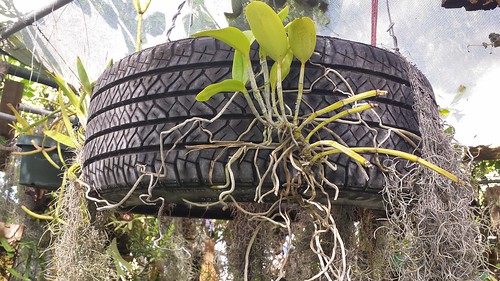
I'm pretty sure that this Cattleya would prefer to grow on some of the phorophytes listed here.
Documenting natural associations is important because it indicates which hosts orchid seeds were able to germinate on. So not only are these hosts suitable for orchids...they are also suitable for the fungi that the orchid seeds need to germinate.
If we plant plenty of preferred phorophytes, then we can help ensure an abundance of orchids and their fungal partners. Kinda like selecting plants in order to attract bees, butterflies and hummingbirds. You would just plant the phorophyte and swoosh...orchids would quickly swarm it like brilliant butterflies. Are there any phorophytes that will attract both orchids and butterflies? Are there any orchids that attract butterflies?
As many of us know all too well...there's a wide range of animals that love to eat orchids. So planting the best phorophytes won't only lead to an abundance of orchids...it will also lead to an abundance of animals that eat the orchids. Not to mention the animals that pollinate the orchids or use them for shelter. This in turn will lead to an abundance of the animals that eat the animals that associate with the orchids that grow on the phorophytes that you planted. Basically, the best phorophytes will have a large multiplier effect on biodiversity. The most relevant technical term is "facilitation cascade". My term for this is "linger longer". Visitors to your garden will have more subjects to photograph.
Another relevant technical term that I also recently learned from the New Zealand Epiphyte Network blog is "synanthrophic" (or... "synanthropic"?). It refers to plants and animals that benefit from human environments. Kirby's blog entry highlighted a study that found that mistletoes in Poland preferred growing on non-native city trees. While googling around for "syanthropic" I found this entry... Synanthropic Habitats. According to the Expanded Environment's website... it's a non-profit organization...
Another relevant technical term that I also recently learned from the New Zealand Epiphyte Network blog is "synanthrophic" (or... "synanthropic"?). It refers to plants and animals that benefit from human environments. Kirby's blog entry highlighted a study that found that mistletoes in Poland preferred growing on non-native city trees. While googling around for "syanthropic" I found this entry... Synanthropic Habitats. According to the Expanded Environment's website... it's a non-profit organization...
...devoted to demonstrating alternate ways of responsibly and synthetically integrating biological and ecological agents into the built world. Its goal is to assist governments, municipalities, provinces, organizations, businesses, and individuals to understand, appreciate and envision a more productive relationship between architectural and biological systems for a better and more sustainable world.What an awesome mission! Promoting the proliferation of preferred phorophytes should be right up their alley.
Unfortunately, many of these phorophytes aren't readily available in cultivation. Hopefully we can work together to try and help remedy this problem. If you grow any of these phorophytes then please share cuttings and/or seeds with others.
********************************************
********************************************
