Showing posts with label facilitation cascades. Show all posts

Monday, November 24, 2014

Natural Orchid Hosts (Phorophytes)

Every once in a while I'll run across a reference to an orchid species growing on a certain species of tree or shrub in nature.  I've recently started to enter these associations into a database.  Wish I had started earlier but...better late than never!

I figured that I might as well share this list on my blog.   It's a little rough around the edges and it's probably always going to be a work in progress.  But I'm hoping that sharing it publicly will help generate interest and help facilitate contributions.   If you happen to run across a natural association that isn't listed here...please share it in a comment.  Given enough eyeballs all associations can be found.

There are three types of natural associations that I'm especially interested in...
  1. Associations of the most commonly grown orchid species...such as Dendrobium nobile, Laelia anceps, Vanda coerulea, etc. 
  2. Associations of the most commonly grown trees here in Southern California...Jacaranda, Camphor, Floss silk, etc.
  3. Associations that occur in drier habitats

Ideally, this list will help people decide which trees to plant.  Whether or not a tree is a good orchid host should be the number one consideration.  Then again, I might be a little biased.

To be clear, this list is exclusively for natural associations.  In cultivation, orchids can be attached to and will grow on a wide range of hosts that they wouldn't necessarily choose in nature.  For example, here's a photo of a Cattleya orchid that's been growing on a tire for several years...
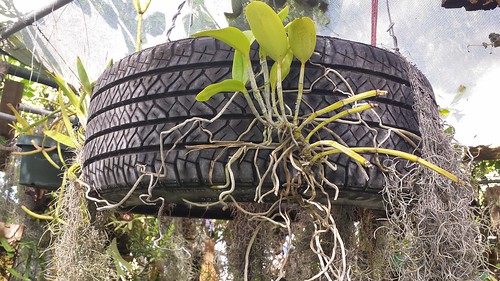

Cattleya Orchid Mounted On Tire


I'm pretty sure that this Cattleya would prefer to grow on some of the phorophytes listed here.

Documenting natural associations is important because it indicates which hosts orchid seeds were able to germinate on.  So not only are these hosts suitable for orchids...they are also suitable for the fungi that the orchid seeds need to germinate.

If we plant plenty of preferred phorophytes, then we can help ensure an abundance of orchids and their fungal partners.  Kinda like selecting plants in order to attract bees, butterflies and hummingbirds.  You would just plant the phorophyte and swoosh...orchids would quickly swarm it like brilliant butterflies.   Are there any phorophytes that will attract both orchids and butterflies?    Are there any orchids that attract butterflies?

As many of us know all too well...there's a wide range of animals that love to eat orchids.  So planting the best phorophytes won't only lead to an abundance of orchids...it will also lead to an abundance of animals that eat the orchids.  Not to mention the animals that pollinate the orchids or use them for shelter.  This in turn will lead to an abundance of the animals that eat the animals that associate with the orchids that grow on the phorophytes that you planted.  Basically, the best phorophytes will have a large multiplier effect on biodiversity.  The most relevant technical term is "facilitation cascade".  My term for this is "linger longer".  Visitors to your garden will have more subjects to photograph.

Another relevant technical term that I also recently learned from the New Zealand Epiphyte Network blog is "synanthrophic" (or... "synanthropic"?).  It refers to plants and animals that benefit from human environments.  Kirby's blog entry highlighted a study that found that mistletoes in Poland preferred growing on non-native city trees.  While googling around for "syanthropic" I found this entry... Synanthropic Habitats.  According to the Expanded Environment's website... it's a non-profit organization...
...devoted to demonstrating alternate ways of responsibly and synthetically integrating biological and ecological agents into the built world. Its goal is to assist governments, municipalities, provinces, organizations, businesses, and individuals to understand, appreciate and envision a more productive relationship between architectural and biological systems for a better and more sustainable world.
What an awesome mission!  Promoting the proliferation of preferred phorophytes should be right up their alley.

Unfortunately, many of these phorophytes aren't readily available in cultivation.  Hopefully we can work together to try and help remedy this problem.  If you grow any of these phorophytes then please share cuttings and/or seeds with others.


********************************************

Monday, November 3, 2014

A Hasty Case For Naturalizing Epiphytes

Reply to thread... Video of Cattleya Blooming on my Tree

***************************************

Thanks! Regarding your honest questions...well...did you ever see the SNL skit with Christopher Walken where he needs more cowbell? I guess I'm the same way with orchids on trees. When I drive around Southern California I shout out the window..."all these trees need more orchids!"

As far back as I can remember I've always been a fan of more nature. When I was a kid my mom bought me the book "Vanishing Eden". It was filled with pages and pages of plants and animals that I really didn't want to vanish. Shortly afterwards I saw Bladerunner for the first time. I really loved the movie but I really didn't want the future to look like that.

Basically, when people attach orchids and other epiphytes to trees...they help to offset the loss of nature elsewhere. There's a lot of nature being lost elsewhere...so it's not just sufficient to add plants to the ground...it's necessary to add plants to trees. Doing so helps to create a virtuous cycle.

An orchid on a tree will help widely disperse far more necessary fungus than an orchid in a pot will. Here's how I've illustrated this...


When more fungus is dispersed to surrounding trees...this increases the chances that orchid seeds will germinate on them. So more orchids on trees will lead to more orchids on trees.

Orchids and other epiphytes on trees help facilitate cascades. As we all know too well...orchids are an excellent source of food for a wide variety of "pests". But adding an orchid to a tree doesn't just provide more food for aphids, mealy bugs, slugs and bush snails...it also provides more food for the spiders, lady bugs and lizards that eat these pests. Plus, an epiphyte on a tree can provide shelter and a home for all sorts of animals. Flowering epiphytes can also provide nectar to a wide variety of pollinators.

In addition to facilitating cascades...it's important to naturalize orchids because this helps to subject them to the process of natural selection. The more orchids that sidestep this selection process...the less orchids that will be able to survive in nature. The world is constantly changing...so if nature changes in one direction...but orchids change in another direction...then in the future we will only be able to see orchids in conservatories. We're not doing anybody any favors by overly protecting orchids from cold or drought.

The orchid family is so successful because they throw a lot of seeds at nature. If we want the orchid family to continue being so successful... then we have to help orchids throw more seeds at nature. If we help throw enough orchid seeds at nature...then it doesn't matter if future conditions are colder/hotter or wetter/drier...there will be plenty of orchids that have sufficiently suitable combinations of traits.

Perhaps it's somehow inevitable that the future will have plenty of trees with orchids growing on them. I don't think this is the case though. I regularly search flickr for orchid tree...and the rate of relevant additions is pretty low. So I do what I can to try and help encourage more people to think outside the pot.

What do you think? Do I need to be so persistent? Does your individual foresight show you a future with an abundance of orchids on trees? Will the world look like more like heaven...or...?

Thursday, December 19, 2013

Flying Pixies Sprinkling Orchid Seeds on Trees

Reply to: Next time the Native Plants Tendency starts an argument...

********************************************
All of which is very consistent with my own anecdotal experience over the past 25 years.

The hypothetical Native Plants Tendency adherent would inevitably reply with a reference to one obscure species of insect that depends upon one equally obscure species of native plant, thus missing the point entirely. But we can apparently rely upon what we see, which is that, if we grow a lot of different stuff from all over the world, the wildlife will figure out a way to make use of it. - David Matzdorf
Thanks for sharing! The subject was recently discussed/debated over on the XericWorld forum...

Bay Area Xeric Guerrilla Gardeners

...and over on the OrchidBoard...

a horribly ambitious and terribly long project

Here is an article on the subject from Stephen Jay Gould: http://arnoldia.arboretum.harvard.edu/pdf/articles/483.pdf - davidmdzn7

Excellent paper!

I've said quite a bit on the topic...but I don't feel like I've really figured out how to adequately convey my position. It seems just out of reach. Maybe it will help if I brainstorm some more!

Neofinetia falcata is an epiphytic monopodial orchid from Japan, Korea and China. As some of you might remember...Tom Velardi shared a video of it blooming on his tree in Japan. Super super cool!

Unfortunately, too many of you do not have the option of growing Neofinetia falcata on your trees. It's cold tolerant...but it's not cold tolerant enough.

Shouldn't all of you have the option to grow Neofinetia falcata on your trees? Yes...very yes.