Showing posts with label seed. Show all posts

Tuesday, August 4, 2026

ficus seeds for rkn trials


  • 2 seeds: ficus opposita x carica (first-of-its-kind hybrid)

  • 20 seeds: ficus dcif 0023 (palmata hybrid)

  • 40 seeds: ficus cherry cordial (palmata hybrid)

  • 60 seeds: ficus carica (numerous different cultivars)


a total of 122 seeds for $40, not including shipping.  


figbid listing

ebay listing 

etsy listing

discussion thread

Monday, November 13, 2023

diversity and productivity sitting in a tree

reply to my thread about florida natural farming (fnf)...

****************************

when i was a kid i would religiously read the peanuts comic strip. lucy would often offer to balance a football so that charlie brown could kick it. each time, at the very last second, she would pull it away and he would fall flat on his back.

fnf has several large inga trees and each time he says that they are going to finally fruit, but every time, at the very last minute, they trick him.  it’s a bit entertaining and endearing.  

i don’t think that i’ve ever heard fnf mention that fruit trees near the ingas grow extra fast, which is interesting because check this out…


the cacao on the left isn’t growing anywhere near any ingas, while the cacao on the right is growing in an inga alley. fake news? the slide is from this video on inga alley cropping, which i only recently learned about thanks to the wikipedia article on mycorrhiza. here’s the wikipedia article on inga alley cropping.

naturally i was quite curious if it has ever been discussed here on tff, and it has been, albeit briefly…about the inga genus. in that 2017 thread there were only 4 participants, one of which was pineislander. he was there. where were we? not there.

one time, nearly a decade ago, at an orchid show i started talking with a random guy. he mentioned something about the orchidboard, and i told him that i was on there as well. i asked him what his username was. when he said what it was, i realized that he was the guy on there who told me to go f myself because he thought my views on orchid conservation were heretical.

flauro01, hint matthew 5:38? nope, i didn't turn my other cheek, i quickly lost all interest in talking with the guy and exited stage left. if i had been a little forgiving then i'm sure that i would have learned some useful stuff from him.

i only made 1 comment on fnf's videos, and he deleted it. in his video he said something about being overwhelmed trying to do everything on his own, so i commented that i’ve met a lot of young and enthusiastic plant people via my local facebook plant group who have been more than willing to lend a hand in my garden. my comment wasn't even vaguely negative or critical, so the fact he deleted it was very off-putting. fortunately, in this case, being so much older and wiser (hah) i just barely managed to turn the cheek and i continued to watch his videos, and i’ve learned useful stuff from them.

sure, it would greatly help fnf's cause if he was more like fff planting garcinias together with an enthusiastic young person, but that's just not who he is. just like most of us don't regularly video document our garden efforts, endeavors and experiments. we all have room for improvement.

in my book, fnf's shortcomings are eclipsed by his crazy cool achievement of growing such a wide variety of crazy cool plants without any irrigation. so it's awesome to see him back on this forum again. if we can all try to turn the cheek, then there's lots of useful stuff that we can learn from each other, such as whether ingas actually do help nearby fruit trees grow faster, via mycorrhizae.

in the wikipedia entry on mycorrhizae there’s a section on orchids. orchids are unique in that their seeds do not contain the energy that they need to germinate (exceptions to the rule). on the one hand, this allows the incredibly small seeds to travel considerable distances on the wind, but on the other hand, the only way that they can germinate is if they get lucky enough to land on a spot where they will be penetrated by a suitable  mycorrhizae. the orchid seed will take the energy it needs to germinate from the fungus, but it doesn't kill it. the fungus takes up residence in the roots of the seedling.  if the orchid seedling is growing on a tree (epiphyte!), then as its roots grow longer and more numerous, this will help the fungus colonize the tree and more of its spores will spread to other trees, which will help to germinate the orchid's seeds.

here's my 2014 attempt to illustrate orchid roots facilitating fungi colonization of its tree...

https://live.staticflickr.com/7432/11726199533_5c6126a5dd_h.jpg

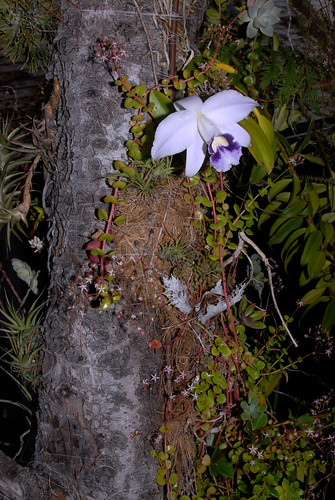
in 2011 i sowed a bunch of different orchid seeds on my deodar cedar tree here in the los angeles area that has orchids and other epiphytes growing on it. i was hoping that some of their roots contained the helpful fungus and it had spread all over the tree, but i wasn’t holding my breath. so it was a very surreal surprise, to say the least, when i noticed several tiny green boogers (aka protocorms) magically appear on the sunny side of the tree on completely barren bark...

https://live.staticflickr.com/6193/6104404673_f85c4a93a6_h.jpg


i immediately started to inspect every inch of the tree and found several dozen protocorms. what was rather fascinating, is that all of the protocorms were located within 1/2" of the roots of the mature orchids on the tree. evidently, in my dry conditions, that was as far as the helpful fungus could travel from its moist home inside the succulent orchid roots.

it turned out that all the orchid seeds that germinated on my tree were from laelia anceps, an orchid native to mexico. another fascinating thing is that the orchid roots in the above picture were from a dendrobium speciosum, which is a distantly related orchid native to australia. the two orchids are so distantly related that they can't be crossed. i also found laelia anceps protocorms growing right next to roots of vanda tricolor, a distantly related orchid native to indonesia. these two orchids are even more distantly related, given that their forms are completely different (sympodial vs monopodial).

where was the fungi from? was it just 1 variety? in any case, it’s important to appreciate that the fungi facilitated an exchange of resources between very distantly related orchid species.

it took nearly a decade for the 1st laelia anceps seedling to bloom.

a couple years ago i removed a division from the 2nd laelia anceps seedling to bloom on my tree and i sent it to my online friend keith in tampa so that he could attach it to his tree in order to try to innoculate it with the beneficial fungi in the orchid’s roots. he actually recently upgraded to a real life friend when i met him in person. a couple months ago i visited florida for the 1st time and he was nice enough to give my friend and i a garden tour. keith is so cool. he's young but already so knowledgeable. he's trying to select coconuts for cold tolerance. and he has a big vanilla (pompona?) vine growing on his tree…

Monday, February 6, 2023

pot optimization

i've always grown some tropical fruit trees, but recently i've become a "bit" more interested in them.  the following post is for the tropical fruit forum...optimal pot riddle.

************************************

"if you really want to give something a head start, put it in a deep, deep ass pot." - flyingfoxfruits 

"after 10+ years of side-by-side tests of different pots, i'm sold on the fabric pots, at least for my conditions." - coplantnut, experiments with container-grown mangosteen in colorado

"neither, after trying both pots you mentioned and the fabric pots, I have finally switched to regular nursery pots coated with microkote." - simon_grow, which is better? air-pots versus rootmaker's rootbuilder II 

when i 1st moved into my place i dug a bunch of holes to plant trees.  if i was lucky i would find a marble.  i'd tell my girlfriend at the time that i had a valuable surprise for her and she was nice enough to pretend to be happy to receive a random marble.  she ended up filling half a jar with them.

when i 1st joined this forum a little over a year ago i have to admit that i didn't do much digging to find old but valuable threads.  the other day though, when i decided to share some of my thoughts on pots, i figured it would be a good idea to 1st dig to try and find some buried treasure.

here are some of the more or less relevant things i unearthed...

side by side microkote experiment - graftingavocados

why do my jackfruit seedlings always fail? - daintree

garcinia seedlings (confessions of a repot head) - ethan

sourcing tree pots - zephian

jabuticaba: how to grow them? - huertasurbanas

greenhouse, rootmaker pots for tropicals and fruit "porn" - mark in texas

air pruning pots--opinions? - starling1

100% synthetic potting mix? - josh-los-angeles

mangosteen and lychee, growing in warm enclosure - socal2warm

did i overlook the most useful content about pots?  if so, please share it.  overlooking the best things in life is one of the worst things in life.  like the time i went to puerto vallarta 25 years ago and overlooked luc's garcinia.

if we could use our donations (to the tff) to determine the creation and order of forum categories, how much would we donate for the topic of pots?  in my previous thread i didn't include the topic of pots among the top three topics that i'd be willing to donate for.  maybe that was a mistake.

prior to digging for pot threads, i had never heard of microkote before, which was curious since it seemed quite useful, but i don't remember it being mentioned in any relatively recent threads.  so i googled within this site and found 1 microkote search result since 2018.  

then i found 0 "semi-hydro" search results since forever.

which is more useful... semi-hydro or microkote or...?

naturally we all have different conditions, so something that is useful in wet conditions, for example, might be useless in dry conditions.  optimal is relative, kinda.

a year ago i visited the salton sea for the 1st time and was intrigued that the shore consisted of a very loose mix of barnacle shells, fish bones and sand.  i asked my friend whether it might make a good medium and she replied something like, no way, it's toxic!  i replied, hold my beer.  i found a random empty 5 gallon pot, filled it with the seashore medium, took it home and rinsed it several times.  then i stuck two well callused aloe cuttings (tenuior and my tenuior hybrid) into the medium in a 1 gallon pot.  for the sake of comparison i stuck two more cuttings in pure pumice and two more cuttings in cat liter (my ex left it)...


the cat liter was an obvious fail, guess it was the wrong kind.  but surprisingly the salton sea medium seemed to work.  here's a recent pic...


the roots...


the left two aloes were in the salton seashore medium, the two on the right were in pure pumice.  the roots that were in pumice look a bit better so it seems reasonable to say that with these two aloes, and in my relatively drier conditions, pumice is a bit more optimal than the salton seashore.   but perhaps in wetter conditions the seashore medium would be a bit more optimal.

Saturday, February 17, 2018

Orchids And Aloes


Here's where we need to make so much more progress...

1. There should be lots of really nice orchids that can easily grow from seed.

2. There should be lots of smallish tree Aloes that we can attach miniature epiphytes to.

Many, if not most, of the typical reed-stem Epidendrums can easily be grown from seed... no flasking required!   The problem is that reed-stems don't usually make the best epiphytes.  So the challenge is to find/make crosses between reed-stems and other orchids in order to find the best crosses that can easily grow from seed.

One exciting cross is Kirchara Georgie (Cattlianthe Golden Wax x Epidendrum O'Brienianum).  I received it last Fall from Fred Clarke of Sunset Valley Orchids...

https://www.sunsetvalleyorchids.com/

There was a new shoot starting to develop when I received it.  I potted the plant in pure pumice and placed it outside.  Over the winter the new shoot matured and produced a flower spike.  I'm happy that the flowers developed on the new shoot (as opposed to developing on a shoot from the previous year).

Right now the plant doesn't have quite enough canes/stems to support a seed pod.  Seed pods are quite costly in terms of energy.  But I definitely plan to use the pollen to pollinate various reed-stems.   Here are some relevant links...

http://epiecon.blogspot.com/2017/04/growing-orchids-from-seed-is-easy.html
http://epiecon.blogspot.com/2017/09/how-adaptable-are-orchids.html
http://www.orchidboard.com/community/advanced-discussion/95431-reed-stem-epidendrum.html

The goal for Aloes is to make some really nice hosts for smallish orchids and other epiphytes.  In the video you can see a cross that's possibly between Aloe bainesii (the largest tree Aloe) and Aloe distans (not even a small tree Aloe).  It's a really neat cross... the trunk is good sized but there needs to be more branches.  Plus, it's a little on the slow side.

Does anybody recognize the Aloe that might be a dichotoma or ramosissima hybrid?  It's also nice but too slow.

The Aloe tenuior hybrid is relatively fast but so far it falls over.  All of the potential fathers are tree Aloes... and their stems do tend to thicken with age. You can read more about the hybrid here...

http://epiecon.blogspot.com/2017/08/better-treasure-maps.html

Towards the end of the video you can see a phorobana that consists of a Sophronitis cernua flowering on a potted Ficus rubiginosa.  The Ficus is fast and grows easily from large cuttings. The drawback is that its flowers aren't even a little showy.  So it's possible that we can make an Aloe that's a better host.  S. cernua is a really neat miniature orchid that grows great outdoors year around here in Southern California.  The drawback is that it can't easily grow from seed.

There's so much room for improvement!  Let's pool our resources and make tons of progress!

Some useful links...

https://www.facebook.com/epiphytesociety/
https://www.facebook.com/epiphytessc/
https://www.facebook.com/orchidssc/
https://www.facebook.com/groups/285776418608743/
https://www.flickr.com/groups/orchidlandscape/
https://www.flickr.com/photos/epiphyte78/

Sunday, May 22, 2016

Exceptional Seeds

Forum thread: Exceptional Seeds

************************************

Check out this thread... Some things currently in bloom. Yeah, they aren't orchids... but if you scroll down you'll see some nice propagation going on.

Succulents are relatively easy to grow from seed. In other words... you don't need to flask them. Which means... what? How different would the succulent hobby be if succulent seeds did require flasking? How different would the orchid hobby be if orchid seeds did not require flasking?

I've mentioned in a couple threads that I've successfully germinated some reed-stem Epidendrum seeds without flasking them. I basically used the same technique that I use for succulent seeds, Begonia seeds, Gesneriad seeds and so on.

I'm guessing that, unlike the seeds of most orchids, the seeds of some reed-stem Epi species contain enough nutrients to germinate on their own. It's just a guess though because the only way to be certain that absolutely no facilitative fungus was involved would be to flask the sterilized seeds without any nutrients. Which I'm probably not going to do...

Instead, I've been going around sticking Epi secundum pollen in different flowers...

- Barkeria cyclotella x Bardendrum Terusan: 1 pod nearly ripe (25 Jan)
- Brassavola digbyana x nodosa: 1 pod developing (5 Apr) and 1 pod around half mature (23 Feb)
- Cattleya nobilior: 1 pod developing (5 Apr)
- Cattleya Big White Floof: 2 pods developing (5 Apr)
- Epc. Cerina 'Nadia': 2 pods around half mature (3 Mar)
- Prosthechea cochleata: 3 pods nearly mature (27 Dec)

For some of these it's a bit surprising that pods have even started to develop. And, interestingly enough, this is pretty much the same list of orchids that I've attempted to pollinate with pollen from Epi secundum. Even though it's a pretty small sample group it seems like many, or even most, orchids in the Cattleya alliance are receptive to Epi secundum pollen.

Here are the registered intergeneric crosses with Epi secundum as the pollen parent....

- Epicatanthe Morningstar Sunshine = Cattlianthe Panache Domaine x Epidendrum secundum
- Epicatanthe Party Blossom = Cattlianthe Hawaiian Party x Epidendrum secundum
- Epicatanthe Saturn's Rings = Cattlianthe Golden Wax x Epidendrum secundum
- Epicattleya Purple Passion = Cattleya intermedia x Epidendrum secundum

That's the entire list! And they were all made by the same nursery... Rex Foster Orchids.

I'm guessing that crosses with Epi secundum as the pollen parent aren't very spectacular. But, some reed-stem intergeneric crosses aren't too shabby... Reed-stem Epidendrum Hybrids. Personally, I'd be pretty happy if I could easily grow Epicattleya Orange Blaze from seed!

Epc Orange Blaze is 75% reed-stem. What are the chances that it can easily grow from seed? Coincidentally, there's one currently on eBay... Epidendrum "Orange Blaze", Orchidée, Orchid... in France.

Here's a clue regarding whether 50% or higher reed-stem Epi crosses might be able to easily germinate from seed...

One of the oldest artificial epidendrum hybrids is Epidendrum O'brienianum, a cross between E. radicans and a member of the E. secundum complex (Epidendrum evectum). The E. secundum influence predominates in that the column is straight and the lip is uppermost with a small fleshy callus. Epidendrum O'brienianum is a common garden plant in subtropical areas; spontaneous seedlings occur in varying colors. This hybrid sometimes "escapes" from the garden and may appear to be native in areas as far apart as Mexico and Africa. Unlabled plants in gardens and greenhouses are likely to be hybrids, and they may have almost any combination of reed-stem species in their background. These epidendrums are usually tetraploids, so that the Epidendrum parent predominates in crosses with Cattleya or Laelia. Epicattleyas of this type could easily pass for pure reed-stems in dim light, but they always have at least the tip of the column free from the lip. - Robert L. Dressler, Will the Real Epidendrum ibaguense Please Stand Up?

If the crosses themselves are strongly influenced by the reed-stem parent... then you'd figure that the same would be true of their seeds. This would mean that there's a decent chance that the seeds of 50% reed-stem crosses can be easily germinated. If it is relatively easy to germinate 50% reed-stem seeds... then, in theory, many people would be happy to hybridize accordingly... and, by the law of truly large numbers, we'd expect to see at least a few 50% reed-stem crosses that we'd be happy to purchase or trade for. Over time there would be an increase in the supply of seeds from desirable crosses. These seeds would be relatively easy to germinate... so as their supply increased... there would be a logical and corresponding increase in total happiness.

With more and more people happily growing orchids from seed we would also expect to see faster climatic convergence. Some seedlings are always going to be better suited to any given conditions. So more seedlings grown would mean faster adaptation. As a result, there would be more and more orchids growing outdoors year around in colder and/or drier areas. Basically...

more seedlings -> more difference -> more progress

Wednesday, May 11, 2016

Tillandsias - Seeds Dispersed By Wind

Here are some super exciting Tillandsia videos...


This Syzygium jambos is downwind of my Cedar tree.    Tillandsia volunteers make pruning a bit more interesting!

And here's a photo of my highest epiphyte...


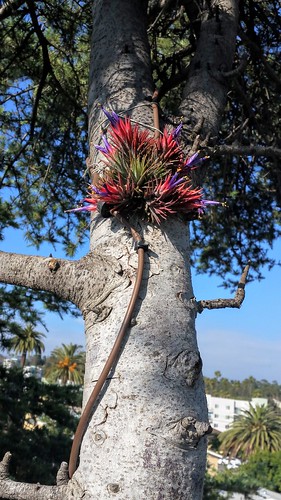
Tillandsia ionantha -  My Highest Epiphyte


This Tillandsia ionantha clump is over 3 stories high.  As you can see by the 1/4" polytube... it's watered via drip... twice a week at night during summer.   Other than the fairly infrequent winter rain... I get the feeling that it doesn't get any water on its leaves.  So I'm guessing that its roots can and do absorb moisture.

It's entertaining watching the hummingbirds go up and down my Cedar tree visiting the different plants in bloom... Tillandsias, Gesneriads, Echeverias and so on.  The tree is a vertical buffet for hummingbirds!

Sunday, September 28, 2014

Orchid Seeds Available For Flasking

A few years ago I sowed various orchid seeds on my tree.  Much to my pleasant surprise some of them actually germinated.  Right now there are around half a dozen seedlings left...down from around two dozen.   The largest seedling looks a lot like Laelia anceps...and I'm guessing that's what the rest are as well.

Seeing the tiny green blobs on my tree motivated me to try and pollinate more orchids.  Unfortunately I haven't noticed any new protocorms on the tree.  Not sure why that is.  It might be because the year the seeds germinated we received more than twice the usual amount of rain.  Perhaps the extra rain created a fungus feeding frenzy.  Or maybe it's because I haven't sown any L. anceps seeds since then.  Last year I failed to adequately hedge my bets so none of the L. anceps flowers that I pollinated developed pods.  But I've also sown a few other orchid seeds in baskets/mounts and some have germinated.

This year I've been especially consistent with pollination and as a result there are quite a few pods in various stages of development.  But because symbiotic germination hasn't been consistent...I'd like to hedge my bets by sharing orchid seeds with anybody interested in flasking them.  Bet hedging, from my perspective, is by far the most important plant lesson.

My primary breeding goal is to make progress in terms of drought tolerance.  It would be wonderful if there were more and more orchids that could thrive with less and less water.  This is especially relevant here in parched Southern California.  So over the past several years my primary purchasing criteria has been drought tolerance.

How much progress can be made in terms of drought tolerance?  Not exactly sure...but I do know that there's always room for improvement.   The orchid family's success is the direct result of each seed pod containing a multitude of chances to discover where there's room for improvement.  In other words...orchids are really good at hedging their bets.

My secondary breeding goal is to make progress in terms of temperature tolerance.  Most drought tolerant orchids are warm growers.  I plan on crossing them with my early growers.  The result will hopefully be drought tolerant orchids with a wider range of growing temps.

Basically, my overall goal is to select for orchids that are better suited to Southern California.  This means selecting for individuals that are more Mediterranean.  I'm pretty sure that the orchid family's gene pool is large enough to develop an epiphytic orchid that can thrive here without any supplemental water.  When will this orchid be developed?  That depends on the quantity of different trait combinations that are thrown at Southern California.  More combinations mean less time.

Here are some pods that are available or will be available...starting with those that have been pollinated with pollen from Psychilis krugii...which is many of them.

Besides being drought tolerant (growing on a cactus)...P. krugii blooms all summer long.  It successively/sequentially blooms on the same spike.  As soon as one flower starts to fade...another starts to open.  Having an extended blooming period is another example of bet hedging.  It increases the chances that some seeds will be dispersed when conditions are sufficiently suitable.  Personally, I really enjoy having an orchid that stays in bloom for so long.  The flowers aren't very showy though...so it would be nice if some of the crosses were also successive bloomers but had larger and/or more colorful flowers.

I'm guessing though that the sequential blooming trait will not be dominant...especially since P. krugii isn't the pod parent.  So the first generation will probably have to be crossed back onto P. krugii in order for the successive blooming trait to express itself in some of the second generation crosses.

Here are some of the orchids that I've pollinated with P. krugii pollen...

Bc Maikai?
Brassocattleya Maikai?

Pollinated Sept 2
Pod Sept 13

Brassavola Jiminy Cricket (Rhyncholaelia digbyana x Brassavola nodosa)
Pollinated Aug 19
Pod Aug 26

Brassavola nodosa
Pod Aug 26

Cat NOID Early Grower
Pollinated Aug 26
Flower and Pod Aug 28
Pod Sept 13

Anybody recognize this NOID Cattleya?  I bought it out-of-bloom for cheap.  When I saw the flowers for the first time I was a bit disappointed.  They are kinda homely.  But then it dawned on me that this Cattleya is one of my very first orchids to complete its growth cycle.  This earned it more than a few points and TLC.  I divided it this past spring which is why it bloomed later than it usually does.  What happens when this C-I-W grower is crossed with a successively blooming warm grower?   Perhaps future generations will have a longer blooming period than P. krugii does?  Can we eventually select for an orchid that's always in bloom?  

Cattleytonia Why Not 'Roundabout' (Guarianthe aurantiaca x Broughtonia sanguinea)
Pod Aug 26
Pod Sept 10 (harvested same day)

Lc Clayton Waglay var alba (Laelia anceps x C. Claesiana (C. intermedia x C. loddigesii))
Pod Aug 26
Pod Sept 13

The three orchids that make up Lc Clayton Waglay...the one Mexican Laelia and two Brazilian Bifoliate Cattleyas...are some of the very best orchids for Southern California.  It shouldn't be a surprise that Clayton Waglay is a really strong grower here.  Hopefully adding P. krugii to the mix will result in an even stronger grower.

Potinara Hoku Gem
Pollinated Aug 19
Pod and flower Aug 26
Pod Sept 13

Failed pods...

Caulocattleya Chantilly Lace 'Hildos' (Cattleya El Dorado Splash x Caularthron bicornutum)
Pollinated Aug 19
Pod Aug 28
Aborted Sept 2

Encyclia NOID
Pollinated Aug 11
Pod Aug 28

Anybody recognize this Encyclia?  Context...

 Encyclia NOID Context

 Close up...

  Encyclia NOID


Laelia pumila coerulea

Laelia pumila Coerulea

Pollinated Aug 26
Pod Sept 13
Aborted Oct 1

Rhyncholaelia digbyana
Pod Aug 26
Pod Sept 13
Harvested Sept 25

Why the really long pod?  It must have lengthened after I pollinated it...right?  But why?  And when exactly did it start lengthening?  It doesn't make much sense for the Rhyncholaelia to waste energy increasing the distance of the race course after somebody has already reached the finish line.  It makes more sense to increase the course distance before anybody has reached the finish line.  Making the selection process even more difficult would help ensure that the winner was fit enough...at least in terms of endurance.  Given that this pod didn't have any seeds...perhaps none of the P. krugii pollen managed to reach the finish line.

Other pods...

Aerides? NOID
Pods Aug 28
Harvested Sept 17

Pretty sure that the Hummingbird pollinated it.  No other monopodials were blooming at the same time...so definitely a self.

Angraecum Longiscott (longicalcar x scottianum)

1st flower - Angraecum calceolus and Vanda suavis - Aug 11
2nd flower - Cyrtorchis chailluana - Aug 19
3rd flower - N. falcata and Aerangis mystacidii - Sept 4

The first two flowers didn't develop pods...but the third has.  Another example of hedging.

Pod Sept 13

Bc Maikai? x Brassavola nodosa
Pollinated Aug 27
Pod Sept 13

Brassavola nodosa x Cattleya harrisoniae
Pod Aug 26

Brassavola Jiminy Cricket x Bc Maikai?
Pollinated Sept 2

Cattleya harrisoniae x (B. nodosa and P. krugii)
Pod Sept 13

Cattleya Penny Kuroda x (Mexican Laelias, Lc Clayton Waglay var alba, P. krugii)
Pods Group A Context Aug 26
Pods Group A Aug 26
Pods Group A Sept 13
Pods Group B Aug 26
Pods Group B Sept 13

There were two pseudobulbs that had around a dozen flowers each.  I pollinated around half the flowers on each spike and half of those have developed.

Dendrobium phaleonopsis? x Dendrobium Gatton Sunray (pulchellum x Illustre (chrysotoxum x pulchellum))
Context
Pod Aug 26

Dendrobium phaleonopsis? x Dendrobium hercoglossum
See above

Dendrobium phaleonopsis? x Dendrobium moschatum
See above

Epidendrum radicans spontaneous

A friend of mine has quite a few different colored Reed Stem Epidendrums.  Last week, with his permission, I harvested a dozen ripe seed pods.

Lc Clayton Waglay var alba x Cattleya Penny Kuroda
Pod Aug 26
Pod Sept 13

Neofinetia falcata x _______

This N. falcata had one spike with four flowers.  One Sept 4 I pollinated all of the flowers...one flower with fresh Angraecum Longiscott pollen, one flower with fresh Aerangis mystacidii pollen, one flower with not-so-fresh Mystacidium capense pollen and one flower with old Phalaenopsis pollen.  Another example of hedging.

Here's a photo of the flowers on Sept 13.  As you can see, only one flower developed a pod.  Which of the four donors would you prefer to be responsible for the pod?  Can you guess who is actually responsible for the pod?

Psychilis krugii spontaneous

My P. krugii isn't very large...so I prefer it to channel its energy into producing pollen rather than seeds.  But I guess it was the hummingbird that thought differently.  I could have removed the pod before it developed...but I decided not to step on the hummingbird's tiny toes.  The pod might not be a self because around a foot away an Encyclia spontaneously developed a pod at around the same time.

Failed pods...

Encyclia NOID x Brassavola nodosa
Pod Aug 28
Pod Sept 13

Encyclia NOID x (Mexican Laelias, Cattleyas)
Three Pods Sept 13

On Aug 27 I pollinated nearly every flower with a mix of pollen from Mexican Laelias and Cattleyas.  Given that only three pods took...I'm guessing that the Mexican Laelias pollen was too old.  And given that the Cattleya pollen largely consisted of relatively fresh Penny Kuroda pollen...I wouldn't be surprised if that is who is responsible for these three pods.  Unfortunately all three pods recently aborted.

For some reason it seems like I haven't had very much success with Encyclia intergeneric pollination.  Earlier in the year I had two very nice Encyclia cordigera var roseas bloom.  If I remember correctly I tried crossing them with Mexican Laelia pollen but pods didn't even form.  Same thing with Encyclia Orchid Jungle, Encyclia fowliei and a few others.  It's pretty good incentive to keep better track of pollination efforts.  That way I can avoid wasting good pollen on the wrong orchids.

A recent pollination...

Epidendrum viviparum x Epidendrum secundum
Pollinated Sept 19

There are also quite a few spiking orchids that I plan to pollinate...


Hopefully my consistent pollination streak will continue and I'll have pods for days.

Anybody interested in some seeds?  If so, just private message me your e-mail and I'll add it to a notification list.  Whenever I harvest a pod I'll send an e-mail to the list.  If you'd like to flask the seeds then you'd simply reply to the e-mail.  Should demand exceed supply...priority will be based on the following criteria...

  1. Return on Investment (ROI).  Not unlike the Parable of the Talents.
  2. Bribes.  There are numerous drought tolerant epiphytic orchids that I don't have.  
  3. Public documentation.  Blogging and/or posting in forums about your flasking technique will earn you points.
  4. Flasking experience.
  5. SoCal residents.  
  6. Outdoor growers.  
  7. Members of the Epiphyte SocietyESSC or OSSC.

Any questions?  Let me try and guess a couple...

Can you buy seeds?  Sure, everything has a price.  

Can you have the seeds professionally flasked?  Yup.
  

Tuesday, May 13, 2014

Anybody Interested In Microcoelia Seeds?

Several months ago I tried pollinating my Microcoelia exilis with pollen from a random Neofinetia hybrid. It was really not easy to do. The Microcoelia flowers are very tiny! Without a microscope or magnifying glass it was extremely difficult to try and remove the specks of Microcoelia pollinia and insert the much larger Neofinetia pollinia. After around two weeks of trying I threw in the towel.

Not too long afterwards...I noticed that some of the tiny ovaries were starting to swell a bit. And now I have around a dozen tiny seed pods on my Microcoelia.

My guess is that it's extremely likely that they were all selfed rather than crossed. I'm pretty sure that in my clumsy effort to remove the pollen I simply managed to self pollinate the Microcoelia flowers. But I could be wrong.

With most of my seed pods I just sow the seeds on my tree. But in this case, because it's not a common orchid, I'd prefer to go with the traditional method. All leafless orchids should definitely be more widely available.

Is anybody interested in the seeds? A few criteria...

1. Must be in the US
2. Must be experienced

This isn't the kind of seed for experimenting with. So if you're interested in some seed...then you must be able to provide some evidence that you've successfully germinated monopodial orchid seeds before.

Plus, I'm going to expect a reasonable percentage of seedlings in return. Maybe 10% or so. Of course there's no guarantee that the seeds are viable.

Not sure when the seed pods are going to be ready to harvest. They look like they could pop any day now. But for all I know it could still be another couple of months. I try and inspect them on a daily basis...and as soon as the first pod starts to open...I will remove all the pods.

So far Microcoelia exilis seems to be a really great outdoor leafless orchid for Southern California. I have two of them. The one with seed pods I traded for last year. This winter was pretty mild though. But my first exilis had no problem with a previous winter's temps down to 32F. Both of them bloomed this year and they started putting out new roots early in the year.

They are both mounted without any moss and located pretty high up under 50% white shade cloth. During the coldest days I water them once a week in the morning. During the hottest days I try and water them every night.