OrchidExchange.org is a new website for orchid growers in Southern California to sell their orchids. The creator of the website promoted it on OrchidBoard and I decided to share some feedback...
*************************************************
Really great website! Thanks for creating it! Here's some feedback...
Last weekend at the Santa Barbara Orchid Show I was happy to see that Peter had Lambara Five Aces (LFA) for sale.
LFA = Bardendrum Nanboh Pixy x Broughtonia sanguinea (and here)
It's a really exciting cross. A few months ago I bought some seedlings of this cross on eBay. The plants that Peter had for sale at the show were full grown and in full bloom. I was super tempted to buy one for myself but decided to buy one for my friend who drove us.
I was surprised that the LFAs weren't selling like hot cakes and I mentioned this to Peter. He said that people are idiots. Hah. No. That's not what he said. He said that most people don't know whether a cross is good or not. Or something along those lines.
It makes sense that most people aren't knowledgeable about crosses. And even people who are knowledgeable about crosses can't be knowledgeable about all crosses! There are just way too many crosses!
Ideally it would be really easy and quick for those who are knowledgeable about crosses to share their expertise with everybody else.
It's already kinda possible to do this. For example, just now I posted a link to Peter's LFA for sale on your website on the Epiphyte Society of Southern California's (ESSC) facebook page. I essentially vouched for the cross. Well... I vouched for the cross's potential.
Your website allows people to review and rate the orchids for sale... which is great. But I'd like the opportunity to offer more substantial feedback on an orchid. And by "substantial" I mean monetary.
Rather than simply giving LFA 5 stars... I'd like to be able to give it 5 cents!
Above the review/rating section there would be a valuation section. In this section you'd display my username along with my valuation...
Epiphyte: $0.05
I would essentially be giving Peter 5 cents for helping to make this really great cross available. Plus, I would be publicly vouching for LFA.
Let's say that Don also valuated this listing...
Cieneguitan: $0.20
The total valuation for this listing would be 25 cents.
Users would have the option to sort listings by their valuations. And you'd probably want to put the top 5 or 10 most valuable listings on your homepage. Users would essentially have the opportunity to use their pennies to help decide which listings were most worthy of being displayed on the homepage.
Also, it would be really awesome if I could click on Don's username and see all his valuations. I could sort them by date to see his most recent valuations and I could also sort them by value to see which listings he most values.
Right now I have the option to pick Don's brain. I can e-mail him and say, "Hey Don! Peter's selling 201 orchids on OrchidExchange. Which ones do you most highly recommend?" It's really wonderful to have easy access to Don's extensive outdoor growing orchid expertise. But it would be even better if everybody could know which of Peter's orchids that Don values the most.
With this system in mind... you would still want people to have the option to see and valuate sold listings. If Peter lists a Laelia speciosa cross and somebody buys it before I do... I'd still want to valuate the listing. I'd still want to give Peter some money for listing such a great cross. The more money this listing receives... the greater the incentive that Peter and other vendors would have to offer more Laelia speciosa crosses for sale.
It wouldn't be technically difficult to facilitate valuations. Members would use paypal to buy digital dollars. I'd give you $5 dollars and you would put $5 digital dollars into my "digital wallet". The digital wallet would simply be a column in the users table.
You would also need a many-to-many table. I'm guessing that you already have one for ratings? You would just need to create another one for valuations.
In the listings table you might want a column to keep track of the total valuations. That might make it faster to sort listings by their valuations.
While I'd certainly be happy to spend some money to promote/sponsor/support/encourage some really nice listings... I'm not sure how many other people would appreciate the opportunity to do so. One possible incentive would be to allow valuators to include a link to their personal website...
Epiphyte (website): $0.05
For my website I might choose the facebook page for the OSSC... or the ESSC... or my flickr page... or my blog.
So my valuation would have three functions...
1. Reward Peter
2. Promote LFA
3. Advertise my website
If you did display the top 5 or 10 most valuable listings on your homepage then this could potentially drive some decent traffic to the websites of the top valuators of those listings.
In this case the motivation to valuate the listings wouldn't be purely altruistic.
Anyways, it's just an idea! But I'm pretty sure that crowd sponsored results are the future.
Web 2.0 made it stupid easy to share information. Voila! Here I am! Here we are! As a result... the internet has lots of information. Web 3.0 will make it stupid easy to share our valuations of the shared information. As a result...it will be stupid easy to find the most valuable information.
Sunday, March 13, 2016

Monday, February 15, 2016
Tree Aloes Blooming In Southern California
I... sound... really...... awkward. It's my first time narrating a video. Clearly it's not my forte. If you want more energy and enthusiasm... then... here you go...
https://www.youtube.com/user/PictureMaria1
She makes it look so easy. For me it's easier to be enthusiastic in my writing...
I LOVE tree Aloes! What's an Aloe good for? Attaching orchids to! If it isn't, then it's good for nothing. I'm kidding... kinda.
Most of my tree Aloes aren't large enough to attach orchids to yet. But, for some reason, most of them bloom at roughly the same time of year. Why is that? Is it a coincidence... or do the bulk of tree Aloes bloom at roughly the same time? Or is it simply that... the bulk of tree Aloes that are commonly available in Southern California bloom at the same time? Or do most Aloes in general bloom during winter?
I read somewhere that pollinating during winter is the best way to select for cold tolerance. Hmmm... so... would this mean that winter bloomers proliferate faster?
As you can see from the video... my front yard, which is in Glendale, is full of drought tolerant and succulent plants. Here's a photo of my front yard that I took 6 years ago...
https://www.flickr.com/photos/epiphyte78/4637338482
It was a lot neater back then. Now my front yard is extremely messy with garden debris here, there and everywhere. I prefer it this way! There's nothing orderly about nature. I decided a while back that I don't want a garden... I want a habitat... and the more complexity/biodiversity the better! I want the most niches for my nature! I want the most species for my space! Tiger, the very old neighborhood tomcat, sure loves the yard. You can see him briefly in the video.
Initially the front yard was nothing but grass. That didn't last long! If you're a TRUE nature lover... then the opportunity cost of lawn is infinitely high. Only one of my plant friends still has a lawn... not going to mention any names... Steve... :D Wait a second... Fernando too? Sheesh...
My very first tree Aloe was the Aloe thraskii in the video. It was a gift from a friend in the Orchid Society of Southern California (OSSC). I think it was only around 2 to 3 feet tall... and I distinctly remember my friend telling me that it wasn't going to grow much taller. Hah! I'm happy that he was quite mistaken. His thraskiis are also now quite taller than 2 to 3 feet!
Since then I've been really interested in tree Aloes and have acquired a decent collection of them. None of my tree Aloes are spectacular specimens like the ones you'd see at the Huntington Botanical Garden or the LA Arboretum... but I sure do enjoy them. The hummingbirds and bees are also big fans of the tree Aloes. And I've also seen a few smaller birds awkwardly trying to get to the nectar.
As you might have noticed... I didn't mention the epiphytes in the video. There are actually quite a few of them so it would have taken too long to mention all the plants. Plus, most of the epiphytes are new additions... so they really haven't had a chance to fill in very much. It's only just recently that the potential hosts in the front yard have gotten large enough to start attaching larger epiphytes to.
It might sound strange to grow orchids alongside Aloes and other succulent plants. But the orchid family actually has more species of technically succulent (CAM) plants than any other family. There are thousands of epiphytic orchid species that are found in dry/spiny tropical forests around the world. Many, if not most, of these drought tolerant orchid species are more than happy to grow outdoors year around here in Southern California.
Here's a gallery that I created on flickr to showcase photos of orchids growing on cactus and other succulent plants...
https://www.flickr.com/photos/epiphyte78/galleries/72157649154617841/
Please let me know if you happen to find any other flickr photos that belong in the gallery!
Epiphytes are wonderful additions to yards in suitable climates because they provide additional color and interest. They also help provide food and shelter for all sorts of creatures.
Ok... so here are some quick notes on the Aloes in this video....
Aloe bainesii: This species is the largest tree Aloe and a relatively fast grower. It's really not "precocious" though. Mine almost bloomed for the first time this year... but then decided to quit.
Aloe africana: A good grower and it has my favorite bloom. Probably. It definitely has the tallest flower spike. Plus, it blooms twice a year. I read somewhere that Aloe hybrids are more likely to bloom twice a year... so maybe my africana isn't the pure species.
Aloe arborescens (variegated): At first I wasn't a fan of variegation... but then it started to grow on me. Maybe someday I'll even catch up to Steve in terms of variegation appreciation. Hah. That would be impossible. But I definitely would love to have a large tree Aloe that's variegated. The problem is that they are not readily available...
http://spikyobsession.blogspot.com/2012/04/going-straight-to-top-of-my-wish-list.html
So I'm hoping that my variegated arborescens will cross with my other tree Aloes. Unfortunately, for some reason, this year it finished blooming just before the rest of my Aloes started blooming. In a month or two I plan on removing the offshoots, rooting them and planting them around the front yard. Hopefully the disparity in locations will result in a disparity in blooming times. I've noticed that this is generally the case with orchids (more shade = less heat = later blooming).
Aloe dichotoma: The slow grower is actually the slowest grower. I've had mine for years but it still hasn't bloomed. It's a stupendous species though. Here's my friend with his...
https://www.flickr.com/photos/32837203@N08/11810077954
Aloe ferox: Not the happiest camper. It bloomed a year or two ago... but then I failed to remove all the flowers that fell into its crown. I guess the rain + detritus proved to be a good combination for some fungus/bacteria... so a bad combination for the Aloe. I thought it was a goner but it seems to be outgrowing the problem. But it's definitely never really thrived.
Aloe Hercules: Is a cross between dichotoma and bainesii. In my opinion it's the fastest grower. You can see some earlier photos of it in this blog entry...
http://epiecon.blogspot.com/2014/11/hercules-hercutherm-hybridize-this-and.html
It bloomed for the first time last year. But evidently it decided that blooming was overrated because it didn't bloom again this year.
Aloe marlothii: Not the fastest grower... but definitely a trooper. It was already pretty large when I planted the The Grevillea "Red Hooks" near it. The Grevillea was in a one gallon pot and I guess I failed to read the label. The label probably said something about Jack and the Beanstalk because the Grevillea skyrocketed right after I planted it.
Aloe plicatilis: A very distinct tree Aloe. This species can potentially make a really great phorophyte for smaller epiphytes... but unfortunately it's a slow grower.
Aloe speciosa: I've heard quite a few people say that this species has the best bloom. And I can definitely see why. The form of the plant itself is also quite pleasing. For some reason I'm a bit surprised that mine is splitting. It's a perfect height to split... but I guess that most of the ones that I've seen have only had one head. Well, as the saying goes, two heads are better than one!
Aloe striata: ... I believe. Not a tree Aloe! Still... there's something about the leaves that are definitely appealing (pastel luminescence?). Usually it starts blooming just as the rest of the Aloes finish blooming. This year it's blooming at the same time. It even has 3 spikes on it. Hopefully some bees or hummingbirds will cross pollinate it with the tree Aloes. I'd definitely love to see what the hybrid would look like!
Aloe thraskii: The plant itself has my favorite form. It's very curvy. The bloom is probably the least showy though. However, it is by far the most consistently pollinated. In fact, the weight of the seed pods usually breaks the flower stalk. So far it's the only Aloe that's "volunteered". I discovered a handful of seedlings near the base of its trunk the spring after we had far more rain than usual.
Aloe vaombe: This species is from Madagascar. "Vaombe" is an excellent word. It's also an excellent Aloe. The form and flowers are both really quite nice.
I'll probably have more Aloe seeds than I can sow. Plus, in order to plant plenty of variegated Aloe arborescens around the front yard... I'm going to have to remove and/or cut back a bunch of other plants. So please let me know if you live in the Glendale area and are interested in some drought tolerant plants/seeds.
Here are some links...
https://www.facebook.com/epiphytesociety/
https://www.facebook.com/epiphytessc/
https://www.facebook.com/orchidssc/
https://www.flickr.com/groups/orchidlandscape/
https://www.flickr.com/photos/epiphyte78/
Please let me know if you have any questions!
Tuesday, October 13, 2015
Crowdfunding Coconut Cold Tolerance
Forum thread: Crowdfunding Coconut Cold Tolerance
Last week my uncle randomly visited me here in Southern California. He lives in McAllen Texas. Not too long ago, some guy gave my uncle and his friend around 10 acres to farm. Knowing my uncle... it's probably a pretty informal arrangement. Right now their plan is to grow beets. Beets? Beets are boring! Plus... it doesn't seem like McAllen's hot and humid climate provides a comparative advantage in terms of beets. I told my uncle that the best strategy is to hedge his bets. So I gave him a bunch of Tillandsias, one Lemon Guava seedling, one small Apple Banana, one small Dwarf Brazilian Banana, four fresh Surinam Cherry seeds and two cuttings each of 5 different varieties of dragon fruit. These are crops that you probably won't find in Minnesota (one of the states where beets are commercially grown). I also told my uncle that he should grow coconuts as well! Unfortunately, I didn't have any coconut seedlings to give him. 
Here's an idea. Feel free to let me know if it's too crazy. Let's all chip in to buy coconuts for my uncle to grow! Yay or nay?
Sure, you could all chip in to buy coconuts for me to grow... but I don't even have an acre and the success rate would be way too low. We could also chip in to buy coconuts for Cindy to grow in Puerto Rico. She's got lots of land and the success rate would be very high. Too high in fact!
When it comes to making progress with discovering/selecting/creating more cold tolerant coconuts... there's a Goldilocks zone where the success rate is not too high and not too low but just right. I should probably mention that I'm defining "success" as a coconut growing to maturity and producing coconuts. What do you think the optimal success rate would be? Maybe 5%? Or 10%? Or 25%? Higher? Generally speaking... around what latitude is the Goldilocks zone? McAllen's latitude is just above 26 degrees. Los Angeles, in comparison, is at 34 degrees.
I'd be surprised if my uncle's farm is exactly in the Goldilocks zone. If somebody has, or knows of, plenty of available land that's closer to the Goldilocks zone... then please chime in. But it isn't just a matter of available and optimally located land... there also needs to be somebody willing to do the work. Although, in theory, we could all chip in to pay somebody to grow the coconuts. That would be pretty neat! Heck, we could even chip in to buy some land! All the cool kids are doing it. For example, members of the Orchid Conservation Alliance chip in to purchase land. But perhaps, when it comes to growing/testing marginal crops, some training wheels would help.
When I told my uncle that he should grow coconuts he said that he would try. But I'm guessing that this doesn't equate to him going out and buying enough coconuts to fill up an entire acre with coconut palms. How many coconut palms would fit on an acre of land anyways? And how many coconuts would have to be purchased in order to fill up an entire acre with mature coconut palms in McAllen?
The real tough question is... how many coconuts would you be willing to sponsor? A coconut a year? A coconut a month? And, are there any plants that you'd be more willing to sponsor than coconuts? Starfruit? Lychee? Pineapple? Vanilla? Durian?
When I told my friend about my uncle's farm he asked whether mangosteens would grow there. I'm guessing that they probably wouldn't. But I might be willing to chip in to buy a mangosteen for my uncle to try and grow. Unless there's adequate evidence that they will not grow there.
The problem with the mangosteen is that it doesn't reproduce sexually. This means that there's not going to be much genetic variation/diversity.... which means negligible progress in terms of cold tolerance. Buying more mangosteens or growing them from seed would closely match Einstein's definition of insanity... doing the same thing over and over but expecting a different outcome. The apple has to fall at least some distance from the tree in order for any progress to be made. With this in mind, the best strategy for coconuts would be to try and grow the widest possible variety of coconuts. Assuming cross-pollination... the result would be numerous different combinations of traits... which would increase the chances of discovering/creating combinations that are better suited for growing in Southern Texas.
Coconuts are pretty much the opposite of orchids in terms of seed quantities. One orchid plant produces more seeds than 100 acres of coconuts. Is that right? A single orchid seed pod can contain around a million seeds... and a decent sized orchid can comfortably produce around 5 seed pods. How many acres of coconut palms would it take to make 5 million coconuts? Assuming 100 coconut palms on one acre... and assuming each coconut palm produces 100 coconuts per year.... that would be 10,000 coconuts per acre. So it would take 500 acres to produce 5 million coconuts. But it would only take a few square feet on a coconut palm for an orchid to produce 5 million seeds. So how many orchid seeds would be produced if every coconut palm in 500 acres had one orchid on it?
Progress is a numbers game. The more combinations that are tested, the more progress that will be made. So it's easier to make a lot more progress in a lot less time with orchids than with coconuts. With this in mind... progress with coconuts could be increased, generally speaking, by also selecting for seed quantity in addition to cold tolerance. Selecting for precociousness would also help more quickly increase the size of the gene pool. A larger gene pool in McAllen would decrease the time necessary to develop a larger gene pool in a coconut orchard an hour or two to the north.
Of course there's no reason that cold/drought tolerant orchids and coconuts couldn't be selected at the same time! A couple months ago I sent my uncle a few orchids. One of the orchids I sent him, Laelia anceps, can be found naturally growing on trees only a couple hours drive across the border. Why hasn't this orchid naturally crossed the border into Texas yet? Where's the bottleneck? Drought? Cold? Pollinator? What other species would L. anceps have to be crossed with in order to eliminate the bottleneck?
Brassavola nodosa naturally grows on coconut palms in nature. Unlike coconut palms though, B. nodosa grows quite well in Southern California. But I'm not quite sure how nodosa would do outdoors in McAllen. It would definitely thrive in the heat... but would it survive an average winter? I'd sure like to know!
I really love the idea of a coconut plantation with orchids, Tillandsias and dragon fruit all growing on the trunks of all the coconut palms. That's two ornamental crops plus two edible crops. More crops in less space. More bang for your buck. More awesome for your acre. Intercropping for the win! Not only would there be greater productivity per acre... but there would also be more cold tolerance selection per acre.
Out of curiosity I googled something about germinating a coconut... and found this video... How to Grow a Coconut Palm from a Dehusked Coconut. I watched it and the follow-up videos... two, three and four. Pretty neat!
I do enjoy eating coconuts... but you can't eat your coconut and grow it too! From now on I'm going to be thinking about the opportunity cost of eating coconuts. Eating a coconut is a momentary pleasure. Growing a coconut in Southern Texas could yield a future benefit. Should we give up momentary pleasure for future benefit?
Generally speaking, the higher your latitude/altitude... the longer it will take you to reap the reward of chipping in for tolerance selection. If you live in Washington... then the benefit might be for your grandchildren... or great grandchildren. Do you really care if your great grandkids can grow coconuts? Maybe a few of you do. But generally speaking, the further away the benefit... the less likely it is that somebody will chip in. But the less people that chip in... the fewer coconuts that will be tested... and the longer it will take for the coconut belt to noticeably widen. Progress... will... be... oh... so... painfully... slow. I know that at least some of you out there would prefer faster, rather than slower, progress when it comes improving the cold tolerance of coconuts.
Most crowdfunding campaigns involve some form of perks. The more you chip in... the bigger the perk. What could some perks be for crowdfunding coconut tolerance trials?
One idea I like is to offer advertising as a perk. The more you donate...the more advertising you get on the PalmTalk.org website! And the more traffic your website receives from the PalmTalk website... the more money that you'd be willing to donate. Clearly this perk works better if you have a website that could benefit from having more visitors who are interested in plants. So go ahead and start a garden blog if you haven't already done so!
Coconuts could also be offered as a perk. Imagine if my uncle received enough money to buy 100 coconuts... but only one grew to maturity and produced coconuts. Clearly it would be a good idea for my uncle to grow most of these exceptional coconuts.... but perhaps a few of them could be offered to the biggest donors. I'm guessing that most of the biggest donors who wanted the coconuts would probably prefer to grow, rather than eat, them. So offering some coconuts as perks would also help us hedge our bets.
Coming up with good perks is important if we want faster progress. Incentives really do matter! I'm sure though that those of you who already live in the coconut belt would be more than happy to regularly send my uncle sprouted coconuts in exchange for nothing more than the warm glow feeling you get when you contribute to a good cause! 
Hmmm... now I'm wondering whether it's better to send my uncle money or coconuts. My first thought was that money was obviously better. Then my uncle could simply go out and buy coconuts. Why would we needlessly pay for costly shipping? But if we all sent my uncle enough money to buy 100 coconuts.... then where would he get 100 coconuts from? From the same source? That would be a problem because progress depends on difference.
But if, on the other hand, 100 of us each send one coconut to my uncle... then chances are good that they'd be from a greater variety of sources. Which would mean more progress.
Also, I kinda struggle seeing my uncle going through the process outlined in the coconut germination Youtube videos with a 100 coconuts. Maybe it would make more sense for each of us to germinate a coconut and send it to him once the threat of frost has passed. Then he would simply have to plant 100 germinated coconuts. And it's not like they would arrive all at once.
Or, rather than germinating the coconuts ourselves, we could simply purchase coconut seedlings...
It's also a really great idea for my uncle to try and grow any coconuts that are locally produced. Fortunately for us, Southern Texas has somebody who is very knowledgeable, experienced and enthusiastic about selecting coconuts for cold tolerance.... Mr. Coconut Palm! A couple years back I sent John an e-mail and we brainstormed a bit about finding a suitable space in Southern Texas to grow and test lots of coconuts and epiphytes. So this really isn't a new idea for either of us! And now, thanks to my uncle acquiring 10 acres and randomly visiting me, the idea has become a lot more tangible.
Hopefully John can get his hands on some locally grown coconuts... and then he could work with my uncle to try and provide them, and all the other coconuts that we send, with the best possible care.
According to John.... Corpus Christi, where he lives, isn't as suitable an area as McAllen... which isn't as suitable as Brownsville. So Brownsville is perhaps the closest we get to the Goldilocks zone in Texas. But a bird in the hand is worth two in the bush! If somebody does happen to have a few acres in Brownsville that they'd be happy to dedicate to coconut palms and companion crops then please let us know.
I'm sure there's a better analogy... but what comes to mind are train stations. Brownsville could be a station in Texas where coconuts might grow the best. This is where the success rate might be the highest. Some of the coconuts produced at the Brownsville station could board the train and head to the next best station... McAllen. After they grew and produced coconuts there... then some of the coconuts would take the train to the Corpus Christi station. In this way the coconuts could systematically and quickly spread across the country. And of course there'd be room on the train for other tropical plants... such as exotic fruit trees, Anthuriums, orchids, bromeliads, gesneriads and so on. This would hopefully generate broader interest and more support in the tropical tolerance project. Tropical tolerance project? I'm sure there's a better name!
Now, to be clear, this process already kinda occurs. We've all purchased plants, and been given plants, and raised plants from seed... that we've selected for cold and/or drought tolerance. Personally I've spent lots of money and time testing orchids and other epiphytes for tolerance. Given how much money and time that I've spent... and how many plants were sacrificed in the testing process... I sure like to think that I've made some progress! And I also like to think that others will be able to benefit from my progress just like I've benefited from the progress made by countless other people. But I'm pretty sure that we could make a lot more progress in a lot less time if we, as a crowd, offered a lot more support to growers/testers in Goldilocks zones. The more coconuts we send to my uncle, or whoever, in McAllen or Brownsville or in equivalently marginal locations in Florida... then the more cold tolerance progress we'll make with coconuts.
To put it more succinctly... the main difference is a matter of scale. Rather than one or two coconuts growing in a few scattered and anonymous yards in Southern Texas... let's see if we can manage to fill up one entire acre in McAllen and/or Brownsville with coconut palms. If we're successful... then we can help establish similar farms in Goldilocks zones around the world... Chile, Argentina, Australia, China, India, South Africa, Spain and so on.
So what do you think? Is crowdfunding coconut cold tolerance a crazy idea? Or is it crazy that we haven't already tried it? If our grandparents had tried it... would most of us be growing coconut palms right now?
I used a Google chart app to create a few climate diagrams...


Wednesday, March 18, 2015
Video Of Orchids Blooming On Tree In Southern California
Description...
***************************************************
Every tree should have at least one orchid growing on it! Here in Southern California there are 1000s of different species of orchids that we can easily grow on our trees. But unfortunately... for some reason the word still hasn't gotten out. :( So I figure that sharing a terrible video is better than not sharing any video!
A couple days ago I shot this video of some orchids and other epiphytes blooming on my Cedar tree here in Southern California. I have enough orchids growing on my tree so that there's always at least one orchid in bloom.
Here's a listing of some of the epiphytes sorted by their appearance in the video...
Vanda tricolor/suavis about to bloom. Can't recommend this orchid enough! Hanging out with a Tillandsia ionontha in bloom.
Laelia anceps... not in bloom... and to the far right a Jumellea (arachnantha x comorensis) that wants to visit my neighbor.
A Dendrobium speciosum just finishing blooming. Another must have orchid for SoCal. A Tillandsia aeranthos is blooming next to it. Also in that frame is a Dendrobium bigibbum with a seed pod on it.
Higher up... on the other side of a tree is a cute little Tolumnia in bloom with cheery yellow flowers. Near the ladder is an Encyclia cordigera var rosea in spike. It's going to have striking and long lasting flowers.
Next is a NOID Tillandsia surrounded by a NOID Crassula.
In the next frames ... towards the left is a sad Dendrobium speciosum. I made a mistake of throwing too many succulents on top of it... now the new growths stays moist too long and rot. It has put out a keiki on the drier side though so I think it will escape just fine.
Above and to the right of the D. speciosum is another Vanda tricolor/suavis. The spike kind of went the wrong way but you can still appreciate the flowers. Now we can scratch our heads together and wonder why we don't see these growing on every tree here in SoCal!
Higher up there's a couple seed pods on Brassavola Jiminy Cricket (Rhyncholaelia (Brassavola) digbyana x Brassavola nodosa).
Next there's a Dendobium nobile type finishing blooming. To the left of it is Dendrobium 'Easter Parade' (kingianum x (bigibbum x canaliculatum)) also finishing blooming.
Moving up the tree you see more Tillandsias and then a more showy type of D. nobile in bloom. There's a happy Tillandsia heteromorpha keeping it company.
My neighbor's roof... some shaky footage... and then the delightful and wonderfully charming Kalanchoe uniflora. Not an orchid but it is an epiphyte! From Madagascar no less.
A terrible shot of Oncidium maculatum. I was holding my phone above my head! O. maculatum is nicely fragrant and I really should have attached it lower on the tree so other people wouldn't have to risk their necks to smell it.
Another Tillandsia aeranthos in bloom... followed by a not so great shot of a seed pod on Potinara Hoku Gem.
All these orchids are available locally (more or less) at the two very best orchid nurseries in the world...
http://www.sborchid.com/
http://www.andysorchids.com/
For a general overview of growing plants epiphytically...
http://epiecon.blogspot.com/2013/11/growing-plants-epiphytically-general.html
If you have any questions I'll be happy to try and answer them. You can post them here or on facebook or flickr...
https://www.facebook.com/orchidssc
https://www.facebook.com/EpiphyteSociety
https://www.flickr.com/groups/orchidlandscape/discuss/
***************************************************
If you haven't seen it already... here's the first video of my tree... Extreme Gardening.
For some big picture thinking... Carrying Model
Saturday, February 14, 2015
The Inefficient Allocation of Epiphytic Orchids
For those of you who don't know, during winter I tend to allocate more of my spare time to a much more important cause... pragmatarianism. Yes, people having the freedom to directly allocate their taxes is far more important than having epiphytes growing everywhere on everything. Which says a lot because I'm really sure that the world would be an infinitely better place with more epiphytes. And if we could choose where our taxes go then I'd spend quite a bit of time trying to make the best case possible for epiphytes being somehow designated a public good that people would have the option to spend their taxes on. Like, shouldn't there be a Dept of Epiphytes (DoEpi)? You'd allocate as much of your taxes as you wanted to the DoEpi and they'd facilitate the flourishing of epiphytes everywhere.
Even though pragmatarianism is a much more important cause... by the time the weather starts to warm up I'm either burnt out trying to sell the creation of a market in the public sector... or the lure of spending my spare time hugging trees with my epiphytes becomes too hard to resist.
Well... even though it's pretty warm... I still haven't hit the wall with pragmatarianism yet. But here I am though! I blame... Catherine Kirby. And Pierrot M.
The reason that I blame Kirby is because of her recent blog entry... Epiphytes in the garden. It's a very exciting entry... she featured Mr. Epiphyte Tree and his most excellent epiphyte extravaganza. She also described a study in Ethiopia where they documented a great variety of epiphytes growing on urban coffee trees. Then Kirby wrote this...
All plants, but especially epiphytes, and especially epiphytic orchids, are about the conquest of space so eventually we'll get there... but I just wish I was smart enough to figure out a brilliant plan to help us get there sooner rather than later. So far herclivation is the best plan that I've come up with.
Herclivation, which is just a theory, and nothing that I'd advocate without plenty of expert vetting/vouching/validating... would involve the introduction/translocation of non-native epiphytic CAM orchids to places like New Zealand. At this stage in the game this is probably the last thing that Kirby and other experts would want people to do... The last uninvaded frontier? And for all I know she could be right! She probably is right! Let's assume that she's right. But I don't think it hurts to explore the possibility that she's wrong. If she is right then how could her theory not hold up to some poking and prodding?
If you scroll down that entry of hers you'll see that she shared a picture of a Dendrobium (delicatum?) that she suspects was deliberately planted on a tree in nature. To play the Dendrobium's advocate... how does she know that the Dendrobium wasn't from a seed that blew in from Australia where those types of orchids are native to? Is that such an unreasonable assumption given that, as I've already pointed out, epiphytic orchids are all about the conquest of space? If it could be proved, beyond a shadow of a doubt, that this was the case... would she still have removed it? Aren't we guessing that all of New Zealand's native epiphytic orchids arrived from Australia? I actually don't know if that's true or not. It just seems reasonable enough to point out... because it would have been a problem if somebody had "weeded" the first arrivals.
The thing about that wayward Dendrobium is, as every Southern California orchid enthusiast knows, it's perfect for growing outdoors here. And if it can thrive outdoors here in our very dry and extremely low humidity climate... then I think it would be pretty darn perfect for New Zealand's urban centers. Here in SoCal we have to worry about watering this orchid every few days during summer... but in New Zealand urban centers... would they even need any supplemental water?
Oh man, I get green with envy at the thought of orchids on street trees not needing any supplemental water!!! Exhibit A... orquideas plantadas em arvarores (Brazil). Exhibit B (shared with permission)...
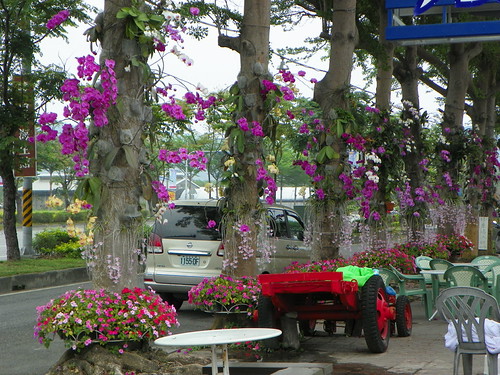
Orchid Flowers On Sidewalk Trees (Taiwan)
For those of you who don't know... there around 30,000 species of orchids... 20,000 of which are epiphytes. A really large chunk of the epiphytic orchids are CAM orchids. This basically means that they are succulents. In fact, with this definition, the orchid family has more succulent plants than any other family... including the cactus family. Quite a few orchids even grow on cactus and other succulents. So with reasonably suitable temperatures such as here in SoCal and in New Zealand... there are literally 1000s of species of CAM orchids that can thrive outdoors on trees in lower humidity habitats.
My gut instinct is that attaching many of these slower growing CAM epiphytic orchids to trees in New Zealand's warmer and lower humidity urban centers would have all sorts of positive externalities. Again and again I'm not advocating or suggesting this... I'm just saying that my gut... which is filled with a not insignificant amount of research into the topic... leads me to this possibility. I just don't see these specialized CAM orchids really competing for the same niches that are preferred by New Zealand's native epiphytes. So I'm really inclined to perceive that it wouldn't be a zero sum game.
In theory, it does stand to reason that the more CAM species that were introduced into New Zealand's urban centers... the greater the chances that one of them would really conquest space and truly crowd out a native orchid. But I think you'd have to introduce quite a few CAM species before the chances were reasonably decent that a native would be displaced. At that point, if you considered all the urban niches (and clearly some wild ones as well) that had been filled... all the added biodiversity... and all the facilitation cascades (fungus partners, pollinators, herbivores and their predators, etc)... and all the carbon sequestering effects... and all the general enjoyment/exposure effects... then it might not seem like a bad trade off. Especially if all of New Zealand's epiphytic orchids have been successfully introduced to California's Pacific Northwest or suitable habitats in Chile. Neither of which have any epiphytic orchids.
The more places that herclivation was implemented... the more progress we'd make towards reaching the goal. This is because it's a numbers game. Orchid seed pods can contain a million seeds. This is pretty much the best recipe for finding where there's room for improvement. So when you have more orchids on trees you greatly facilitate the conquest of space. As a result, orchids would be able to grow on trees in France sooner rather than later.
And by that time that orchids can grow on trees in France it's a given that we'd have far more species than we do now. The more places you put a species, the more species you'll create. This is because no two places are exactly alike. So when the same species adapts to different places... you get more species.
With Edens vanishing around the world... I think there's an obligation to help, in some way, to offset the loss of nature. Maybe herclivation isn't the best way to do this... but we should really encourage and support epiphytic thinking when it comes to such an important topic.
Even though pragmatarianism is a much more important cause... by the time the weather starts to warm up I'm either burnt out trying to sell the creation of a market in the public sector... or the lure of spending my spare time hugging trees with my epiphytes becomes too hard to resist.
Well... even though it's pretty warm... I still haven't hit the wall with pragmatarianism yet. But here I am though! I blame... Catherine Kirby. And Pierrot M.
The reason that I blame Kirby is because of her recent blog entry... Epiphytes in the garden. It's a very exciting entry... she featured Mr. Epiphyte Tree and his most excellent epiphyte extravaganza. She also described a study in Ethiopia where they documented a great variety of epiphytes growing on urban coffee trees. Then Kirby wrote this...
I don't think that the Ethiopian situation is mirrored in New Zealand because we can't achieve forest-like humidity in urban centres but I would be interested to hear from anyone who has a good epiphyte load in their home garden, either planted or naturally occurring?A day or two later Pierrot M posted this comment on my Youtube video Extreme Gardening...
I am really amazed, what you have done is really wonderfull, i have a very big garden ( parc ) in France and i 'd love to do the same, but the climate doesn't allow it. I love orchids, i have seen a lot in the whole world, but the vertical garden you done is unique. A question : is the climate in california soft enough in winter to allow the plants to survive? do you water them? what is the care you do?If Pierrot wants to attach orchids to trees then he'd have to move somewhere else! That's a terrible predicament that nobody should have to be in. Wherever trees can grow there should be dozens or hundreds or thousands of different epiphytic orchids that can grow on them. This is orchids' goal and mine as well.
All plants, but especially epiphytes, and especially epiphytic orchids, are about the conquest of space so eventually we'll get there... but I just wish I was smart enough to figure out a brilliant plan to help us get there sooner rather than later. So far herclivation is the best plan that I've come up with.
Herclivation, which is just a theory, and nothing that I'd advocate without plenty of expert vetting/vouching/validating... would involve the introduction/translocation of non-native epiphytic CAM orchids to places like New Zealand. At this stage in the game this is probably the last thing that Kirby and other experts would want people to do... The last uninvaded frontier? And for all I know she could be right! She probably is right! Let's assume that she's right. But I don't think it hurts to explore the possibility that she's wrong. If she is right then how could her theory not hold up to some poking and prodding?
If you scroll down that entry of hers you'll see that she shared a picture of a Dendrobium (delicatum?) that she suspects was deliberately planted on a tree in nature. To play the Dendrobium's advocate... how does she know that the Dendrobium wasn't from a seed that blew in from Australia where those types of orchids are native to? Is that such an unreasonable assumption given that, as I've already pointed out, epiphytic orchids are all about the conquest of space? If it could be proved, beyond a shadow of a doubt, that this was the case... would she still have removed it? Aren't we guessing that all of New Zealand's native epiphytic orchids arrived from Australia? I actually don't know if that's true or not. It just seems reasonable enough to point out... because it would have been a problem if somebody had "weeded" the first arrivals.
The thing about that wayward Dendrobium is, as every Southern California orchid enthusiast knows, it's perfect for growing outdoors here. And if it can thrive outdoors here in our very dry and extremely low humidity climate... then I think it would be pretty darn perfect for New Zealand's urban centers. Here in SoCal we have to worry about watering this orchid every few days during summer... but in New Zealand urban centers... would they even need any supplemental water?
Oh man, I get green with envy at the thought of orchids on street trees not needing any supplemental water!!! Exhibit A... orquideas plantadas em arvarores (Brazil). Exhibit B (shared with permission)...
Orchid Flowers On Sidewalk Trees (Taiwan)
For those of you who don't know... there around 30,000 species of orchids... 20,000 of which are epiphytes. A really large chunk of the epiphytic orchids are CAM orchids. This basically means that they are succulents. In fact, with this definition, the orchid family has more succulent plants than any other family... including the cactus family. Quite a few orchids even grow on cactus and other succulents. So with reasonably suitable temperatures such as here in SoCal and in New Zealand... there are literally 1000s of species of CAM orchids that can thrive outdoors on trees in lower humidity habitats.
My gut instinct is that attaching many of these slower growing CAM epiphytic orchids to trees in New Zealand's warmer and lower humidity urban centers would have all sorts of positive externalities. Again and again I'm not advocating or suggesting this... I'm just saying that my gut... which is filled with a not insignificant amount of research into the topic... leads me to this possibility. I just don't see these specialized CAM orchids really competing for the same niches that are preferred by New Zealand's native epiphytes. So I'm really inclined to perceive that it wouldn't be a zero sum game.
In theory, it does stand to reason that the more CAM species that were introduced into New Zealand's urban centers... the greater the chances that one of them would really conquest space and truly crowd out a native orchid. But I think you'd have to introduce quite a few CAM species before the chances were reasonably decent that a native would be displaced. At that point, if you considered all the urban niches (and clearly some wild ones as well) that had been filled... all the added biodiversity... and all the facilitation cascades (fungus partners, pollinators, herbivores and their predators, etc)... and all the carbon sequestering effects... and all the general enjoyment/exposure effects... then it might not seem like a bad trade off. Especially if all of New Zealand's epiphytic orchids have been successfully introduced to California's Pacific Northwest or suitable habitats in Chile. Neither of which have any epiphytic orchids.
The more places that herclivation was implemented... the more progress we'd make towards reaching the goal. This is because it's a numbers game. Orchid seed pods can contain a million seeds. This is pretty much the best recipe for finding where there's room for improvement. So when you have more orchids on trees you greatly facilitate the conquest of space. As a result, orchids would be able to grow on trees in France sooner rather than later.
And by that time that orchids can grow on trees in France it's a given that we'd have far more species than we do now. The more places you put a species, the more species you'll create. This is because no two places are exactly alike. So when the same species adapts to different places... you get more species.
With Edens vanishing around the world... I think there's an obligation to help, in some way, to offset the loss of nature. Maybe herclivation isn't the best way to do this... but we should really encourage and support epiphytic thinking when it comes to such an important topic.
Wednesday, December 17, 2014
Tasmanian Tigers/Devils Aren't Bad Consolation Prizes
More pure theory and hypothesis. Again, I do not support or advocate the introduction of any nonnative species.
Reply to: A Different Way To Protect The Ghost Orchid
**************************************************
gnathaniel, thanks for sharing those two examples. That Galapagos story was pretty crazy. What was the takeaway?
Is that right? Am I missing any?
That was kind of grizzly about the goats. I really hope that all that meat didn't go to waste.
Speaking of conservation/eradication...
The Big Kill (hat tip MT)
I knew about the Moas but I didn't realize that there also use to be a giant eagle that preyed on them... Haast's eagle. I always feel ripped off when I learn about a modern extinction...especially when it's something as cool as a giant eagle.
People in the not-so-distant past stole many valuable treasures from us. But it's hard to judge them too harshly because we wouldn't be here if it wasn't for them. As it stands, most of us are really glad that we don't have to live in "those" times.
Prior to humans visiting New Zealand, the islands didn't have any mammals other than a few bats. As a result, birds had the opportunity to adaptively radiate into the major empty niches. The Moas functioned as deer and the eagles functioned as wolves.
This is relevant because herclivation is based on the premise that there's an abundance of unfilled arboreal niches. For reasons previously discussed, I've argued that we should seriously consider filling them as quickly as possible. But, if we had somehow applied my logic to prehistoric New Zealand and filled the empty niches with deer and wolves...then Moas and Haast's eagles would never have evolved.
This does give me pause...but, then again, Tasmanian Devils and Tigers are/were pretty cool as well.
If us humans weren't around, and barring any natural disaster, in a few million years or so Florida's epiphytic diversity would probably rival the epiphytic diversity of present day Costa Rica. And Canada would have as many epiphytic orchids as Florida currently does.
Maybe future Florida would have had a giant species of Ghost Orchid that was pollinated by a moth the size of a hawk. How crazy cool would that have been?
The not-so-minor detail is that us humans, well, we are around. Maybe in the long long run most of us will rocket away and help terraform a swath of lifeless planets. We'll stop cramping mother nature's style here on earth and she could get back to churning out Moas and giant eagles. But who knows when or if we'll ever make it off this planet (it depends on how long it takes people to understand that progress depends on difference).
Because wild habitats have been drastically reduced in size and number...it's a given that the future is going to have far less biodiversity than it would have had. So if we want the future to have more, rather than less biodiversity, then I think we need to seriously consider trying to help maximize the speciation potential of any and all habitats. This means filling empty niches with life...which, over time, will change and adapt to the different selective pressures of the new environments. As I've argued before, places like Florida are a good place to start because there's an abundance of unoccupied arboreal niches.
We can imagine mother nature as a scientist in a laboratory churning out new species. Here we are on this forum because we're big fans of the orchids that she's produced. What's important to understand is that every output, whether it's a Ghost Orchid or a Haarst eagle, depends on inputs. The two main inputs that mother nature needs for her outputs are wild habitats and genetic material. If either input is reduced then her output will also be reduced. Given that we've drastically reduced the amount of wild habitat that she has to work with, mother nature's productivity will drastically suffer...unless we offset the reduction of habitat material by giving her more genetic material to work with.
So the basic function looks something like this...
xSpace * yGenes = zSpecies
x and y are the inputs and z is the output. We've slashed x which means we need to boost y in order to avoid ripping off future generations. They won't get Moas and Haast's eagles but they'll get Tasmanian Tigers/Devils...which are pretty cool consolation prizes.
Reply to: A Different Way To Protect The Ghost Orchid
**************************************************
gnathaniel, thanks for sharing those two examples. That Galapagos story was pretty crazy. What was the takeaway?
- change is constant
- Goats are bad
- Pirates are mostly bad but they can be unintentionally good
- Don't keep all your tortoises on one island (hedge your bets)
- A certain intern has a very interesting resume
- Hybrid swarms can be used to recreate the parent species
- A Hybrid finch might be less suspectible to brain sucking maggots (hedge your bets)
- Future biodiversity depends on how well we play God
Is that right? Am I missing any?
That was kind of grizzly about the goats. I really hope that all that meat didn't go to waste.
Speaking of conservation/eradication...
The Big Kill (hat tip MT)
I knew about the Moas but I didn't realize that there also use to be a giant eagle that preyed on them... Haast's eagle. I always feel ripped off when I learn about a modern extinction...especially when it's something as cool as a giant eagle.
People in the not-so-distant past stole many valuable treasures from us. But it's hard to judge them too harshly because we wouldn't be here if it wasn't for them. As it stands, most of us are really glad that we don't have to live in "those" times.
Prior to humans visiting New Zealand, the islands didn't have any mammals other than a few bats. As a result, birds had the opportunity to adaptively radiate into the major empty niches. The Moas functioned as deer and the eagles functioned as wolves.
This is relevant because herclivation is based on the premise that there's an abundance of unfilled arboreal niches. For reasons previously discussed, I've argued that we should seriously consider filling them as quickly as possible. But, if we had somehow applied my logic to prehistoric New Zealand and filled the empty niches with deer and wolves...then Moas and Haast's eagles would never have evolved.
This does give me pause...but, then again, Tasmanian Devils and Tigers are/were pretty cool as well.
If us humans weren't around, and barring any natural disaster, in a few million years or so Florida's epiphytic diversity would probably rival the epiphytic diversity of present day Costa Rica. And Canada would have as many epiphytic orchids as Florida currently does.
Maybe future Florida would have had a giant species of Ghost Orchid that was pollinated by a moth the size of a hawk. How crazy cool would that have been?
The not-so-minor detail is that us humans, well, we are around. Maybe in the long long run most of us will rocket away and help terraform a swath of lifeless planets. We'll stop cramping mother nature's style here on earth and she could get back to churning out Moas and giant eagles. But who knows when or if we'll ever make it off this planet (it depends on how long it takes people to understand that progress depends on difference).
Because wild habitats have been drastically reduced in size and number...it's a given that the future is going to have far less biodiversity than it would have had. So if we want the future to have more, rather than less biodiversity, then I think we need to seriously consider trying to help maximize the speciation potential of any and all habitats. This means filling empty niches with life...which, over time, will change and adapt to the different selective pressures of the new environments. As I've argued before, places like Florida are a good place to start because there's an abundance of unoccupied arboreal niches.
We can imagine mother nature as a scientist in a laboratory churning out new species. Here we are on this forum because we're big fans of the orchids that she's produced. What's important to understand is that every output, whether it's a Ghost Orchid or a Haarst eagle, depends on inputs. The two main inputs that mother nature needs for her outputs are wild habitats and genetic material. If either input is reduced then her output will also be reduced. Given that we've drastically reduced the amount of wild habitat that she has to work with, mother nature's productivity will drastically suffer...unless we offset the reduction of habitat material by giving her more genetic material to work with.
So the basic function looks something like this...
xSpace * yGenes = zSpecies
x and y are the inputs and z is the output. We've slashed x which means we need to boost y in order to avoid ripping off future generations. They won't get Moas and Haast's eagles but they'll get Tasmanian Tigers/Devils...which are pretty cool consolation prizes.
Saturday, December 13, 2014
Herclivation
Backstory: The Ghost Orchid, Dendrophylax lindenii, is an endangered orchid that grows on trees in the Florida Everglades (plants that grow on trees are epiphytes). I've been fleshing out a theoretical, process based approach... "herclivation"...that could potentially facilitate this orchid's adaptive radiation into different (micro)habitats. This approach would involve introducing its hybrids (ie Gripp's Ghost) and/or closely related species into Southern Florida. Again, this is simply a theory. Let me make it very clear...I do not advocate or support the illegal introduction of plants or animals outside of their native habitats. My hope here is to facilitate constructive feedback, expert or otherwise, on why this plan might not be feasible. Given enough eyeballs, all bugs are shallow (Linus's Law).
This blog entry is a reply to a couple replies in this forum thread... A Different Way To Protect The Ghost Orchid
*********************************************************
lotis146, good lord is right! You're on the 7th page? This is only the second page for me. Either you like clicking page numbers and waiting for pages to load...or nobody told you that you that you can change your settings in order to view more posts per page.
This blog entry is a reply to a couple replies in this forum thread... A Different Way To Protect The Ghost Orchid
*********************************************************
lotis146, good lord is right! You're on the 7th page? This is only the second page for me. Either you like clicking page numbers and waiting for pages to load...or nobody told you that you that you can change your settings in order to view more posts per page.
Subscribe to:
Posts (Atom)