Showing posts with label succulents. Show all posts

Friday, May 10, 2019

Culver City Succulent and Bromeliad Show 2019

Before I share some show pics, I'd like to mention that I finally met my favorite Ficus friend Kyle!!!  We've been online plant friends for nearly 20 years and a couple weeks ago we met at the LA Arboretum.  Scadoxus joined us and the three of us had a great time.  It was surreal meeting Kyle in person after having known him online for so many years.  One big difference is that he's so much funnier in person.  His humor is... subtle?  Not exactly sure how to describe it, but I love it.   

I'm so happy that Kyle is no longer on my list of plant friends that I'd love to actually meet in person.  Two people who are still on this list are Carlos in Brazil (flickr) and Erik in Australia (flickr).  Both of them joined the tropical plant lovers Facebook group that Kyle recently created!  Yay!!!  Now I'm two people closer to realizing my dream of all my plant friends being friends with each other.  I have this very bright idea that, the better connected my plant friends are to each other, the more awesome the outcome.  We can create a huge and incredibly dense network that will quickly capture all the best plants and plant ideas. 

With this in mind, my favorite thing about the show was that several of my plant friends got to meet each other for the first time!  For example, Monica and Sarah met, Dave and Ulysses met,  Rich and Steve met and so on.  Each meeting really deserves its own blog entry!

I enjoyed the show itself and took several pics of the show plants.  Unfortunately, I'm not happy with how many of the pics turned out (insert typical excuses here... ie poor lighting), but I figure that even a poor pic of a great plant is better than nothing.  Some of my motivation in sharing the pics is that I've got a plant friend, not going to mention any names, *cough* Allison *cough*, who doesn't think that bromeliads are so wonderful.  Yikes!  Unfortunately, she wasn't able to make it to the show, so figured it might be worthwhile to bring the show to her, and to you too! 


Cyrtanthus elatus x montanus

This wasn't in the show, it was in the sales area for $20.  Since Scadoxus loves bulbs, but wasn't at the show yet, I texted her a pic and asked if she wanted it.  She replied asking if it had a pretty flower.  Heh.  Steve ended up buying it and then later on when I searched my gmail for "Cyrtanthus" I learned that, not too long ago, Shawn had given me a small bulb of this species and I had given it to Scadoxus.  Sheesh.  There's actually a Cyrtanthus epiphyticus!  Yes, I already tried it epiphytically and sadly it didn't survive.  It was a long time ago though, so maybe it was before I started using the quality New Zealand Sphagnum moss for certain plants.  I haven't tried many bulbs epiphytically but so far the biggest winner by far is the pregnant onion (Albuca bracteata). 


Hydnophytum formicarum

This is a really cool epiphyte that has a big caudex that, in nature, provides a home for ants.  In this case we get a peak inside the caudex.  Exhibited by Laurel Woodley who I was lucky enough to chat with.  In 2013 I took a pic of the same plant at the same show.  She brings it inside during the winter.  I've been growing a related species, Myrmecodia beccarii, outside year around since 2012.  It is still small though because I have it on a small mount without much moss and it probably doesn't get as much water as it would like during the summer.  Maybe I should auction it off at the upcoming VGT plant share? 

Dave has been growing Myrmecodia platytyrea entirely outside (with protection from the rain) for a few years in Eagle Rock...


Maybe it's the biggest epiphytic ant plant in the Rubiaceae family that is growing outside year around in California?  Do you know of a bigger one?  If you're interested in learning more about this species I highly recommend checking out the ant-plant forum. 

Back to the show...


Sedum torulosum

Also exhibited by Laurel Woodley.  For a while I've really appreciated the "treelike" Sedums and Crassulas.  For example, check out Sedum dendroideum ‘Colossus’.  Do you see the picture of Myron Kimnach standing next to it??  Woah!!  Mine is around 3', I should really bring some cuttings to the plant share. 


Sinningia polyantha

Similar to the Sinningia piresiana growing on my tree, but much taller.  Yes, I sincerely do wish that I had learned about Gesneriads a whole lot earlier!


Aeonium Bing Thing

Aeonium Bing Thing = (tabuliforme ×  arboreum Zwartkop) × sedifolium.  This is a crazy cool cross made by John Trager.  A. sedifolium is super tiny!  I'm very glad that Nels Christianson decided to enter this plant into the show!  Remind me to ask him if he'd be willing to trade a cutting of it for something.  I'd also be happy to have some seeds of it, because I'd be very curious to see how much variation there would be among the seedlings. 


Peperomia Amigo Marcello

Woah!  Is this the right name??  I've been calling this Peperomia Elmer Lorenz for years, because that's who gave it to me, but he didn't know the name.  This Peperomia does great epiphytically. 


Euphorbia sp

Unreal!!  Wish that the pic was clearer!  Anybody know which species it is? 


Rebutia flavistyla

Exhibited by Christine Kaunitz.  I'd love to see this species growing and blooming on a tree! 


Pelargonium punctatum

This one stunned Fernando.  Heh.  Stunned me too!  This would look amazing on a tree!  He is actually growing Pelargonium tetragonum epiphytically.


Vriesea Strawberry

Dang, I'm so disappointed that my picture failed to capture the luminescent glow of this bromeliad!  :( 


Vriesea Strawberry

Closer pic. 


Billbergia Casa Blanca

Fun foliage!


Billbergia Mystic Torch

Billbergia Mystic Torch = (Pink Champagne x Arriba) x Domingos Martins.  More funner foliage? 


Epiphytically Enhanced Branch

Tillandsia albertiana, Maxillaria tenuifolia (?), Crassula (which one?), Ledebouria socialis, Hoya serpens, Rhipsalis... wow!!  Exhibited by James W Schumacher.  I'd sure like to make friends with this guy!!


Tillandsia duratii

This is the bigger variety.  The sequentially opening flowers are relatively large and very fragrant.  I think they smell kinda like grape kool-aid.  Everybody should grow this species.  Exhibited by ESSC member Rich Fleg! 


Tillandsia novakii

So so so so impressive!!!!   Several years ago I first saw this species at the Conservatory of Flowers and instantly loved it.  Fortunately, this one was exhibited by ESSC member Sarah de Heras, so hopefully there will be seeds available to spread around! 


Tillandsia novakii

I volunteered Ulysses to provide some scale.   Thanks bro, sorry about the bad pic!  :( 


Tillandsia sp

Also exhibited by Sarah de Heras.  Love it!  Hopefully she will place it next to the Tillandsia novakii so that the hummingbirds can cross-pollinate them. 


Tillandsia prodigiosa

Also exhibited by Sarah de Heras!  Not the best pic, and the spike isn't fully developed, but everybody should know about this Tillandsia.  Check out the Google Image search results for this species.  One sad thing about this species is that it is monocarpic!  Ugh.  Hopefully it will produce lots of seeds though. 


Scadoxus' haul box, it was the prettiest one that I ever did see!  I'll share the list later on. 

If you live in the Los Angeles area and love plants then be sure to join Village Green Thumbs!  And if you live outside of the LA area and love tropical plants, then be sure to join Tropical Plant Lovers!

Tuesday, February 26, 2019

Sorry

I'm all about elevating the discourse but... rules have exceptions.


Titania McGrath is funny.  I wanted to share this pic in this thread.  In another thread I want to share a photo of Dischidia formosana growing epiphytically on my tree fern (VGT post for more info).


In a third thread I want to share this photo of Scadoxus' Scadoxus puniceus (VGT post)...


Saturday, September 22, 2018

Growing Succulents Epiphytically

For Agaveville Forum

***********************************

Ever wonder why humans are exceptionally intelligent?  My theory is that it's because walking upright gave us the ability to simultaneously carry many things, and deciding what to carry is cognitively challenging.  Correctly discerning what to keep, and what to discard, depends on using more brainpower to process more information.  I collect relevant passages... jettison... here's one that I found on this forum...

Also, I recall reading a post somewhere a few years back written by someone who said he knew DW, and went on to describe how DW had thousands of hybrids, and saved the best, and discarded (believe it or not!) MANY of his "rejects" into a canyon off his property. The story goes, he did this until he caught wind that others were scrounging his castoffs in that canyon, after which he started destroying them instead. - Spination, A couple more new to me hybrids

Recently I separated a bunch of Echeveria rosea seedlings...


I'm pretty sure that most of the larger seedlings have Echeveria gibbiflora as their father.  It was blooming at the same time in the same area as rosea.  Am I going to destroy any of these seedlings?  Nooooooo.  Echeveria rosea is my very favorite Echeveria, so I really want everybody to grow it and/or its hybrids.  I'm going to give all the seedlings away next month at the Village Green Thumbs plant trade.  My friend Scadoxus and I recently created that Facebook group for plant enthusiasts in her area (Culver City) to trade/share/sell plants.  One person's trash is another person's treasure.  

Echeveria rosea is primarily an epiphyte, but I've found that it isn't a drier grower.  It slowly declined  on my tree when I reduced watering from 3x to 2x a week at night during summer.  Echeveria gibbiflora, on the other hand, is not an epiphyte but it is a drier grower, so the seedlings on my tree had no problem with less frequent watering.  Unfortunately they tended to slowly break their own necks.  Here are a couple exceptions that are starting to spike...


These are more compact than the typical form, all of which broke their necks.  In the photo you can also see an orchid blooming and a dragon fruit blooming.  The dragon fruit is actually growing on the fence.  Here's a pic of the orchid...


Rhynchovola Jimminey Cricket (Brassavola nodosa × Rhyncholaelia digbyana) is a strong grower that blooms more often as it gets more pseudobulbs.  The flowers are pretty big, but they aren't very long-lived... and the color white really doesn't stand out on the tree.  Ideally when an orchid blooms on a tree every hummingbird in the neighborhood should be drawn to it.  

This orchid is definitely a relatively succulent orchid.  But I'd prefer if this thread was primarily about growing non-epiphytic succulents epiphytically.  For example...


Plectranthus spicatus has succulent leaves and does quite well on the tree.  You can see another Plectranthus that's thriving... but it isn't nearly as succulent... I don't know the name of it.  

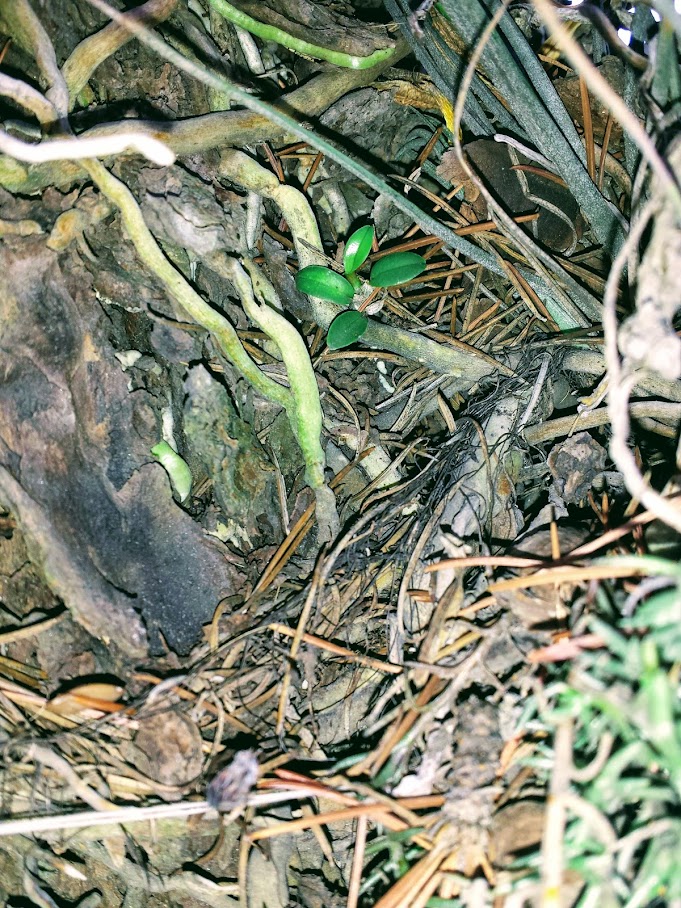
In Feb 2016 I sowed a bunch of Golden Barrel Cactus (Echinocactus grusonii) seeds together with seeds from Reed Stem Epidendrums.  It turned out that birds really like to eat the cactus seeds.  Fortunately I didn't keep all my eggs in the same basket.  I put a few pots in buckets covered in clear plastic, here's one of them...


If you look closely you can see one reed-stem seedling... it's the only green thing in the pic.  The cactus won this round, maybe because the medium was too big for the tiny orchid seeds.  

I also sowed some of both seeds behind a mounted Platycerium, here's a recent pic...


There are actually quite a few seedlings competing for very limited resources.  Here's another mount that I sowed some of the seeds on....


In this case I think most of the cactus seeds, or seedlings, fell off.  Neither of these mounts were watered frequently enough for the reed-stem seeds to germinate and/or grow.  

Some of the cactus seedlings in pots are much bigger than the mounted seedlings.  But it's not like I really have the space for a mature Golden Barrel cactus.  The mounted seedlings won't get very large.... they will essentially be bonsai'd.  Well, in theory!

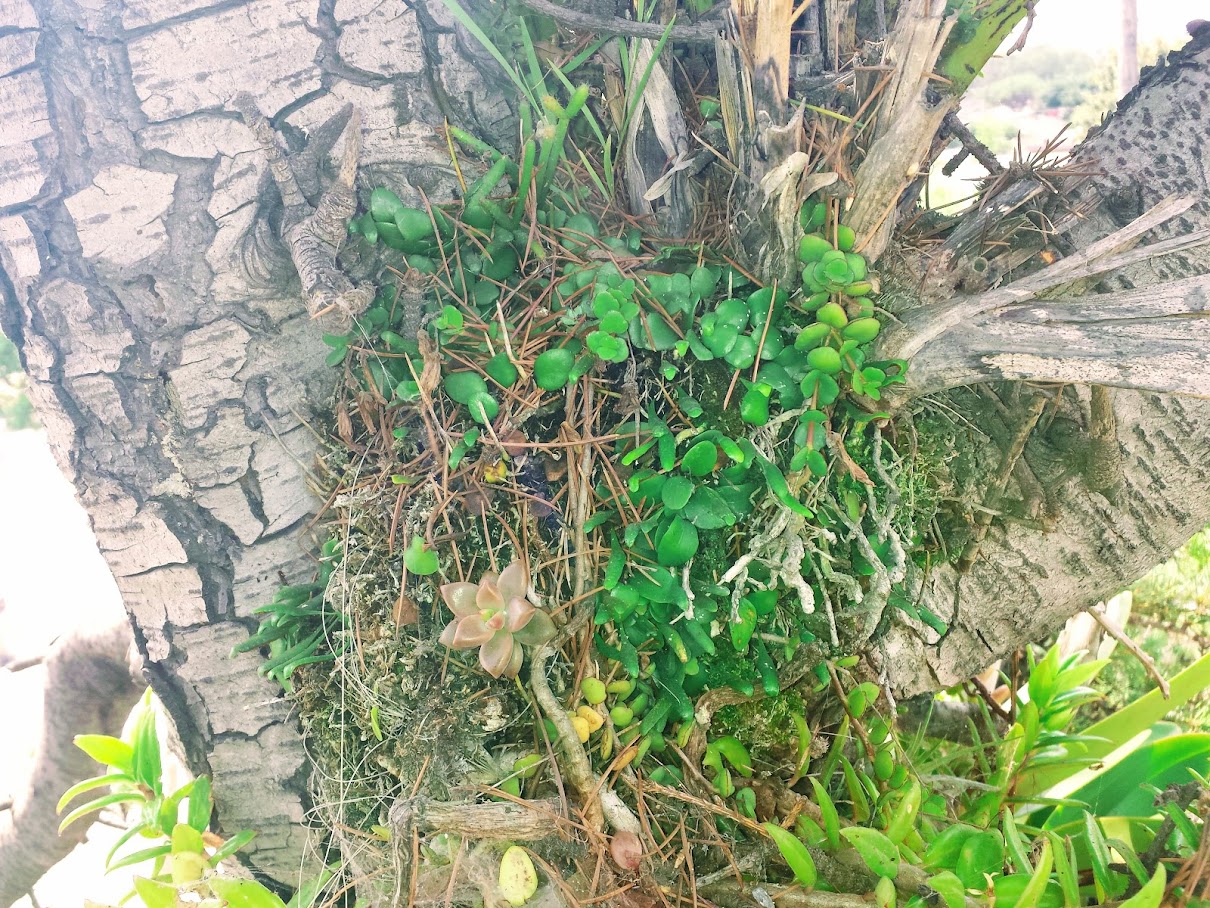
On Flickr I created a gallery of accidentally epiphytic cactus and here's a gallery of accidentally epiphytic succulents.  Anybody recognize this Aloe?  I'd love to know what it is because it's sure thriving on that tree.  Some of the stems of this Aloe are much longer and thicker than I realized when I first saw the pic.  I'm somewhat embarrassed to admit that I only just recently mounted my first Aloe... Aloe bakeri.  

For some reason you can't add your own photos to your own galleries, so I created an album for my photos of accidentally epiphytic plants.  There are a few succulents in it.

Three years ago at the Huntington I took this pic of an Aloe accidentally growing on a big cactus...


Anybody recognize the Aloe?   

Daniel Gledhill, who is very knowledgeable about tree Aloes and runs the Tree Aloe group on Facebook, said that he's seen Aloe thraskii growing epiphytically before.  He also informed me that Thomas Cole's Aloes of Uganda mentions that Aloe lukeana can be found growing on trees.

Why aren't there already the Aloe equivalents of epiphytic cactus?  Maybe it's because Aloe seeds are less likely to end up on trees than cactus seeds.  

Thanks to the Pinoy Epiphyte Addicts group on Facebook, I indirectly learned about a thread created in this forum for Agaves growing epiphytically.  Not sure how I managed to overlook that thread.  I didn't overlook the 2009 thread that Stone Jaguar created in the Growing on the Edge forum for Yucca lacandonica.  A Google search revealed a somewhat blurry picture of Agave mitis growing epiphytically in a cloud forest (Tamaulipas).   All these pics have got me really curious how a nondescript miniature Agave I have would do epiphytically.

A few years back, in the XericWorld forum, I created a thread for the same topic of growing succulents epiphytically.  I, and others, added quite a few pictures and links to the thread... it was really great!  But then one day the entire website was gone.  Evidently the owner decided that it was no longer worth carrying.  It was obviously his prerogative to make that decision, but his decision certainly wasn't informed by my valuation of my threads and other people's threads.  He knew the cost and benefit of the website for himself, but he didn't know the benefit of the website to others.  As a result, his cost/benefit analysis wasn't correct. 

Whether we're talking about a plant forum or an Aloe hybrid, correctly determining the actual worth of something depends on giving everybody the opportunity to share their valuations of it.    

Friday, September 22, 2017

Cedar Tree Epiphytes

[update] If you have trouble seeing any of the photos in this entry try this link to my Google photos album. [/update]

Recently I got thinking about one of my vining epiphytes...


Cattleya Portia coerulea Mounted


It's on the second mount from the left.  At first I was pretty sure that it was a Dischidia.  My guess was Dischidia acuminata.  But then I became pretty sure that it was a Hoya.  My guess was Hoya micrantha.  I think the reason that I changed my mind was because I saw the flowers.  They looked a lot more like Hoya flowers.  However, they were so small and underwhelming that I didn't bother taking a photo of them.

What's remarkable about this Hoya is how well it does epiphytically.  It does really well.  Really well!   It's definitely a very strong contender for the best epiphytic growing Hoya family plant in Southern California.  I've seen it in several people's collections but nobody ever knows its name.

The other day I decided to inspect the one growing on my Cedar tree...


Hoya NOID


This one growing on the tree has smaller leaves that are yellow and quite succulent.  During summer I usually water the tree 2x/week at night.  As the temps get cooler I water less frequently.

I inspected the plant more closely but didn't see any flowers.  But I did see this...


It's a seed pod!  Surprise surprise!  The only other of my Hoyas that has produced a seed pod is Hoya serpens.  So far none of my Dischidias has produced a pod.

The other plants in the photo are a bunch of Tillandsia aeranthos volunteers growing on a Nematanthus stem.  Yesterday I was eating some lemon guavas off my tree and I brushed a bit of spider web off of one.  When I looked closer at the web, it was actually the "parachute" of a Tillandsia aeranthos seed, that had just started to germinate.

Also in the photo is Dockrillia teretifolia.  I have three different ones on my tree.  They've all had plenty of time to become specimens, but none have done so.  Maybe they want more water?

Finding the seed pod on my Hoya got me extra curious to see what else was happening on my tree.  So I started climbing.  Here's one of the three NOID orchid seedlings that most recently germinated on my tree...


Here's a pic that I took last year of one of the other NOID seedlings...


New Orchid Seed Germinated On My Tree


All three seedlings are growing next to the roots of a Vanda tricolor/suavis.  The seedlings have been growing soooooo slow.  It's like they are trying to kill me with suspense.

The previous batch of seedlings that germinated on my tree all turned out to be Laelia anceps.  There are around half a dozen on the tree... ranging from super small to blooming size.  I thought the largest seedling would bloom for the first time this year... but nope.  It's been around 6 years since they germinated.  Sheesh.  Here's an album with some pics.

Speaking of super slow seedlings... at the top of this NOID Sedum there was a succulent seedling...


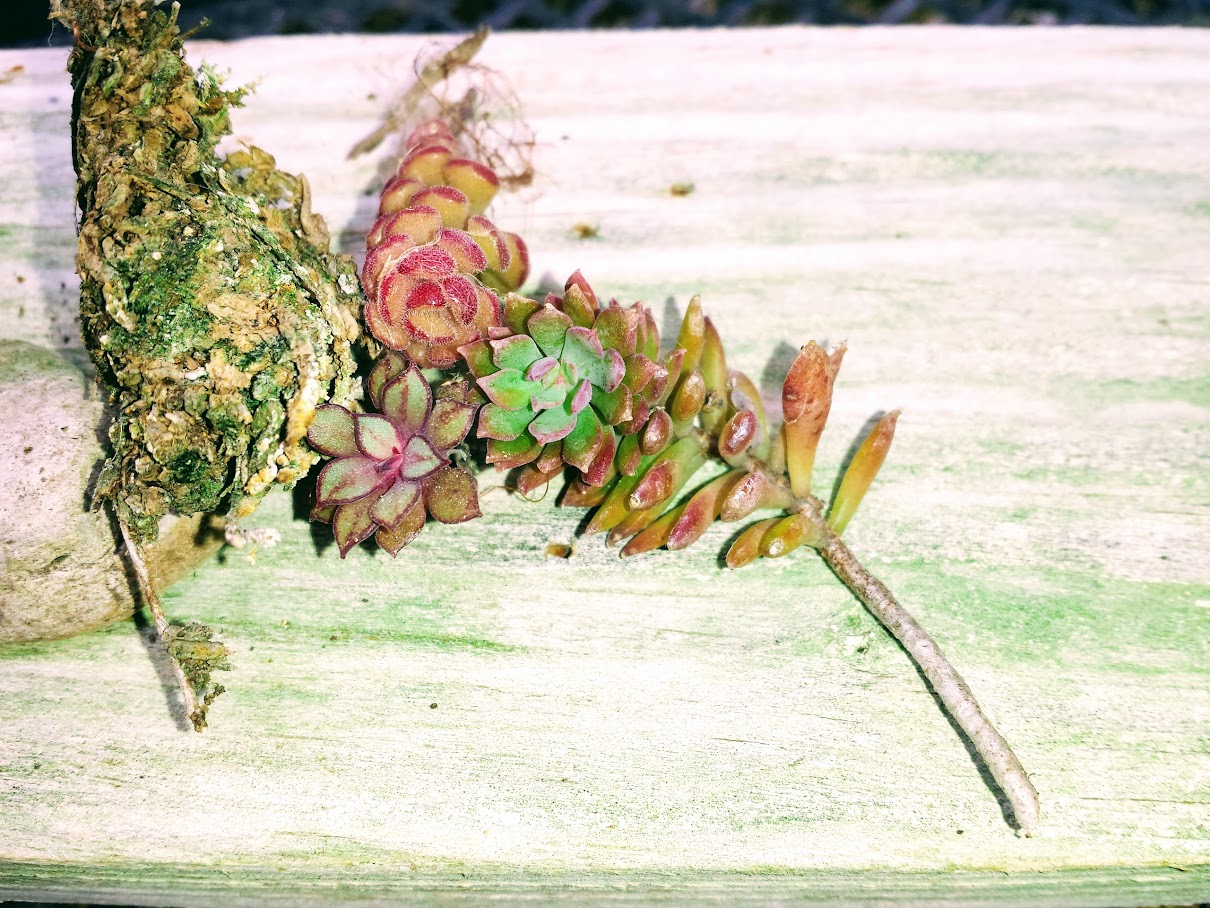
At least I'm pretty sure that it was a seedling.  I was happy to discover that it was still there.  It's been hanging in there for several years.  So I decided to carefully remove it along with a section of the moss that it was growing on.  Here it is with two other small succulents...


Sedum versadense (top) and Sedeveria 'Acultzingo' (right) were also growing on the tree.   The third succulent is the NOID seedling.  Perhaps it's Echeveria nodulosa.  I did sow some seeds of it on my tree a long time ago.

I attached all three succulents to a board with Sphagnum moss on it.  The mount is now hanging in a small section of my garden that I water 3x/week at night during summer.  Hopefully the seedling will respond positively.  As I mentioned in this blog entry, I would like to try and cross Echeveria nodulosa with rosea.

Here's one of the Echeverias that has done really well on the tree...


I'm guessing it's Echeveria minima.  Also in the photo is Columnea Elmer Lorenz, Dischidia formosana, Crassula pruinosa, Sedum rubrotinctum and Cattleya Portia coerulea.

The Echeveria clump is happily growing among the roots of Anthurium schlechtendalii.  If you look closely just below the Echeveria clump you'll see the Anthurium's two very first offshoots.  What's rather surprising is the amount of distance between the offshoots and the root crown.  The angle of the photo makes it hard to tell but the distance is around 2 feet.  Then again, now that I think about it, perhaps they might be seedlings.  Every couple of years or so the Anthurium manages to produce quite a few berries.

One very consistent and productive fruiter is Columnea Elmer Lorenz...


Here are all the fruits that I harvested...


Last month I harvested pretty much the same amount of fruit.  Columnea Elmer Lorenz is the only epiphyte I have that is almost always in bloom.

In order to extract the seeds, I peel the skin and put the fruit into a water bottle that I fill half way with water.  I put the lid on and shake the bottle vigorously to separate the seeds and the fruit.  The seeds will sink to the bottom and the fruity water can be poured off.  Usually there are at least a few unsunken seeds so I'll pour the fruity water into a large bottle.  Once I'm done processing all the epiphyte fruit (ie Anthurium) I'll pour the contents of the large bottle on mounts and in hanging pots/baskets.

This time I decided to drink the Columnea's fruity water.  I knew that the fruit was edible.  Well... I guessed that it was edible.  I remember Kartuz saying that Codonanthe fruit is edible.  Not sure though if he said that all Gesneriad fruit is edible.  Anyways, the Columnea fruit water turned out to be quite bland.

But it got me thinking about how different cultivated corn is from wild corn.  What would the fruit of Gesneriads, Rhipsalis or Anthuriums look and taste like after a 1000 years of selection?

I climbed a little higher on the tree and took a photo of the roots of this Cattleya Portia coerulea...


The roots are covered in moss.  Unfortunately this moss doesn't really escape onto the bark.  I super wish that I could find a moss that would be happy to grow directly on the bark.  It would help capture and germinate all sorts of seeds and spore.

Here's a photo of the shady side of the Anthurium schlechtendalii's root ball...


The plants in this photo include Columnea Elmer Lorenz, Dischidia formosana, Anthurium NOID seedling, Polypodium aureum, Crassula marginalis minuta (?) and an Aeonium that grew from seed that I sowed on the tree.

The Anthurium seedling grew from a seed that I received from Loran Whitelock during a tour of his place.  He had a decent sized Anthurium growing in the ground that had quite a few ripe berries on it.  I asked if I could have some and he said sure.  After I got home I sowed them on the tree.  This seedling and a bigger one higher up on the tree are the result.  Unfortunately, I don't remember taking a photo of the mother Anthurium.  But I'm guessing that it's something that has been referred to as  Anthurium 'whitelockii'.  This page has a picture of a mature plant.  What's rather tricky is that PalmBob and a few other sources indicate that the name has been changed to Anthurium faustomirandae.  From my perspective though the size and orientation of the leaves are quite different.  Plus, the leaves of Whitelock's plant are much more glaucous.

A few years back Dylan Hannon sold an Anthurium on eBay that was very similar to Whitelock's.  Here was the description that he gave...

Anthurium sp. Tomellin Canyon, Oaxaca, Mexico. This is a dramatic species that slowly grows to about 3ft across and not quite as tall. Leaves are strikingly blue-glaucous, very tough and heavy. Spadix and spathe are maroon. Fruits take well over two years to mature. This is an excellent outdoor plant in Southern California and has been around a while since its introduction by the late Loran Whitelock. It goes under a few names but I am not sure any of them are correct and it could still be an undescribed (new) species. Sale item (2nd photo) is a young seedling.

Let's set this mystery aside for a bit and continue climbing the tree...


Not sure if this succulent is a Sedeveria (Sedum x Echeveria) or a Graptoveria (Graptopetalum x Echeveria).  Maybe it's Graptosedum (Graptopetalum x Sedum) Alpenglow?  Whatever it is, it can get a nice bronzy/burgundy color and does really great on the tree.  It grows super easy from leaf cuttings.  I just break some leaves off and place them wherever I want this succulent to grow.  Evidently I wanted it to grow here among the roots of Cymbidium madidum.  For some context, here's a picture that I took last year...


Cymbidium aloifolium and Cymbidium madidum


The other orchid blooming in this photo is Cymbidium aloifolium.  On the shady side of this orchid is a really neat trailing fern...


Lemmaphyllum microphyllum is an epiphyte and lithophyte from Japan.  It's perfectly happy with our temps here in SoCal.  It can handle drying out, especially during the winter, but it does appreciate a decent amount of moisture when it's warm.  Like the rest of the plants on the tree, this fern receives water 2x/week at night during summer.  However, it's growing on a decent amount of Sphagnum moss.  So far it has not managed to "escape" from the moss.  One of the best escape artists, as far as ferns go, is the somewhat larger trailing epiphytic fern Microgramma vacciniifolia.

Moving up the tree even further I have a big clump of plants all growing with the really excellent fern Aglaomorpha coronans...


In this photo you can see a never-blooming Oncidium sphacelatum, a Codonanthe carnosa (round leaves) that grew from seed sown on the tree, several Echeveria gibbifloras that also grew from seed sown on the tree, and a clump of seed sown/grown Tillandsia aeranthos.

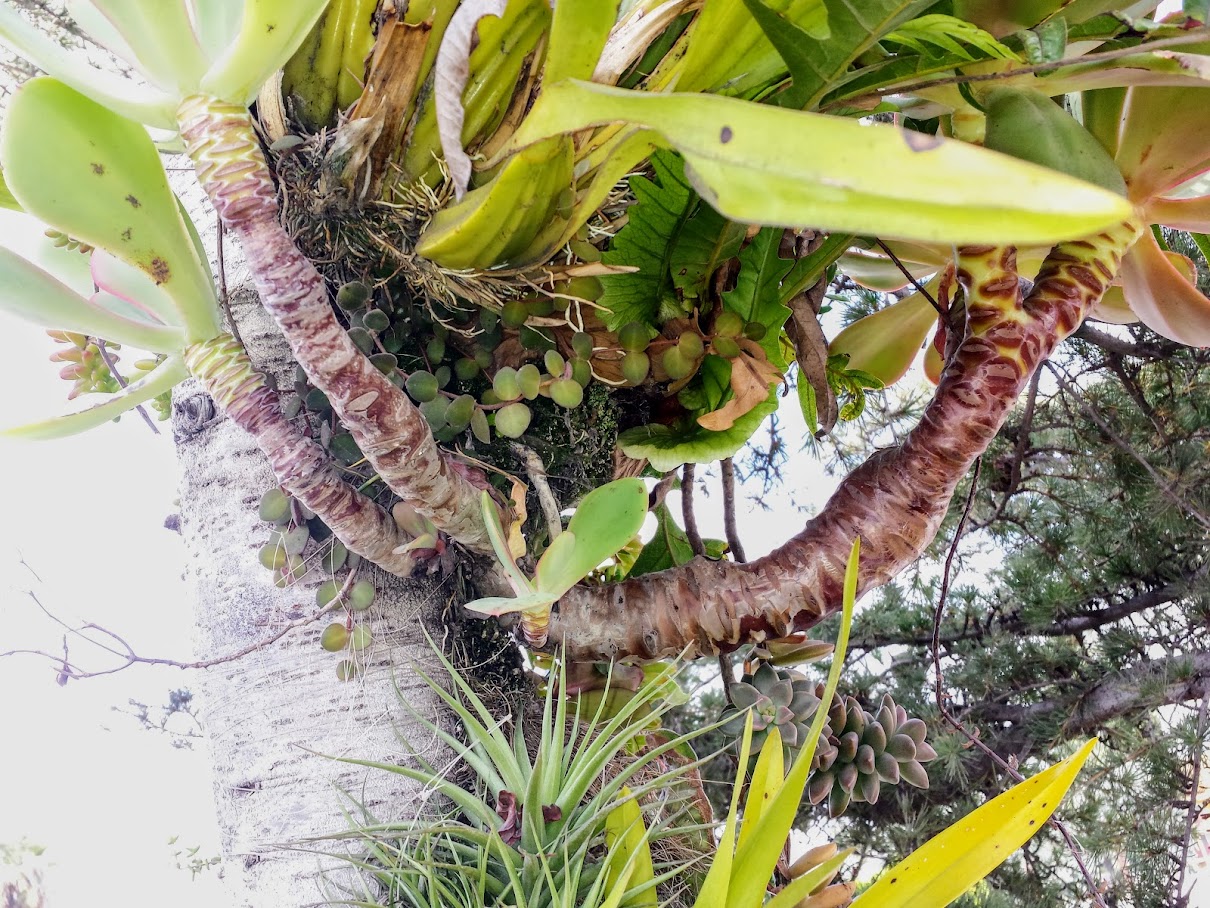
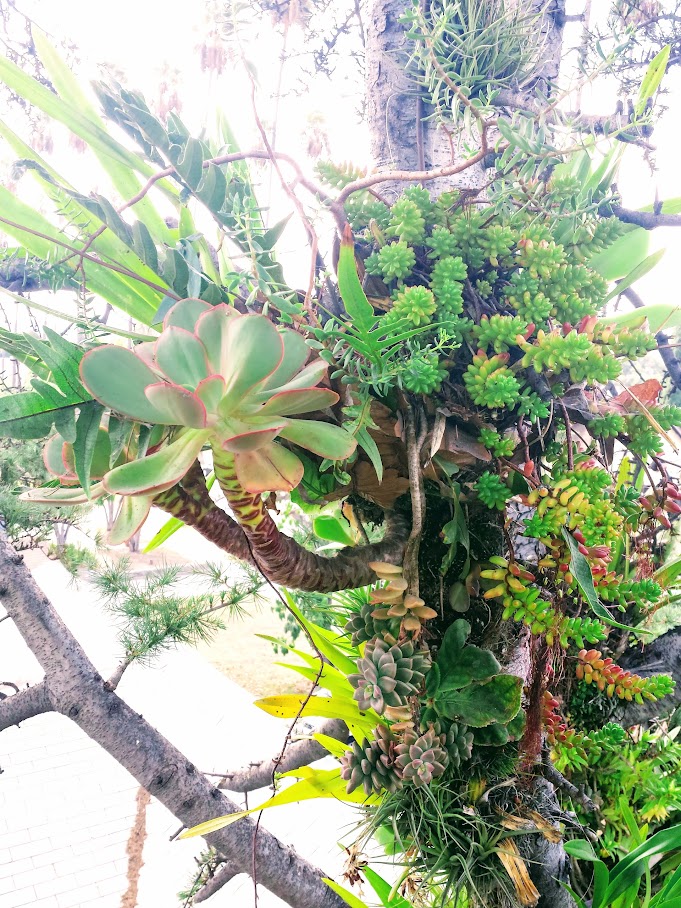
As I mentioned in this entry, the E. gibbiflora seedlings grew really great on my tree... until they reached blooming size.  The very large and heavy rosette would badly bend the trunk and the plant would slowly deteriorate.  There have been a few exceptions.  The E. gibbiflora seedlings in the photo that are growing to the left aren't quite blooming size but the seedling growing to the right is.  It has already bloomed for a couple years but the trunk still hasn't badly bent.  One difference is that this seedling, unlike all the ones that badly bent, has branched.  You can see it a little better from this angle...


There are several different plants in this photo.  At the top is Tillandsia aeranthos (by far my most productive Tillandsia), Crassula sarcocaulis, Sedum rubrotinctum, Oncidium sphacelatum, Aglaomorpha coronans, Echeveria gibbiflora, NOID succulent (Sedeveria?), NOID Sinningia and another clump of Tillandsia aeranthos.

This gibbiflora has actually branched twice and is going to branch again.  Another difference, besides branching, is that the leaves aren't as long and the red outline seems to be more pronounced.  Here's the view from above...


In the upper left hand corner of the pic you can see the second Anthurium seedling that grew from seed that Whitelock let me have.  It is just starting to get the glaucous appearance of mature plants.  Recently I asked my friend if he had Anthurium whitelockii.  He said that he did and he gave me a seedling.  It is between my two seedlings in size, and looks somewhat similar.

If you only saw the Echeveria from this angle you'd really have no idea that it's actually one plant.  Here's a picture that I took last year of the mother plant...


Echeveria Epiplus Orchid - With Trimmed Bush


I attached a Dendrobium orchid and a few Tillandsias to the trunk of the Ecehveria.  It's near a Parkinsonia aculeata tree which has grown quite a bit.  As a result, the Echeveria was in too much shade and it started to lean.  Here's a recent pic...


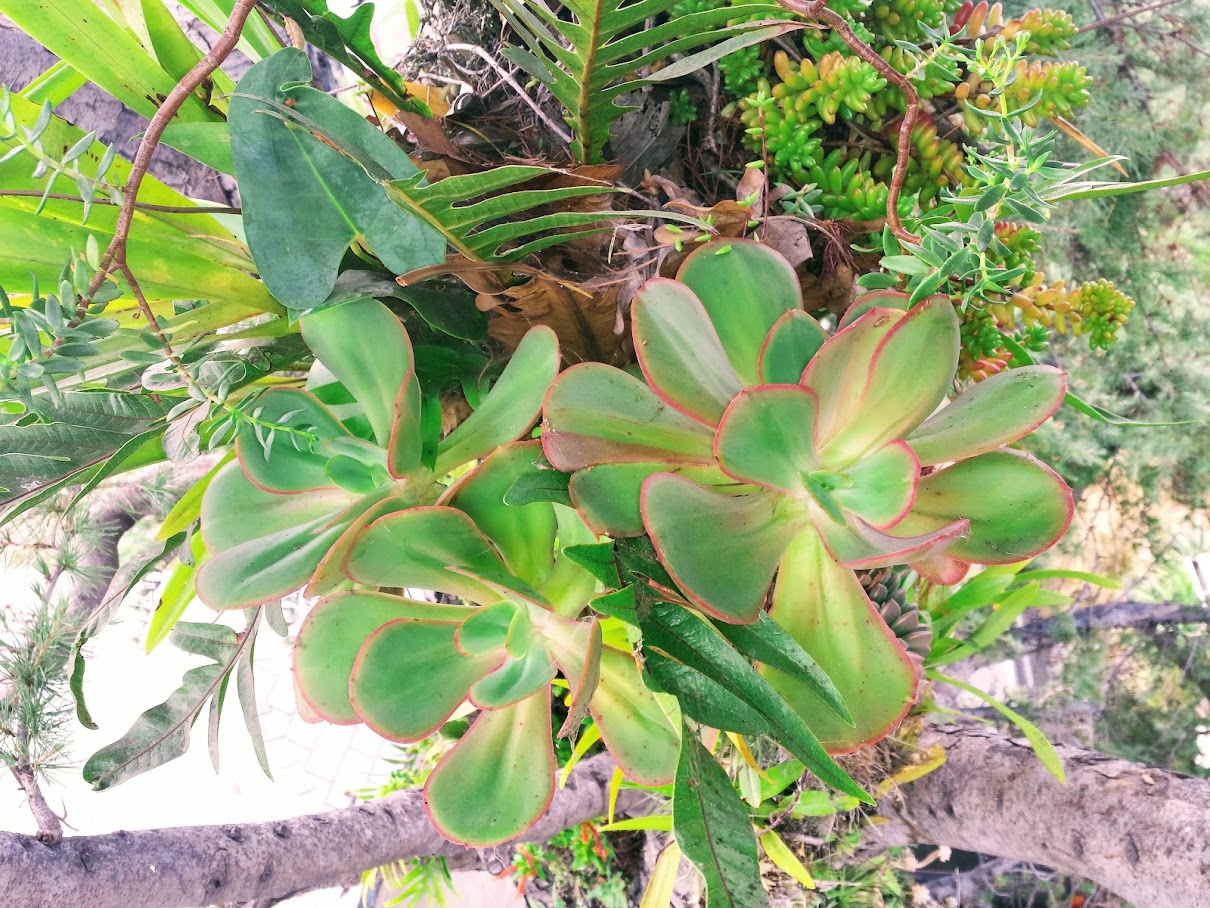
Echeveria gibbiflora fell into the open arms of Kalanchoe beharensis.  It would be wonderful to have a sturdier Echeveria that readily branched.  Then epiphytes could be attached to its branches.  One potential cross with this goal in mind would be to cross Echeveria gibbiflora with Sedum dendroideum ‘Colossus’.  Wow!  But I'm guessing that they wouldn't be compatible though.

In addition to harvesting a bunch of different seeds from the plants growing on my tree, here are some of the plants that I harvested...


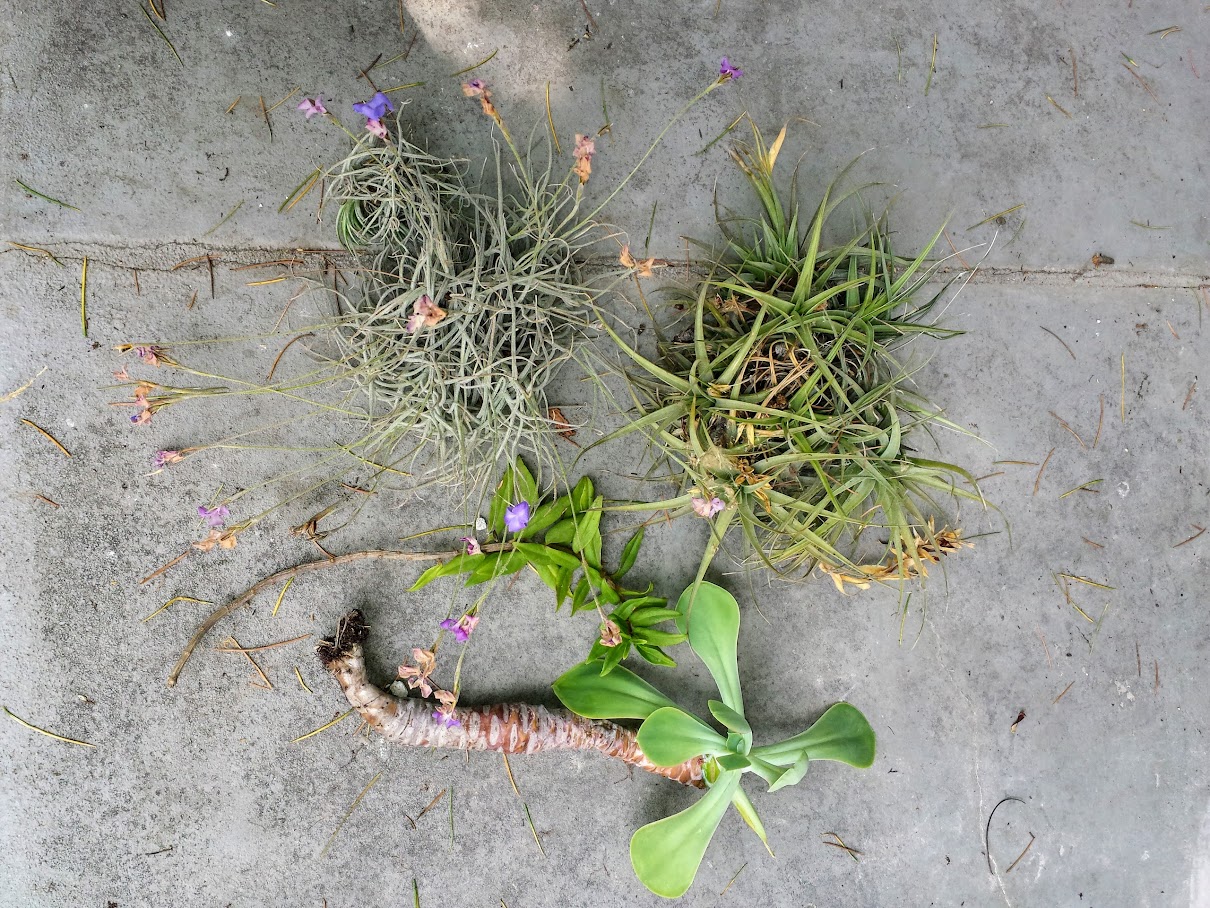
Tillandsia mallemontii clump (upper left) grew from seed that I sowed on the tree.  The picture really doesn't do it justice.  It was so full of blooms that I decided to remove the clump to share divisions with members of the Epiphyte Society.  The Tillandsia aeranthos clump (upper right) grew from seed that volunteered on my tree.  It was growing in my way so I decided to remove it to share.  Below the Tillandsias is a cutting of Columnea Elmer Lorenz.  I didn't make the cutting.  Last month I found 3 other cuttings.  I'm guessing that a squirrel or raccoon had made them.  The last plant is an Echeveria gibbiflora seedling that grew from seed that I sowed on the tree.  It was hanging rather precariously.

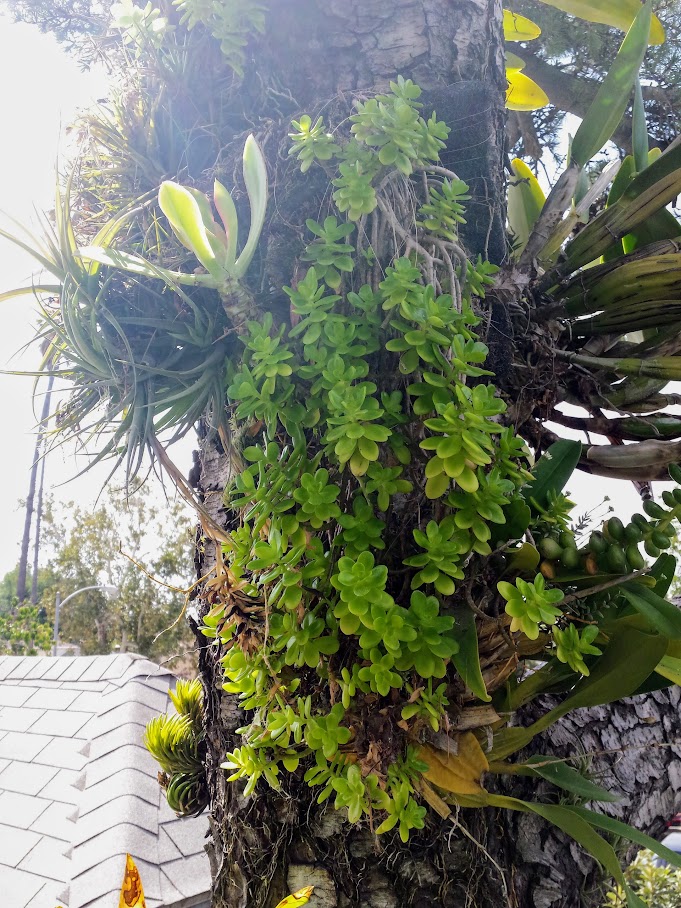
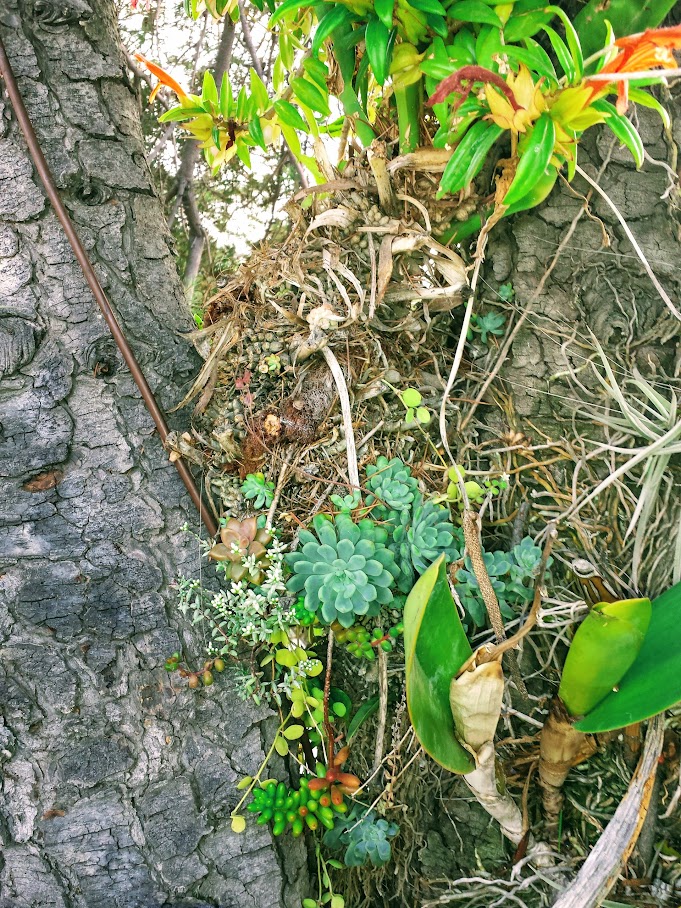
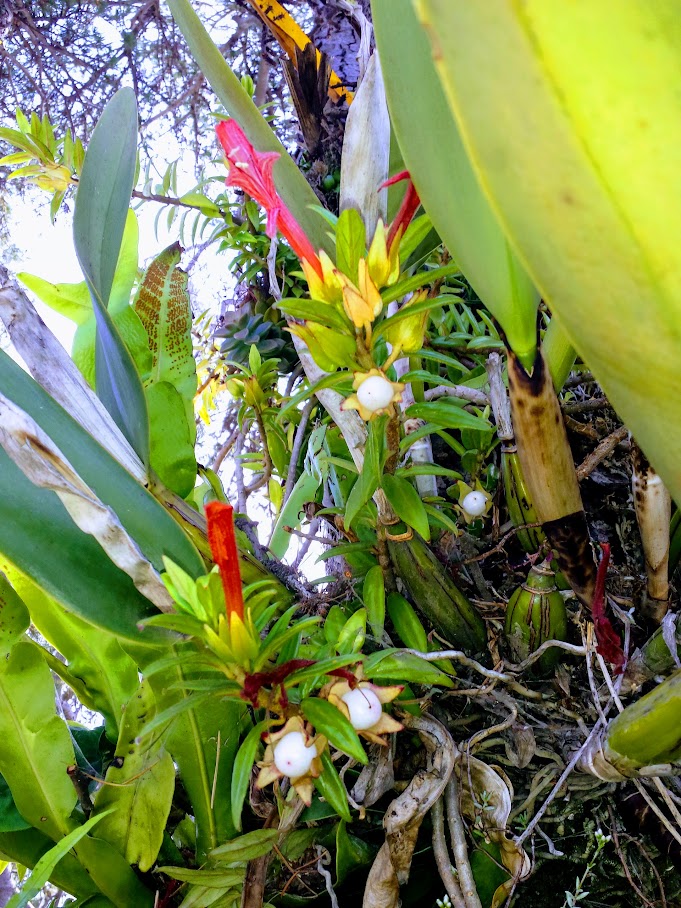
My tree has so much going on!!!  I probably only documented 5% of it.  Watching the tree is better than watching most TV shows.