************************
In 2011 I sowed a bunch of different orchid seeds on my Cedar tree and much to my very pleasant surprise some of them actually germinated...
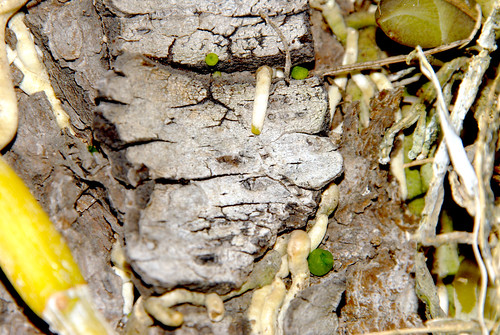
All the seedlings turned out to be Laelia anceps. Over the years I've documented the growth of the largest seedling...
December 2012
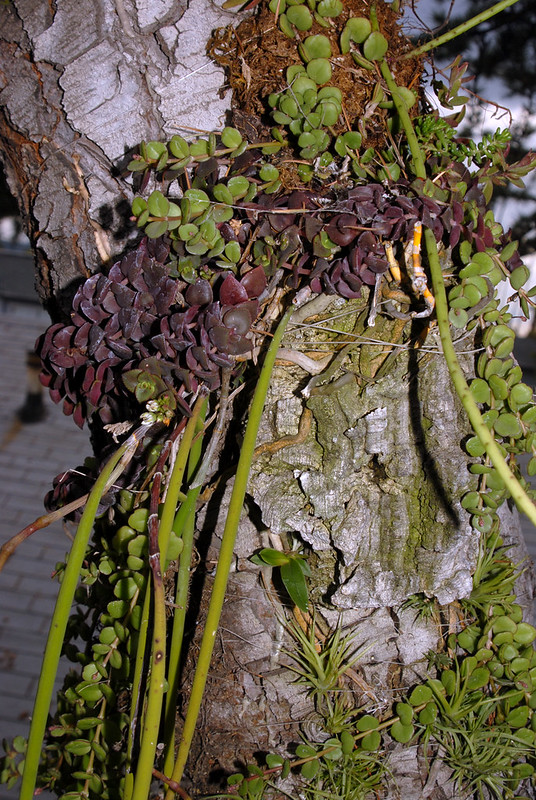
June 2013
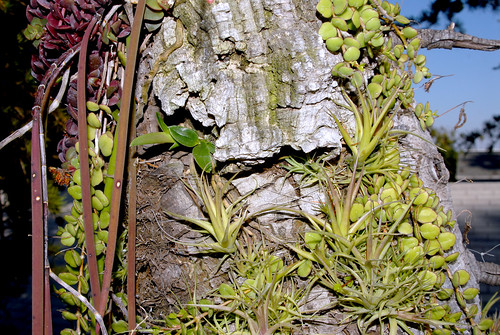
Dec 2013
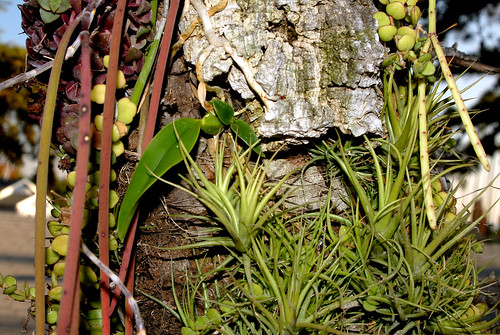
Aug 2014
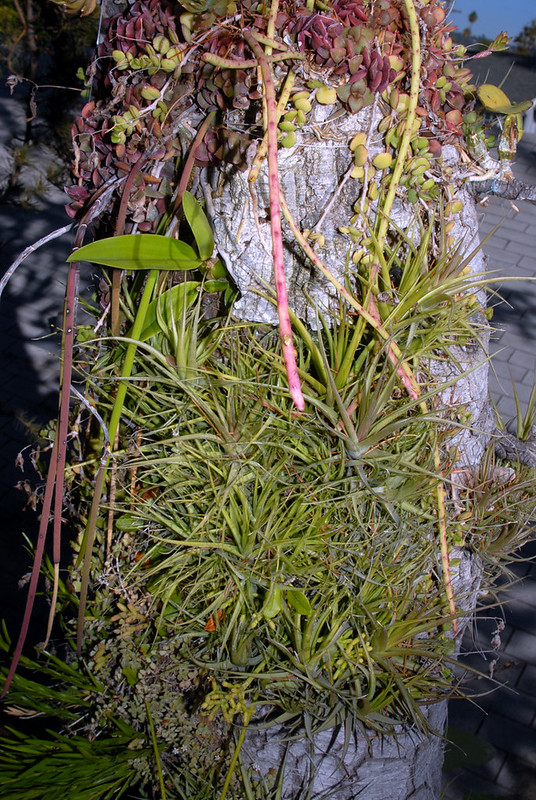
Nov 2014
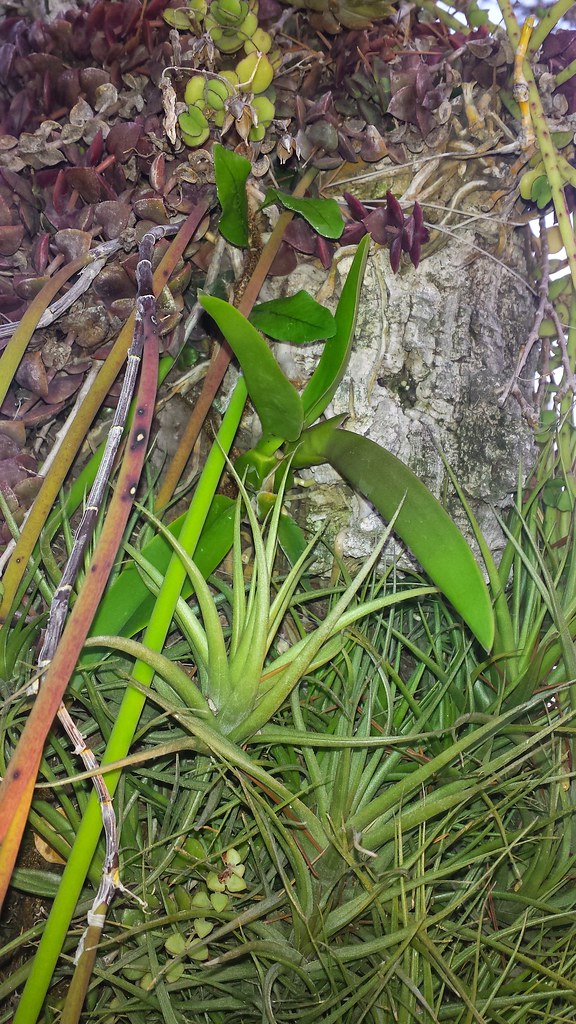
April 2016
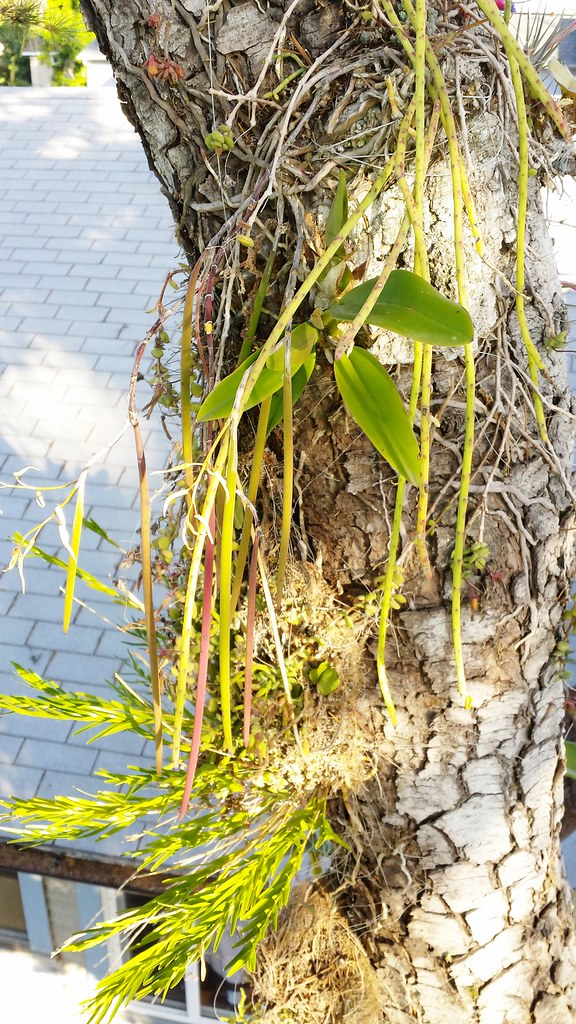
June 2018
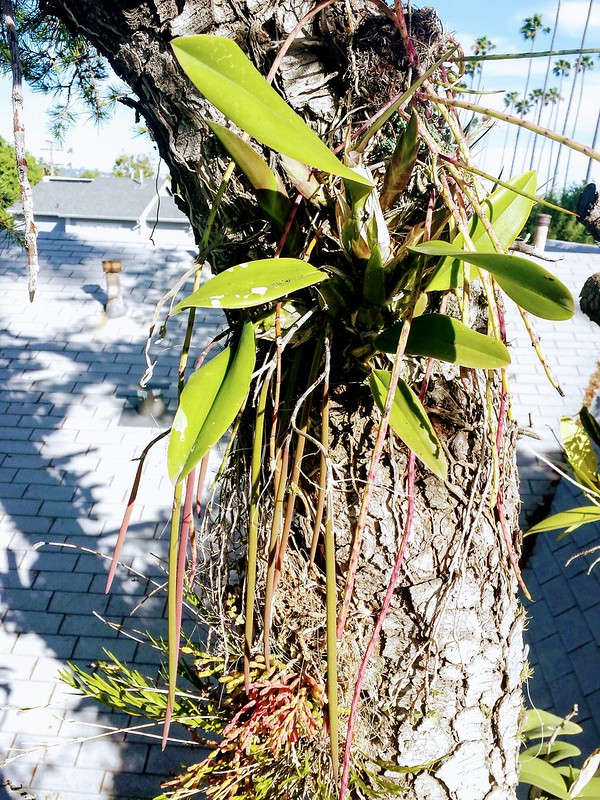
There's a really big disparity between the seedlings in terms of size. Here's one of the smallest seedlings...

What explains the remarkable size disparity? Is it because of the difference in the seeds and/or the difference in the microhabitats and/or the difference in the helper fungus?
The largest seedling germinated right next to the roots of a slow growing variety of Dendrobium teretifolium. Evidently the Dendrobium harbored a fungus in its roots that the Laelia seed was able to put to good use. Is this fungus from Australia like the Dendrobium, or from Mexico like the Laelia, or is it pantropical? In any case, given that the Laelia is in the process of outgrowing and overgrowing the Dendrobium, clearly it isn't always advantageous for an orchid to harbor fungus that can help germinate the seeds of unrelated orchids. I wonder whether the seeds of this Dendrobium would be able to germinate near the roots of this Laelia.
Right now the largest seedling has five new pseudobulbs starting to grow. In many, if not most, years its pseudobulbs mature around August and new ones would start to grow. They would mature late winter or early spring. Part of the reason for this is because this individual hasn't yet allocated any energy to blooming! It is definitely not precocious. The trade-off between growing and blooming is quite interesting.
Last year I removed two keikis from my very wonderful Dendrobium Gloucester Sands (discolor x canaliculatum) and attached them to boards...

The smaller keiki decided to put out roots and a new pseudobulb while the larger keiki decided to bloom. Blooming is very costly in terms of energy so, for a plant this size, I'd normally nip the spike in the bud, so to speak. In this case I decided to leave it for illustrative purposes. Some animal decided to mostly override my decision by eating all of the buds except for one.
The "pockets" made of shade cloth are filled with slow-release fertilizer granules. This effectively fertilizes all the mounted plants beneath it, but I really shouldn't have attached the pockets to the boards. Bundling the pockets and the boards discourages me from moving the boards. Instead, I should have made completely "independent" pockets. Another thing, seedlings and small newly mounted divisions don't respond well to lots of fertilizer.
Getting back to the Den Gloucester Sands, here are its roots growing on my Pachypodium lamerei...

Here's a video of it...
Diversity is the best. Last September I excitedly purchased a flask of Bc Beulah Bradeen (Cattleya walkeriana x Brassavola nodosa) from eBay. Both parents have done quite well for me so I was very curious to see whether their offspring might do even better. As per my standard operating procedure, I carefully mounted the largest seedlings on sections of trellis wood...

I distributed all the mounts throughout the garden. So far only around five seedlings survived the winter. And it was a pretty reasonable winter... it didn't even freeze.
Why did so many seedlings die? Was it primarily from a lack of heat? Or was it primarily from a lack of water? During winter, for most of my plants I drastically cut back on watering. In any case, given that a few seedlings survived, there's certainly variation in terms of the seedlings and/or the microhabitats.
One issue with flasks is that there's usually no selection in terms of drought tolerance. Last fall I had a relevant e-mail discussion with an orchid hybridizer in Australia who specializes in tea tree orchids. He had recently registered Dendrobium Ultraviolet, which is a cross between a less succulent orchid, Den Berry, and a more succulent orchid, Den canaliculatum. Even though the cross is 62.5% canaliculatum, it looks more like kingianum.
My theory is that, in a flask with adequate moisture, storing water is a disadvantage. Seedlings that are more succulent are going to lose the competition for limited space to the seedlings that are less succulent. So when a more succulent orchid is crossed with a less succulent orchid, if the seeds are flasked, then the seedlings will be less succulent.
I think the same concept must be true for temperature. If a cooler growing orchid (ie Den Berry) is crossed with a warmer growing orchid (ie Den canaliculatum), and the flasked seeds are kept cooler, then the seedlings will predominantly be cooler growers. I doubt that any professional flasking laboratories expose their flasks to temps as high as the temps that Den canaliculatum experiences in its native habitat. Basically, the deck is stacked against Den canaliculatum's warmer growing and drought tolerating traits.
Orchids populations, like all populations, conform/adapt to their conditions/environment. Here's the most relevant passage that I've found on the general topic...
An ovule is successfully fertilized by only one pollen grain out of (potentially) many thousands. If fertilization is performed at a sufficiently low temperature, the growth of chilling-resistant genotypes of pollen will be favored over others. These will reach the ovule first so that their genes will appear in the resulting seed. At no other stage of development can selection be made on such large numbers of genotypes. - Brad D. Patterson and Michael S. Reid, Genetic and Environmental Inlfuences on the Expression of Chilling Injury
What's very interesting to consider is what happens when an orchid is pollinated during the spring or fall here in Southern California. A few days ago the high temps were in the low 90s. Now the highs are in the low 70s. That's a pretty big range of high temps. Imagine how much impact this fluctuation would have on the race for the ovule. In theory the most hercuthermal genotypes should win the race.
Laelia anceps generally blooms from fall to spring... depending on the plant and its conditions. Honestly I don't even remember pollinating my Laelia anceps. For all I know the seeds that germinated on my tree were from a Laelia anceps owned by unknown neighbors. But in terms of adapting to SoCal's climate, it is advantageous for Laelia anceps to bloom when it does. Unfortunately, its blooming also coincides with my break from my plants. I think that, after the seeds germinated on my tree, I only once tried to pollinate my anceps, but no pods developed. Evidently the pollen that I used (ie Brassavola) was too different.
There have been a few other times when I sowed other orchid seeds on my tree. Only one of these other sowings was somewhat successful...
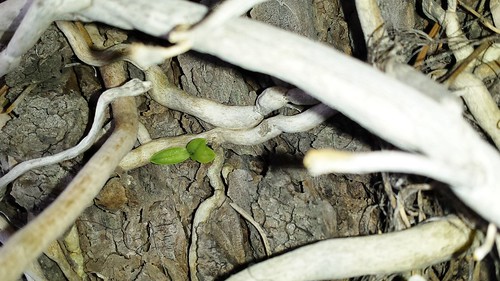
I noticed this NOID seedling in 2016. It germinated right next to the roots of a Vanda tricolor. I looked around and managed to spot a few other similar seedlings in the vicinity. It is definitely a sympodial orchid and its pseudobulbs and the undersides of its leaves are burgundy. When Camille1585 asked for an update on the Laelia anceps seedlings, I climbed the tree and noticed that one of these NOID seedlings was about to fall off because somebody, probably a squirrel, had dislodged the piece of bark that it was attached to. I carefully removed the seedling and attached it to a board...

If you zoom in you can see a bunch of reed-stem Epidendrum seeds germinating near the NOID seedling. My hope is that the helper fungus in the roots of the NOID seedling will inoculate the reed seeds. It's my best guess that, unlike other orchid seeds, reed seeds already have enough nutrients to germinate on their own. Even if this is the case I still want to help to spread the fungus that helped the NOID seedling germinate.
The board is sitting on my coffee table without any sort of covering and its right under a bendy octopus type lamp that stays on during the day. Right now the reed seeds are completely dry. Hopefully this is giving an advantage to the marginally more drought tolerant individuals.
Next to the NOID seedling's mount is another mossy mount that has a reed seedling on it...

Also on the board are some Echeveria gibbiflora seedlings and a Schlumbergera microsphaerica that I received last fall. The Schlumbergera grew quite well over the winter. I'm really happy with how well it has done even though the house was coldish during the winter. If anybody is interested, this species is currently for sale on eBay. The vendor also has some other interesting plants for sale.
Getting back to orchids, one of my very favorites is Dendrobium trilamellatum...
This robust epiphyte thrives in habitats in which few other orchids can survive. It occurs from a little south of Cooktown to the islands of Torres Strait, southern New Guinea and the Top End of the Northern Territory. It is a species of the very seasonal and hot open melaleuca woodlands where the wet season usually starts in December with occasional storms building to heavy rain in January to March, followed by a dry season in which virtually no rain falls from June to November. The Yellow Antelope Orchid flowers in spring (July to November) and the flowers are attractive, long lasting and pleasantly scented. They are about three to four centimetres across. In cultivation this species does moderately well, but must be given a dry season and the medium must be well drained. - Bill Lavarack, Bruce Gray, Australian Tropical Orchids
Last month mine bloomed for the first time. There were only two flowers. I really wasn't quite in my plant "mood" yet, but because I love this orchid so much, I knew that I'd be really disgruntled with myself if I didn't endeavor to put the pollen to good use. So I used the pollen to try and pollinate two closely related Dendrobiums...
Dendrobium canaliculatum x (parnatanum x trilamellatum)
Dendrobium canaliculatum x antennatum
Both these orchids now have a seed pod developing on them, but the first orchid's seed pod is twice as large. When the pods ripen should I sow the seeds on my tree? I'd like to, in order to select for the individuals that are best suited to my conditions, but I'm not confident that any seeds would germinate. Right now I'm leaning towards offering the seeds to the curator of the Huntington's succulent collection.... John Trager. A while back he had an Oncidium cebolleta cross flasked and the seedlings were included as part of the 2012 International Succulent Introductions (ISI). It was really great to see an orchid offered alongside the other succulent plants. Since that year no other orchid has been offered in the ISI so naturally I think it's time for another orchid, or two, to crash the succulent party.
If I was going to summarize all of this entry with one word... I'd go with "Californication". It's a show staring David Duchovny as a writer. Unfortunately the show isn't about plants but the word "Californication" strikes me as really relevant to the incredible and amazing and fascinating process of the millions and millions of non-native plants growing here in California being selected for, and adapting to, California's climate. Any Californian who grows non-native plants outdoors helps to facilitate this process, especially when they grow these plants from seed. In theory, since orchids produce so many seeds, they should adapt the fastest. But then there's the tricky issue that virtually all orchid seeds require fungus or flasking to germinate. Well, this issue is only tricky if we assume, or decide, that Californication is truly desirable.
Anybody else a fan of Blade Runner? The setting is Los Angeles in 2019. There's an abundance of flying cars, but a scarcity of plants. Personally, if we are going to err, then we should err on the side of too many plants. If we're going to give future people something to complain about, then let them complain about an abundance of plants. Let them complain that California has too many different varieties of tree Aloes that host too many different varieties of orchids that nourish too many different varieties of hummingbirds and harbor too many different varieties of lizards.
Maybe the one movie that best depicts how we should err is Annihilation. This passage comes to mind...
A few species of orchids are occasionally able to become established in very odd microhabitats. Withner (personal communication) reports seeing small orchids - probably Comparettia Poep. And Endl. - growing on mango leaves. Since the leaves last about three years, this suggests that the orchid may complete a life cycle within this relatively short time. Even more bizarre, Bowling (orchid propagator, Kew; personal communication) told me that he had once seen a tiny Microcoelia Lind. Growing on a spider's web in Ghana! I very much doubt, however, that either leaves or webs will ever become very important orchid habitats. - William W. Sanford, The Orchids, Scientific Studies
Here's a photo of orchids growing on leaves, here are some photos of an orchid blooming on a leaf, and here's a video of an orchid blooming on a leaf. Unfortunately I haven't seen a photo of an orchid growing on a spider's web, but I've seen plenty of spider webs on orchids. Maybe Sanford is correct that leaves and webs won't become important orchid habitats but, given that ants live inside the pseudobulbs of certain orchid species, and virtually all orchid seeds need a fungus in order to germinate, and there are many different orchids that are happy to grow on cactus, I personally wouldn't underestimate potential associations between orchids and other organisms.
[UPDATE]
The largest Laelia anceps bloomed on Jan 2019....


