Showing posts with label Columnea. Show all posts

Thursday, July 26, 2018

Everybody Should Trade Plants In Los Angeles

Nobody walks in LA, but everybody in LA should trade plants.  And give them away as well.  In previous years I've posted free plants on Craigslist and usually quite a few people have responded.  This year not so much.  But one of the responses was an invitation to check out the Facebook group for Plant Traders Los Angeles/OC Garden Trading Community.  I did so and it sure seems like a pretty great bunch of plant people.  How come it took me so long to get the memo???

They have a trade coming up this Saturday and I've been trying to prioritize which plants to share.  So far I've posted that I have seeds of Echeveria coccinea available...


Here are some other seeds or cuttings that I should share...

Columnea Elmer Lorenz seeds
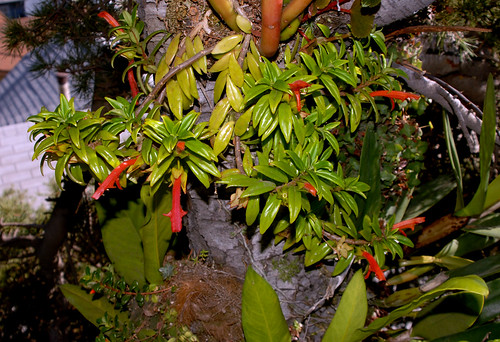

The Best Orchid Companion


Not sure what its "real" name is... maybe it's Columnea crassifolia?  The leaves are certainly very succulent... for a Columnea.  My plant mentor Elmer Lorenz gave it to me several years ago and I've been really happy with it.  This epiphyte is exceptional because it stays in bloom for almost the entire year.   My friend Dave says the same is true of Columnea schiedeana.  I wonder which one would grow the best epiphytically.

Anthurium scandens (xeric form) seeds


Anthurium scandens Growing Epiphytically


This epiphyte is the winner of the 2011 Epiphyte Grand Prix.  The flowers aren't showy but it does make nice clusters of purplish fruits.

Epiphytic Kalanchoe cuttings (bundle)

Here's what would be included in the bundle...

- Kalanchoe ‘Orangery’ (K. manginii × K. jongmansii)
- Kalanchoe schizophylla (hemiepiphyte)
- Kalanchoe 'Tessa' (K. gracilipes x K. manginii)
- Kalanchoe uniflora (my favorite)
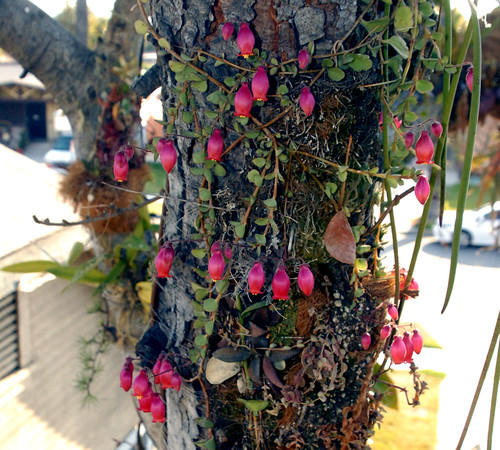

Kalanchoe uniflora Growing Epiphytically


Mixed succulent seeds

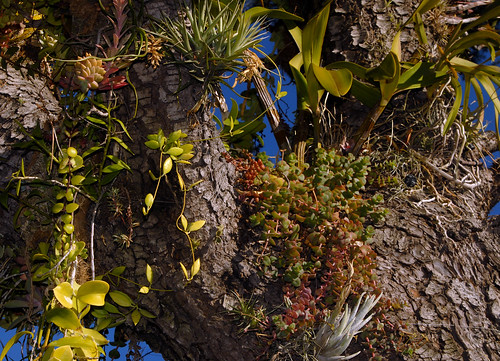
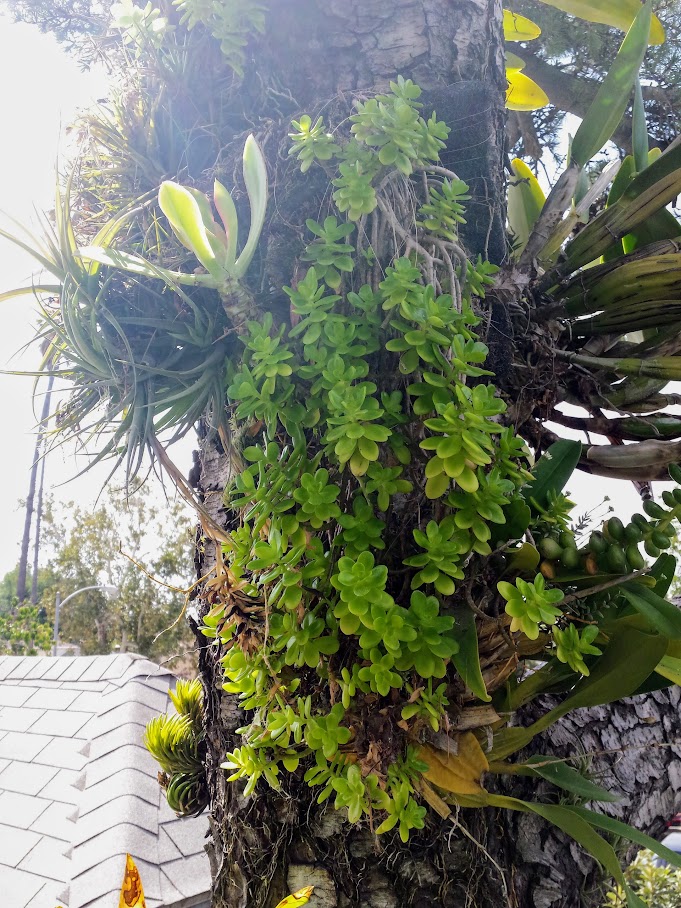
I have lots of different succulents, mostly in the Crassulaceae family, happily growing on my tree.  For example...


I'm guessing that this little succulent is Echeveria minima.   The seeds from this succulent, and from several other ones growing on my tree, will be included in this mix.

Mixed Tillandsia seeds

The seeds from various Tillandsias growing on my tree.  Primarily from Tillandsia aeranthos but also from a few others such as ionantha...


Tillandsia ionantha -  My Highest Epiphyte


Reed-stem Epidendrum seeds

Most orchid seeds don't have enough nutrients to germinate on their own.  In order to germinate in nature they depend on specific varieties of microscopic fungus to supply the necessary nutrients.  My impression is that the seeds of some orchids, such as those of reed-stems, are an exception to the rule.

Sowing Instructions

I sow all these seeds, except for the Tillandsia seeds, the same way.  First I put some well-drained medium into a small pot.  Then I add a layer of New Zealand Sphagnum moss on top.  I sow the seeds on the moss, put the pots in zip lock bags and place them near a bright window or under grow lights.

For the pots I use 500 ml water bottles.  I cut the tops off, remove the labels and cut some drainage holes in the bottom.  Three of these fit nicely in a gallon zip lock bag.

Usually I don't completely seal the bags, but this means that every so often I'll have to inspect them to make sure that pots aren't drying out too much.  I think it's safer to err on the side of too dry rather than too moist.  If the pots are too moist then they can start to get slimy.

I rarely ever sow one type of seed by itself.  For example, when I sow the reed-stem seeds I'll include one or two seeds from Anthurium scandens in the pot.  This helps me hedge my bets.  Using small pots also helps to hedge bets.  It's important to avoid putting too many eggs in one basket.  For example, my friend had several different nice plants in a terrarium.  They were all wiped out when she introduced a new plant.  Putting three small pots in one bag helps to limit the spread of pathogens.

I also hedge my bets by using different medium mixes.  Mixes include different combinations of...

- peat
- perlite
- pumice
- small bark

For the Tillandsia seeds I usually sow them directly on suitably sized branches which I'll soak at night 3-4 times per week.

Seed Sowing Logic

The point of growing plants from seed is select for trait combinations which are the most closely suited to your conditions.   Seeds are all different, which means that they won't all prefer the same exact conditions.  Some seeds will be better suited to your conditions than others.  Plus, seeds won't be equally tolerant of heat or cold or dryness.   All progress with plants depends on growing them from seed.

Updates 


While I'm at it, here are some recent pics of the plants growing on my Cedar tree...


Meiracyllium trinasutum pretending to be an Encyclia (nematocaulon).  Also in the photo is Tillandsia albertiana and Microgramma vacciniifolia.


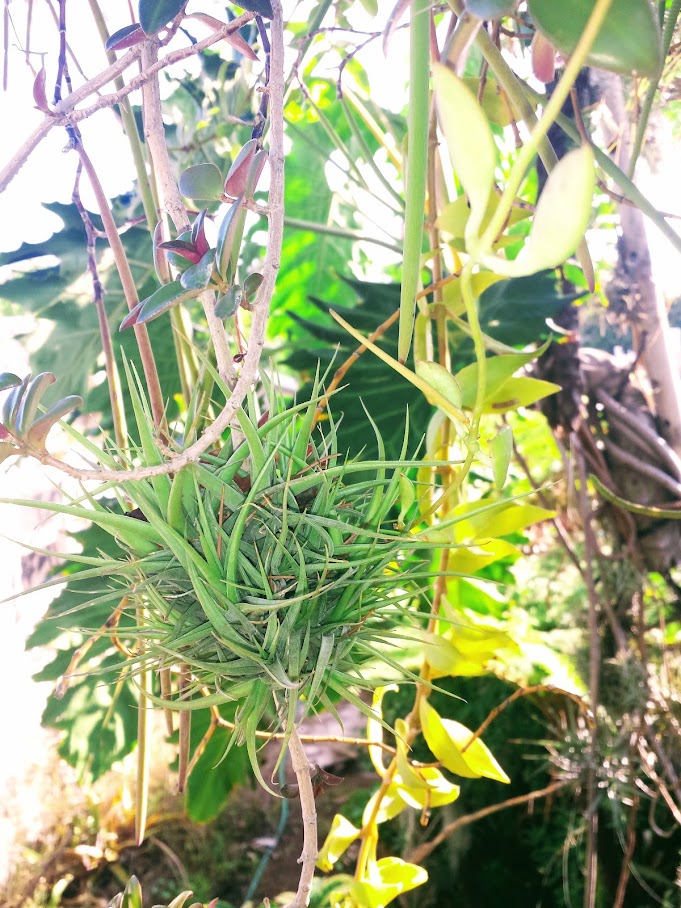
This Tillandsia aeranthos volunteer looks a little different... like it's more star-shaped or something.  Looks similar to this one.


This looks like a seedling of Cotyledon orbiculata.... but I don't remember sowing any of these seeds on the tree.


This Crassula pruinosa isn't the most exciting, and this photo isn't so great, but I'm happy with this little dangling succulent.  It has earned some attention.


Several years ago Elmer gave me several seedlings of Anthurium coriaceum.  I shared several with my friends and put a few on my tree.  Mine grew so much slower than my friends'.  Well yeah, they put theirs in pots!  But I'm happy to see that the new leaf on this one is significantly larger than the older leaves.


This is Lemmaphyllum microphyllum, a miniature fern from Japan, growing on a big bunch of New Zealand Spahgnum moss around three stories up on my tree.  The fern hasn't managed to escape from the moss, but a different variety of moss is trying to....


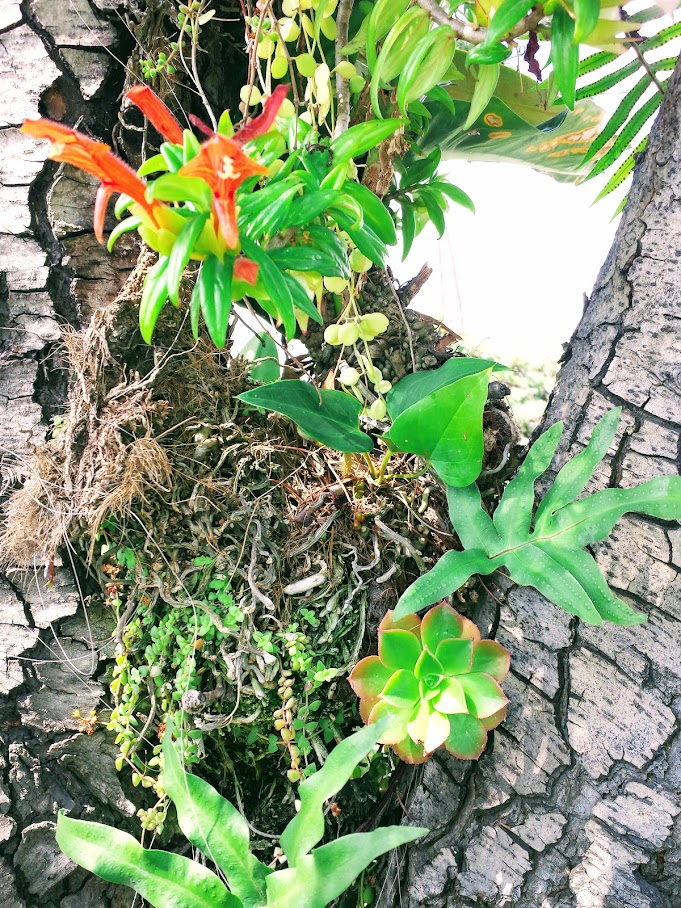
The challenge is that the bark isn't very good at storing water.  Here you can see the fern in context...


The orange flowers are from Columnea Elmer Lorenz.  I wish that I had attached it to a horizontal branch instead.

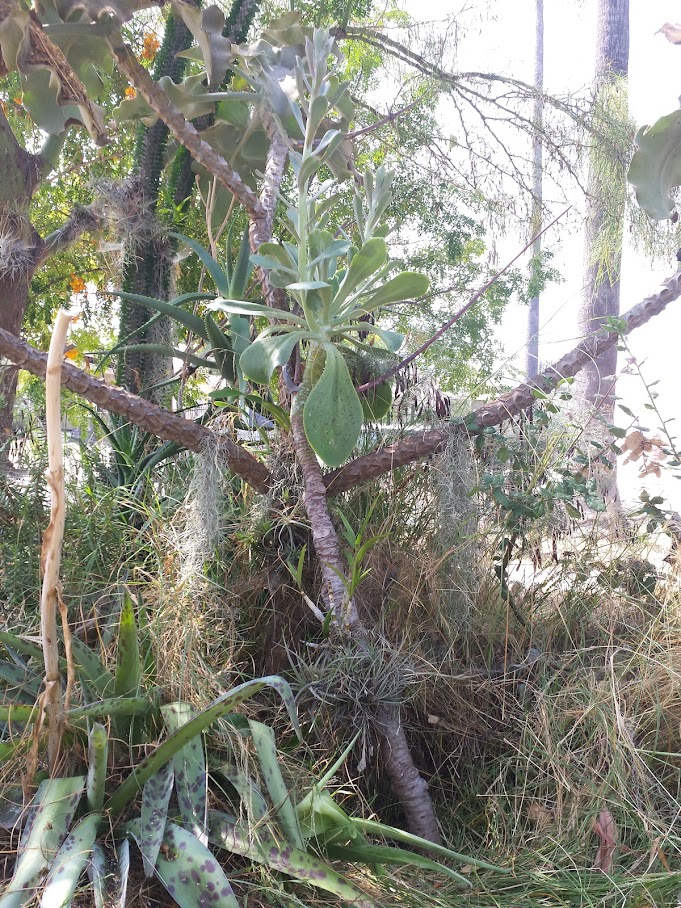
Further up on the tree I noticed that my clump of plants growing all over Aglaomorpha coronans had been dislodged by some critter.  It didn't help that a nice, but heavy, Echeveria gibbiflora was pulling down on the clump.  Here's a picture that I took last year of the Echeveria...


This Echeveria, which grew from seed that I had sown on the tree, is different from the other seedlings because its leaves are more rounded and the plant itself branches.  None of the numerous other seedlings have branched.  I really like the idea of a branching gibbiflora so I decided to cut this one off in order to give it more TLC than it has been receiving.  Here's the pic I took after removing it...
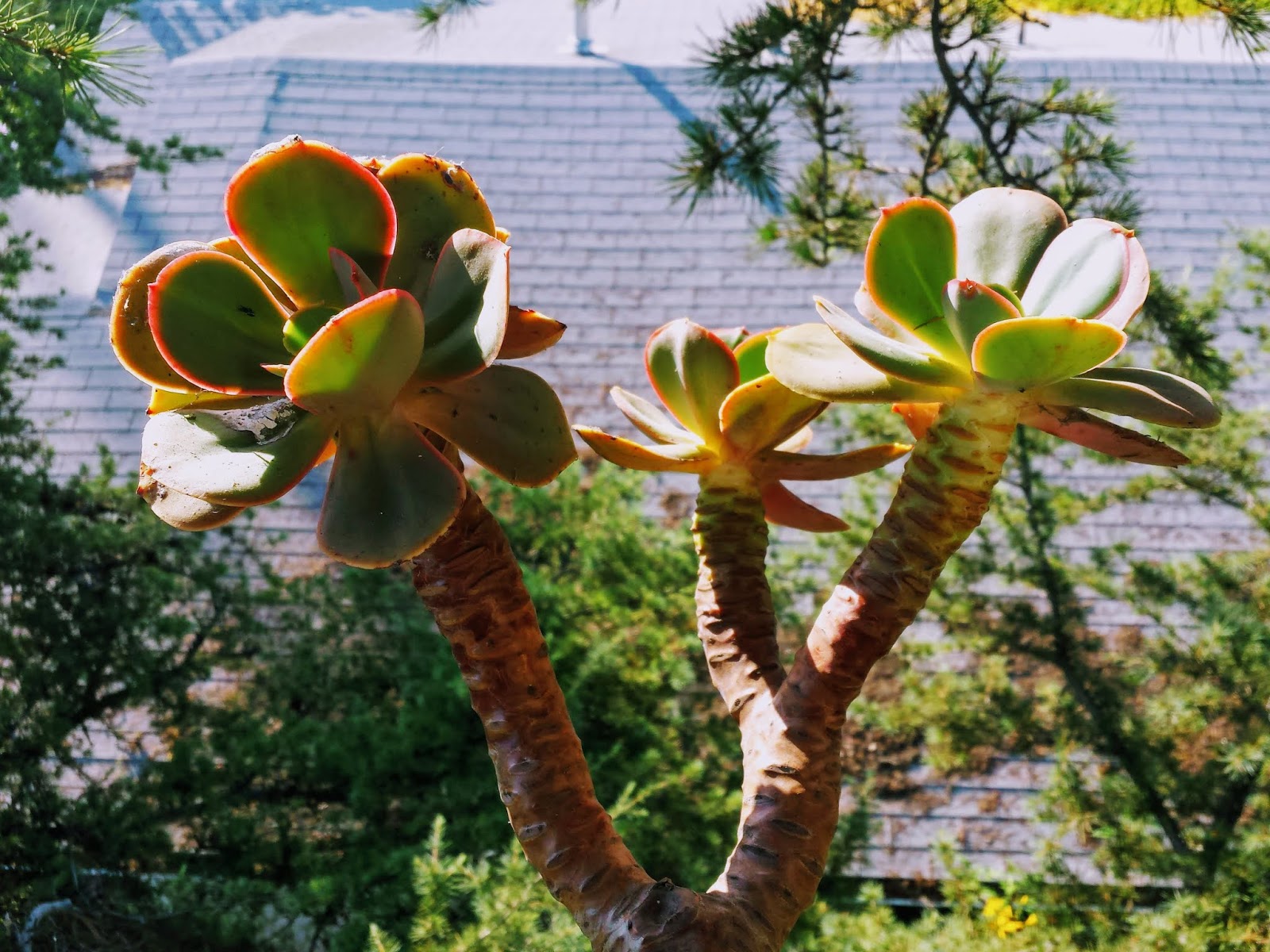


And here's a pic of it with a one gallon pot for reference...


How awesome would it be to have an Echeveria that branches just as much as a Jade plant?

Lastly, here's a context pic of Anthurium scandens....


In retrospect, Columnea Elmer Lorenz should have been a contestant in the 2011 Epiphyte Grand Prix.  How different would the tree look?

I water the entire tree twice a week at night during the summer.  When the weather starts to get cooler, I water less and less frequently and earlier and earlier in the day.

Every tree in California should have at least a few plants growing on it!

Friday, September 22, 2017

Cedar Tree Epiphytes

[update] If you have trouble seeing any of the photos in this entry try this link to my Google photos album. [/update]

Recently I got thinking about one of my vining epiphytes...


Cattleya Portia coerulea Mounted


It's on the second mount from the left.  At first I was pretty sure that it was a Dischidia.  My guess was Dischidia acuminata.  But then I became pretty sure that it was a Hoya.  My guess was Hoya micrantha.  I think the reason that I changed my mind was because I saw the flowers.  They looked a lot more like Hoya flowers.  However, they were so small and underwhelming that I didn't bother taking a photo of them.

What's remarkable about this Hoya is how well it does epiphytically.  It does really well.  Really well!   It's definitely a very strong contender for the best epiphytic growing Hoya family plant in Southern California.  I've seen it in several people's collections but nobody ever knows its name.

The other day I decided to inspect the one growing on my Cedar tree...


Hoya NOID


This one growing on the tree has smaller leaves that are yellow and quite succulent.  During summer I usually water the tree 2x/week at night.  As the temps get cooler I water less frequently.

I inspected the plant more closely but didn't see any flowers.  But I did see this...


It's a seed pod!  Surprise surprise!  The only other of my Hoyas that has produced a seed pod is Hoya serpens.  So far none of my Dischidias has produced a pod.

The other plants in the photo are a bunch of Tillandsia aeranthos volunteers growing on a Nematanthus stem.  Yesterday I was eating some lemon guavas off my tree and I brushed a bit of spider web off of one.  When I looked closer at the web, it was actually the "parachute" of a Tillandsia aeranthos seed, that had just started to germinate.

Also in the photo is Dockrillia teretifolia.  I have three different ones on my tree.  They've all had plenty of time to become specimens, but none have done so.  Maybe they want more water?

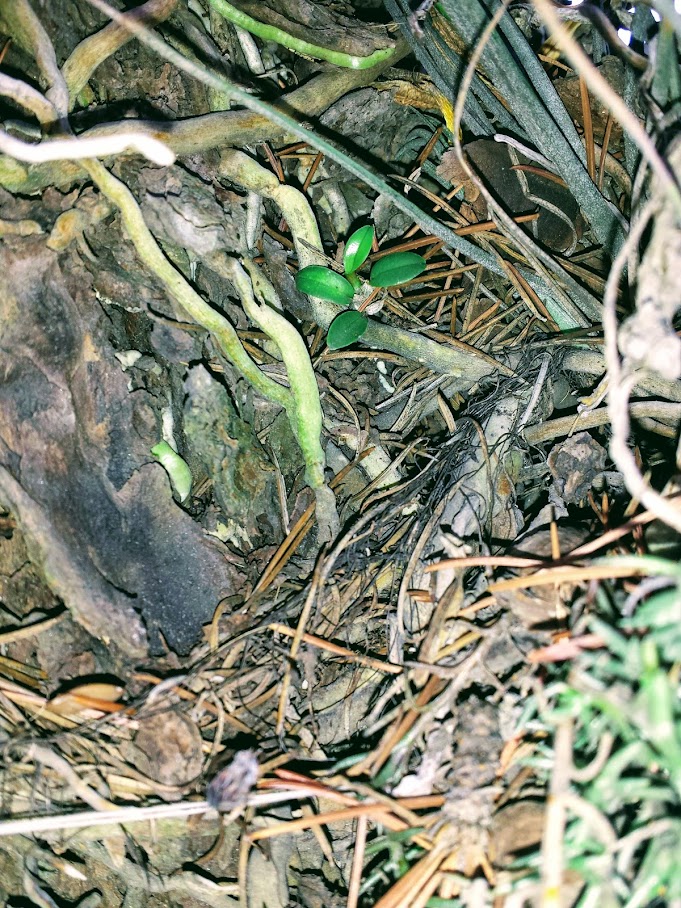
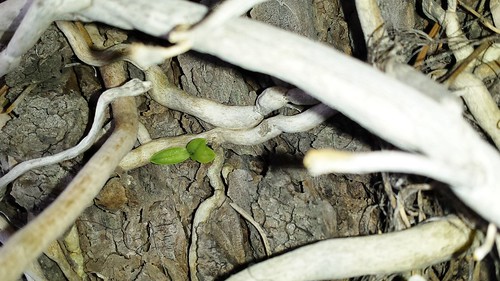
Finding the seed pod on my Hoya got me extra curious to see what else was happening on my tree.  So I started climbing.  Here's one of the three NOID orchid seedlings that most recently germinated on my tree...


Here's a pic that I took last year of one of the other NOID seedlings...


New Orchid Seed Germinated On My Tree


All three seedlings are growing next to the roots of a Vanda tricolor/suavis.  The seedlings have been growing soooooo slow.  It's like they are trying to kill me with suspense.

The previous batch of seedlings that germinated on my tree all turned out to be Laelia anceps.  There are around half a dozen on the tree... ranging from super small to blooming size.  I thought the largest seedling would bloom for the first time this year... but nope.  It's been around 6 years since they germinated.  Sheesh.  Here's an album with some pics.

Speaking of super slow seedlings... at the top of this NOID Sedum there was a succulent seedling...


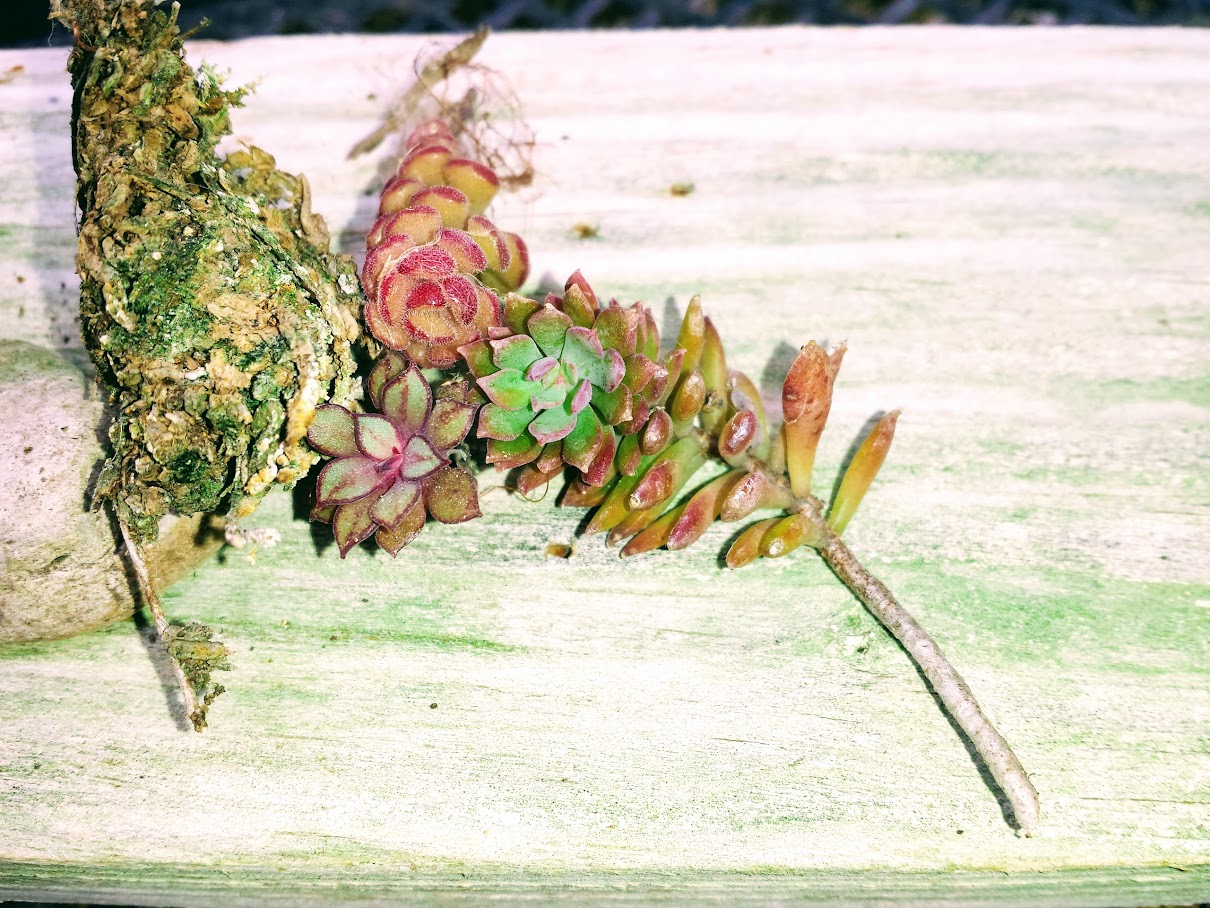
At least I'm pretty sure that it was a seedling.  I was happy to discover that it was still there.  It's been hanging in there for several years.  So I decided to carefully remove it along with a section of the moss that it was growing on.  Here it is with two other small succulents...


Sedum versadense (top) and Sedeveria 'Acultzingo' (right) were also growing on the tree.   The third succulent is the NOID seedling.  Perhaps it's Echeveria nodulosa.  I did sow some seeds of it on my tree a long time ago.

I attached all three succulents to a board with Sphagnum moss on it.  The mount is now hanging in a small section of my garden that I water 3x/week at night during summer.  Hopefully the seedling will respond positively.  As I mentioned in this blog entry, I would like to try and cross Echeveria nodulosa with rosea.

Here's one of the Echeverias that has done really well on the tree...


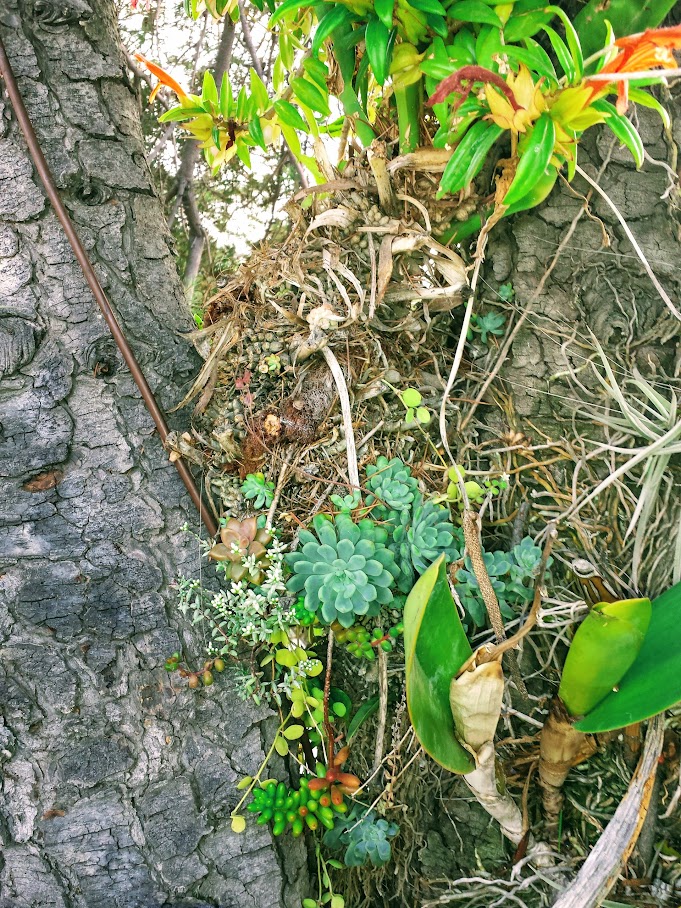
I'm guessing it's Echeveria minima.  Also in the photo is Columnea Elmer Lorenz, Dischidia formosana, Crassula pruinosa, Sedum rubrotinctum and Cattleya Portia coerulea.

The Echeveria clump is happily growing among the roots of Anthurium schlechtendalii.  If you look closely just below the Echeveria clump you'll see the Anthurium's two very first offshoots.  What's rather surprising is the amount of distance between the offshoots and the root crown.  The angle of the photo makes it hard to tell but the distance is around 2 feet.  Then again, now that I think about it, perhaps they might be seedlings.  Every couple of years or so the Anthurium manages to produce quite a few berries.

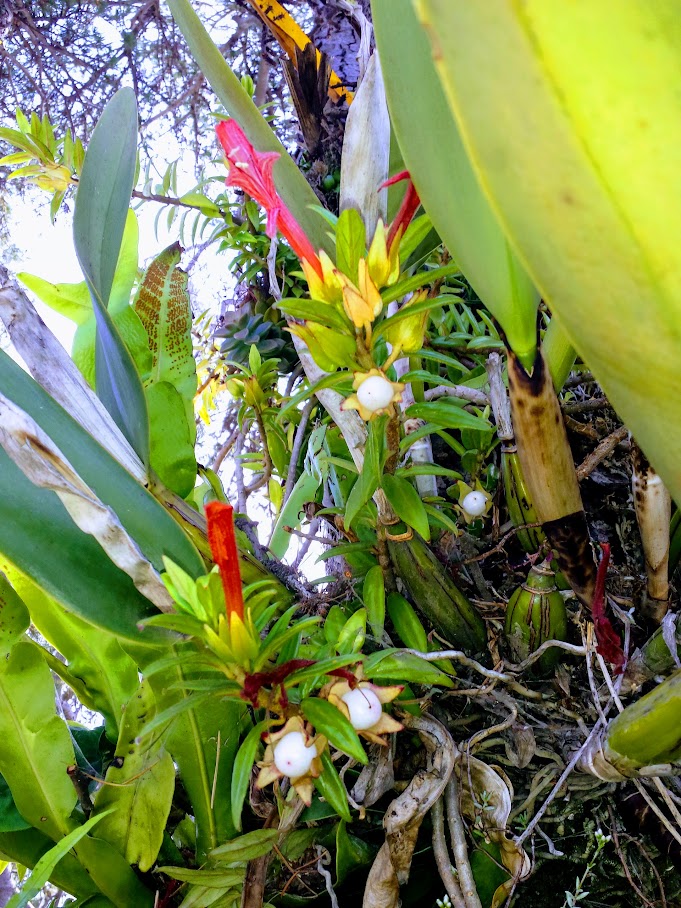
One very consistent and productive fruiter is Columnea Elmer Lorenz...


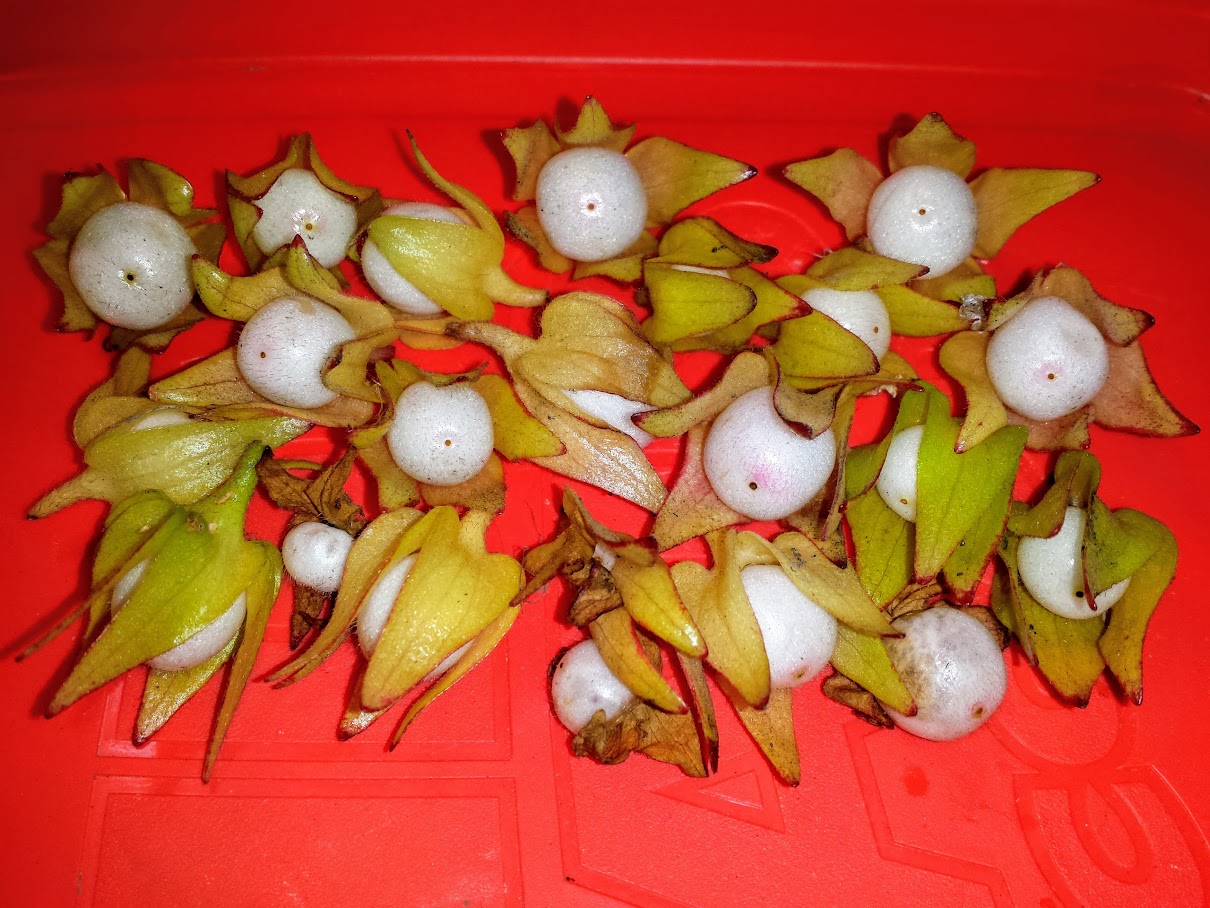
Here are all the fruits that I harvested...


Last month I harvested pretty much the same amount of fruit.  Columnea Elmer Lorenz is the only epiphyte I have that is almost always in bloom.

In order to extract the seeds, I peel the skin and put the fruit into a water bottle that I fill half way with water.  I put the lid on and shake the bottle vigorously to separate the seeds and the fruit.  The seeds will sink to the bottom and the fruity water can be poured off.  Usually there are at least a few unsunken seeds so I'll pour the fruity water into a large bottle.  Once I'm done processing all the epiphyte fruit (ie Anthurium) I'll pour the contents of the large bottle on mounts and in hanging pots/baskets.

This time I decided to drink the Columnea's fruity water.  I knew that the fruit was edible.  Well... I guessed that it was edible.  I remember Kartuz saying that Codonanthe fruit is edible.  Not sure though if he said that all Gesneriad fruit is edible.  Anyways, the Columnea fruit water turned out to be quite bland.

But it got me thinking about how different cultivated corn is from wild corn.  What would the fruit of Gesneriads, Rhipsalis or Anthuriums look and taste like after a 1000 years of selection?

I climbed a little higher on the tree and took a photo of the roots of this Cattleya Portia coerulea...


The roots are covered in moss.  Unfortunately this moss doesn't really escape onto the bark.  I super wish that I could find a moss that would be happy to grow directly on the bark.  It would help capture and germinate all sorts of seeds and spore.

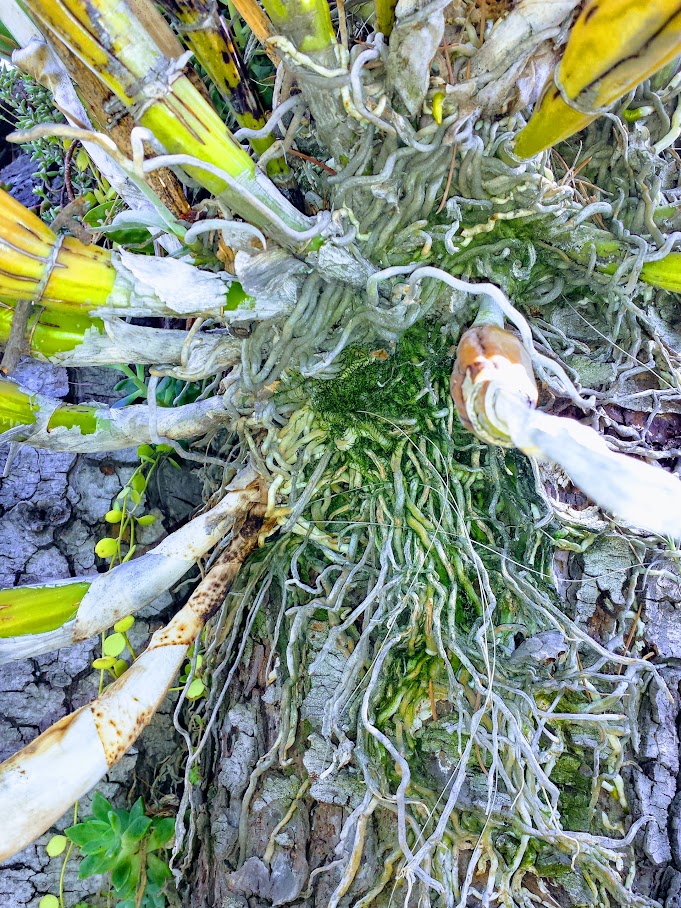
Here's a photo of the shady side of the Anthurium schlechtendalii's root ball...


The plants in this photo include Columnea Elmer Lorenz, Dischidia formosana, Anthurium NOID seedling, Polypodium aureum, Crassula marginalis minuta (?) and an Aeonium that grew from seed that I sowed on the tree.

The Anthurium seedling grew from a seed that I received from Loran Whitelock during a tour of his place.  He had a decent sized Anthurium growing in the ground that had quite a few ripe berries on it.  I asked if I could have some and he said sure.  After I got home I sowed them on the tree.  This seedling and a bigger one higher up on the tree are the result.  Unfortunately, I don't remember taking a photo of the mother Anthurium.  But I'm guessing that it's something that has been referred to as  Anthurium 'whitelockii'.  This page has a picture of a mature plant.  What's rather tricky is that PalmBob and a few other sources indicate that the name has been changed to Anthurium faustomirandae.  From my perspective though the size and orientation of the leaves are quite different.  Plus, the leaves of Whitelock's plant are much more glaucous.

A few years back Dylan Hannon sold an Anthurium on eBay that was very similar to Whitelock's.  Here was the description that he gave...

Anthurium sp. Tomellin Canyon, Oaxaca, Mexico. This is a dramatic species that slowly grows to about 3ft across and not quite as tall. Leaves are strikingly blue-glaucous, very tough and heavy. Spadix and spathe are maroon. Fruits take well over two years to mature. This is an excellent outdoor plant in Southern California and has been around a while since its introduction by the late Loran Whitelock. It goes under a few names but I am not sure any of them are correct and it could still be an undescribed (new) species. Sale item (2nd photo) is a young seedling.

Let's set this mystery aside for a bit and continue climbing the tree...


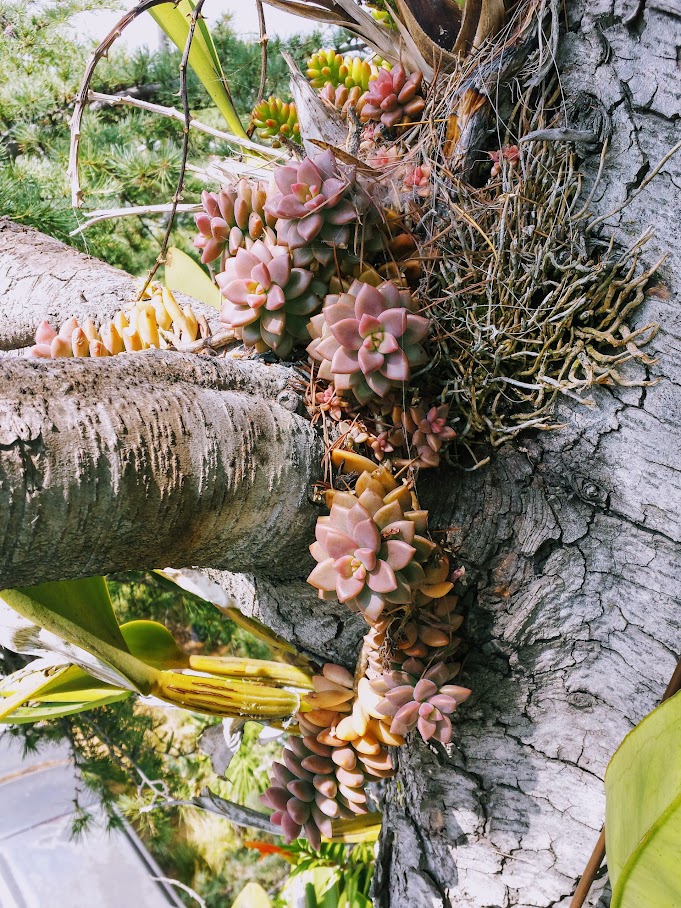
Not sure if this succulent is a Sedeveria (Sedum x Echeveria) or a Graptoveria (Graptopetalum x Echeveria).  Maybe it's Graptosedum (Graptopetalum x Sedum) Alpenglow?  Whatever it is, it can get a nice bronzy/burgundy color and does really great on the tree.  It grows super easy from leaf cuttings.  I just break some leaves off and place them wherever I want this succulent to grow.  Evidently I wanted it to grow here among the roots of Cymbidium madidum.  For some context, here's a picture that I took last year...


Cymbidium aloifolium and Cymbidium madidum


The other orchid blooming in this photo is Cymbidium aloifolium.  On the shady side of this orchid is a really neat trailing fern...


Lemmaphyllum microphyllum is an epiphyte and lithophyte from Japan.  It's perfectly happy with our temps here in SoCal.  It can handle drying out, especially during the winter, but it does appreciate a decent amount of moisture when it's warm.  Like the rest of the plants on the tree, this fern receives water 2x/week at night during summer.  However, it's growing on a decent amount of Sphagnum moss.  So far it has not managed to "escape" from the moss.  One of the best escape artists, as far as ferns go, is the somewhat larger trailing epiphytic fern Microgramma vacciniifolia.

Moving up the tree even further I have a big clump of plants all growing with the really excellent fern Aglaomorpha coronans...


In this photo you can see a never-blooming Oncidium sphacelatum, a Codonanthe carnosa (round leaves) that grew from seed sown on the tree, several Echeveria gibbifloras that also grew from seed sown on the tree, and a clump of seed sown/grown Tillandsia aeranthos.

As I mentioned in this entry, the E. gibbiflora seedlings grew really great on my tree... until they reached blooming size.  The very large and heavy rosette would badly bend the trunk and the plant would slowly deteriorate.  There have been a few exceptions.  The E. gibbiflora seedlings in the photo that are growing to the left aren't quite blooming size but the seedling growing to the right is.  It has already bloomed for a couple years but the trunk still hasn't badly bent.  One difference is that this seedling, unlike all the ones that badly bent, has branched.  You can see it a little better from this angle...


There are several different plants in this photo.  At the top is Tillandsia aeranthos (by far my most productive Tillandsia), Crassula sarcocaulis, Sedum rubrotinctum, Oncidium sphacelatum, Aglaomorpha coronans, Echeveria gibbiflora, NOID succulent (Sedeveria?), NOID Sinningia and another clump of Tillandsia aeranthos.

This gibbiflora has actually branched twice and is going to branch again.  Another difference, besides branching, is that the leaves aren't as long and the red outline seems to be more pronounced.  Here's the view from above...


In the upper left hand corner of the pic you can see the second Anthurium seedling that grew from seed that Whitelock let me have.  It is just starting to get the glaucous appearance of mature plants.  Recently I asked my friend if he had Anthurium whitelockii.  He said that he did and he gave me a seedling.  It is between my two seedlings in size, and looks somewhat similar.

If you only saw the Echeveria from this angle you'd really have no idea that it's actually one plant.  Here's a picture that I took last year of the mother plant...


Echeveria Epiplus Orchid - With Trimmed Bush


I attached a Dendrobium orchid and a few Tillandsias to the trunk of the Ecehveria.  It's near a Parkinsonia aculeata tree which has grown quite a bit.  As a result, the Echeveria was in too much shade and it started to lean.  Here's a recent pic...


Echeveria gibbiflora fell into the open arms of Kalanchoe beharensis.  It would be wonderful to have a sturdier Echeveria that readily branched.  Then epiphytes could be attached to its branches.  One potential cross with this goal in mind would be to cross Echeveria gibbiflora with Sedum dendroideum ‘Colossus’.  Wow!  But I'm guessing that they wouldn't be compatible though.

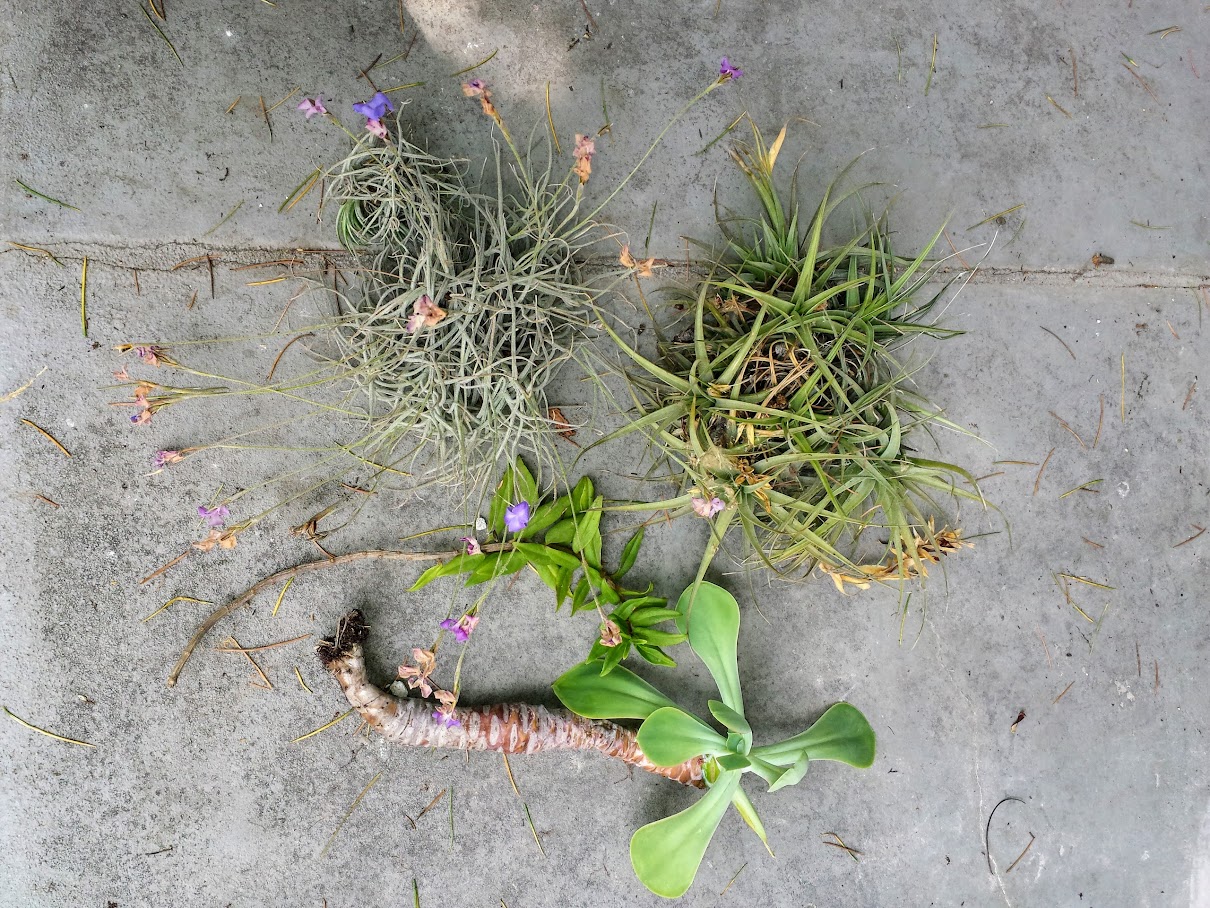
In addition to harvesting a bunch of different seeds from the plants growing on my tree, here are some of the plants that I harvested...


Tillandsia mallemontii clump (upper left) grew from seed that I sowed on the tree.  The picture really doesn't do it justice.  It was so full of blooms that I decided to remove the clump to share divisions with members of the Epiphyte Society.  The Tillandsia aeranthos clump (upper right) grew from seed that volunteered on my tree.  It was growing in my way so I decided to remove it to share.  Below the Tillandsias is a cutting of Columnea Elmer Lorenz.  I didn't make the cutting.  Last month I found 3 other cuttings.  I'm guessing that a squirrel or raccoon had made them.  The last plant is an Echeveria gibbiflora seedling that grew from seed that I sowed on the tree.  It was hanging rather precariously.

My tree has so much going on!!!  I probably only documented 5% of it.  Watching the tree is better than watching most TV shows.