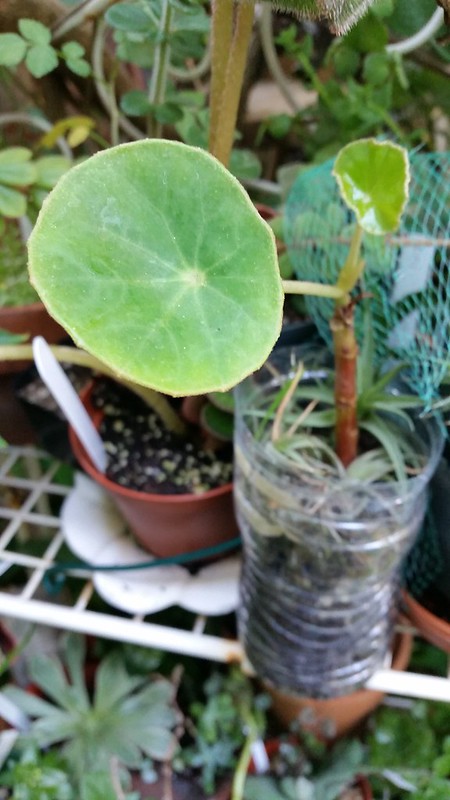
She said that it hasn't grown much since I gave it to her. Which is interesting because mine have certainly grown.
Maybe my thumb is greener? 😁 Or maybe I fertilize more? Perhaps it has something to do with the fact that my area gets warmer than her area. We both live in SoCal but she's closer to the coast than I am.
It got me thinking. What if she had sown all the seeds? In theory, since her area is cooler, the coolest growing seeds would have had an advantage. So the seedlings she ended up with would have been better adapted to her conditions.
Is this obvious?
Recently I sowed some seeds from two of my Echeveria roseas. I grabbed 6 hanging baskets/pots that already had well draining medium in them, placed Sphagnum moss on top of the medium and sowed seeds of E. rosea, Columnea Elmer Lorenz, Anthurium scandens, a couple different Rhipsalis and a NOID Sinningia. I also placed a few pieces of a NOID Peperomia, Pyrossia and Dischidia on top of the moss. Then I put each basket/pot in a two gallon zip lock bag. The hanger made a nice teepee with a hole in the top of the bag. Lastly I put the baskets/pots in two rows of three on a table in the garage under grow lights near an open window.
The Rhipsalis started to germinate the next day, shortly followed by the Anthurium, and then the rest of the seeds started germinating a couple days after. There was a significant disparity in the number of seeds that have germinated in the pots. Here's a pot with a bunch of E. rosea seeds that look perfectly viable but haven't yet germinated...

You'll probably have to click on the picture in order to see the seeds. Here's the pot with the most seedlings in it...

The two pots closest to the window have the most seedlings, the two pots furthest from the window have the least seedlings, and the two pots in the middle have an average amount of seedlings. It might be a coincidence, but I'm guessing that it has to do with a difference in temperature. It's marginally cooler closer to the window. Right after I sowed the seeds it was over 100F each day for a week. Even though the pots are right next to each other, they are in a small, but significant, continuum of temps.
According to this website, E. rosea is the best Echeveria for the UK. This means that, not only is it cold tolerant, it's also cooler growing. Temps over 100F certainly don't count as cool. Here's where the plot thickens. I had placed the two blooming roseas right next to other blooming Echeverias (coccinea, gibbiflora) in order for the hummingbirds to cross pollinate them. E. coccinea and gibbiflora are warmer growers than rosea. So in warmer temps, the hybrid rosea seeds would have an advantage over the species rosea seeds.
Here's a pic of a rosea seed just starting to germinate...

You'll have to look closely to see it.
Right now my Epc Cerina 'Nadia' has a nice big seed pod on it…

Here’s what Cerina’s made of...
81.25% = Epi. cinnabarinum
6.25% = Epi. jamiesonis
6.25% = Epi. radicans
3.13% = C. guttata
3.13% = C. luteola
From what I've read, Epi cinnabarinum is a warmer grower with larger flowers. So it was pretty popular for the reed-stem breeding that was done in Hawaii. When I asked an Epi grower here in SoCal about Cerina he said that it has never rebloomed for him or produced keikis. Fortunately, it has for me. Here’s a pic of a couple of keikis…

Probably the main difference between the Epi grower and myself is that he is right on the coast. So his conditions are a lot cooler than mine. The disparity in Cerina’s performance provides some evidence that it does require a decent amount of heat.
Cerina’s flowers are significantly larger than the flowers of typical reed-stems. Here’s the only pic that I have of them…
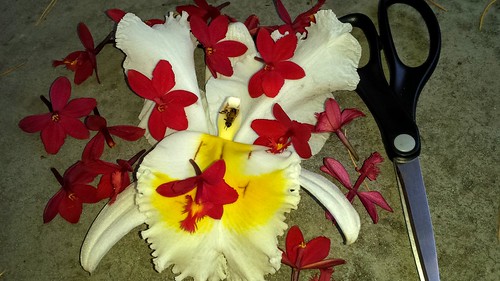
The reason that I removed Cerina’s flowers was to more comfortably/carefully extricate the pollen. I put the pollen into a small zip lock bag and climbed my tree to pollinate the big floofy white Cattleya. When I inspected the first flower, I discovered that somebody else had already tried to pollinate it, and had died in the attempt. I pollinated a couple of other flowers and they developed very large pods. Unfortunately, when I harvested them, they turned out to be completely empty. The orchid and I were both tricked.
Cerina’s roots, canes and leaves are also larger than typical reed-stems. Here’s a side by side comparison of the canes of Cerina and the canes of a typical reed-stem...

The pod that is currently developing on Cerina is hopefully the result of pollen from…
Epi (Pacific Eclipse x Pacific Canary) ‘Yellow Sun’ x Epi magnoliae
Scadoxus purchased it from Sunset Valley Orchids and let me borrow it for pollination. Its yellow flowers are average sized. The plant itself is more stocky than the typical reed-stem and the leaves are relatively succulent. Right now it has a keiki on it with several thick roots.
Epi magnoliae is the Northernmost occurring epiphytic orchid in the Americas. So it's certainly cold tolerant, but I'm not under the impression that it's a cooler grower. Andy notes the Florida form as favoring warmer temps. The other states in which it occurs also have hot summers.
Here's the breakdown for Epi. Pacific Eclipse...
46.88% = Epi. cinnabarinum
39.06% = Epi. radicans
14.06% = Epi. jamiesonis
And for Epi. Pacific Canary...
28.13% = Epi. cinnabarinum
25.0% = na (eh?)
23.44% = Epi. radicans
12.5% = Epi. secundum
10.94% = Epi. jamiesonis
Let's imagine that I split Cerina’s seed pod with Scadoxus. Hopefully the seeds will be able to germinate without flasking or fungus. My guess is that cinnabarinum would be pretty influential in the cross. This should mean that more of my seeds would germinate. However, this might not be the case if we sowed the seeds in the fall. Even though my area is warmer than Scadoxus' area in the summer, our temps are more equal in the fall and spring, and my area is actually cooler than hers in the winter.
To keep things simple let's say that Scadoxus and myself each ended up with 50 seedlings out of 1000s and 1000s of seeds. If we exchanged half our seedlings with each other then I'm guessing that, in my garden, my seedlings would grow faster than her seedlings. In her garden, her seedlings would grow faster than my seedlings.
Is this obvious?
What really isn't obvious to me is the difference in speed. I have absolutely no idea how much better my seedlings would do in my conditions compared to her seedlings. Would the difference in performance be barely noticeable? Or would it be somewhat noticeable? Or would it be very noticeable?
To put it in terms of blooming... in my conditions how much sooner would my seedlings bloom than hers? Would my seedlings bloom a week before hers? Or a month? Or a year?
The bigger the difference, the more adaptable the cross is. The bigger the difference, the more rapidly the cross will conform to its conditions. Right?
We should all know that orchids are adaptable. But I've never heard of any experiment or study that has attempted to quantify how adaptable any given orchid is. Well... maybe I have... Sem and Phylogenetic Analysis of Naturalized and Cultivated Epidendrum in Hawaii (PDF). In Hawaii, cultivated Epis were compared to naturalized Epis. It seems that there were some noticeable differences between the two groups. This is interesting given how relatively short a time that the Epis have been naturalized in Hawaii.
Reed-stems naturalizing in Hawaii isn't a very huge feat. It would be a very different story if reed-stems naturalized in California. The time it takes for them to be capable of doing so largely depends on how adaptable they are.
Does it matter to us as orchid growers how adaptable orchids are? The more adaptable an orchid is, the greater the benefit of growing it from seed yourself.
We've all heard the expression that the apple didn't fall far from the tree. If orchid seeds don't fall far from their parents, then we can't expect that some seeds will be noticeably better suited to our conditions than other seeds.
Assuming that Cerina’s pod is full of seeds, what should I do with them? Of course I’d be interested in splitting them with Scadoxus in order to try and measure how adaptable the cross is. But I’ve also considered the idea of dividing them among the members of this forum. If there are 10,000 members perhaps each one would receive 10 seeds. Heh. The more members that successfully germinated their seeds, the more adaptable the cross is?
In order to get the individuals that are best suited to my conditions, I should sow all the seeds myself. It’s always better to select from a larger pool of trait combinations. But what if I divide the seeds among 10 members? On the one hand, a smaller pool means somewhat less well-adapted seedlings. On the other hand, if 10 other members also grow the same cross, then… what?
My number one plant rule is to hedge my bets. The other day, when I inspected one of the pots with E. rosea seedlings, I discovered half a dozen tiny bush snails. I have no idea how they got in there… but it’s a good thing that I hedged my bets by sowing the seeds in 5 other pots, each in their own ziplock bag. If I shared Cerina’s seeds with 10 other members, then hopefully I would be able to obtain some seedlings from these members if something happened to mine. This alone is adequate justification for sharing the seeds.
In terms of making progress though, would there be any benefit to sharing the seeds? Here’s how I personally define “progress” when it come orchids…
Drier growing (requiring less frequent watering)
Cooler and warmer growing (hercuthermal)
Let’s say that I give 10,000 seeds to my friend Orchid Dude. If he keeps the seeds/seedlings in one of his greenhouses, then the perfect conditions won’t provide an advantage to the individuals that are exceptionally drier growing and/or hercuthermal. So if he shares some of his seedlings with me, because something happened to mine, then I’d be glad that I hedged my bets. But his seedlings probably wouldn’t be very “progressive”, for lack of a better term.
So in terms of maximizing progress, the seeds should be shared with the members whose conditions/culture will favor the most progressive individuals. In other words, the seeds should be shared with the members who will provide optimally challenging conditions. Except, the large majority of people with optimally challenging conditions probably aren't members of this forum. So I'm leaning towards the idea of auctioning off the seeds to forum members in order to raise money to promote the thread dedicated to the project.


%20large%20form)