Showing posts with label ferns. Show all posts

Tuesday, June 7, 2022

Upcoming Fern And Exotic Plant Show

This Friday, Saturday and Sunday I'll be selling some plants at the Fern and Exotic Plant Show which will be held at the Los Angeles Arboretum.  

Naturally I'll be selling some mounts, for example...


This mount, which is up for auction, includes...

  1. Aeschynanthus bolero bicolore
  2. Ceropegia woodii variegata
  3. Dischidia oiantha
  4. Hatiora epiphylloides ssp. bradei
  5. Hatiora salicornioides fa. Bambusoides
  6. Hoya BP-03
  7. Hoya burtoniae? 
  8. Hoya engleriana
  9. Hoya nummularioides
  10. Microgramma squamulosa
  11. Peperomia NOID 1
  12. Peperomia NOID 2 
  13. Philodendron paraiso verde (reverted)
  14. Schlumbergera NOID 


Here are some pics from previous shows...


Outdoor grown Hoya revolubilis specimen, one of my fav fav Hoyas.  


Tillandsia flabellata.  Sadly I killed mine recently, probably because I didn't mount it.  


Hoya Mathilde (carnosa x serpens) outdoor grown specimen.  


Platycerium andinum (left) and Platycerium Dragon, both are good outdoor growers here.


Begonia bogneri in a terrarium.

Saturday, August 18, 2018

Ideas For Plant Societies


Bundles aren't inherently bad.  This entry, like most of mine, will bundle a few different ideas and topics together... but they will all be more, or less, relevant to the topic of plant societies.

My friend Monica is a member of the Epiphyte Society of Southern California (ESSC).  A few weeks ago she invited Dave and I over to see her place.   Dave is another ESSC member.  Last year she saw his collection but he still hasn't seen hers.  Unfortunately, he couldn't make it this time... so I asked another ESSC member, Scadoxus, to join me instead.  We'd both already seen Monica's nice collection but it's been at least a year so Scadoxus and I figured that it would be worth it to see it again.

The day before we visited Monica, Scadoxus and I had driven down to Cerritos to attend our very first meeting of the LA/OC plant trading group on Facebook.  In my previous entry I listed a few different seeds and cuttings that I was offering to anybody in that group who was interested in them.  The meeting started at 10 am and it was held in a public park.  It seemed like over 50 people showed up with a wide variety of plants to share and trade.  Some people also brought food and drinks.  Plus there was a plant raffle.

After the meeting ended at 11 am, Scadoxus and I drove a few miles away to attend a begonia sale that was being held at a private residence in Lakewood.  Scadoxus wasn't sure if it would be worth it to attend because it had started at 9 am and she figured that all the nice plants would be gone.  She was wrong though, we found a really nice thick-stemmed begonia (Begonia dichotoma?) for only $5 dollars.  Plus, she ended up getting a good deal on a burgundy plumeria.

The owner of the residence was a really nice lady by the name of Chris.  She gave Scadoxus and I a tour of her collection.  I'm grateful that she did!  Her collection was nicely balanced.  In her shade house she had a specimen Nepenthes that she generously shared cuttings of.  Plus I saw some especially nice Begonias...


Begonia 'Spotted Medora'

I really liked the form of this Begonia.  It was wonderfully shaped like a little tree, so of course I'd want to attach a few miniature epiphytes to it (ie Tillandsia tricholepsis).  I learned that this form is referred to as "standard".


Begonia 'Gryphon'

I really liked this thick-stem begonia, it reminds me of Begonia 'Kudos' (not its real name).


Begonia 'Joy Blair'?

So nice!  It looks like a relatively drought tolerant Begonia.  The label says "Joy's Garden, Joy Blair" but a Google search didn't reveal any relevant results.  I'd really love some seeds of this when it blooms.  Chris did let me collect some seeds from her nice cane Begonias.

After Scadoxus and I finished at the sale, we drove a few blocks away to visit ESSC member Steve.  I'd been to his place a few times before but Scadoxus had never been.  One of Steve's very favorite things is variegated plants... he has many many many different ones.


Steve's Front Yard

Lawn!?  He says that each year the border moves a foot.  From my perspective the rate is too slow.  There should already be a variegated Aloe Hercules right in the center.


Adenia perrieri

Steve had recently acquired this really cool plant with variegated snowflake leaves.

Even though Steve and Chris both love plants and live only a few blocks away from each other for many years... they didn't even know of each other's existence.  Let's say that they had become friends as soon as the second one had moved into the neighborhood.  How different would their collections now be?  I think it's a given that their collections would be better... otherwise there'd be no point in making plant friends!

My first job was working in a privately owned orchid greenhouse.  It was the summer after my freshman year in high school and my task was to divide and repot Cattleyas.  The owner of the greenhouse didn't have any mounted orchids, neither did he have any orchids outside the greenhouse.  I asked him if any of the orchids in the greenhouse could grow outside but he didn't know.  He did however very generously give me a couple big garbage bags full of backbulbs.  I remember excitedly attaching them to the trees in my backyard.  Alas, they all died... except for one Oncidium which managed to put some roots on the tree... which were promptly eaten by slugs.  Still, the fact that I had managed to achieve even a little success fueled my interest in growing orchids on trees.

It was several years later, probably when I was in my senior year of high school that, after lots of trial and error, and after many orchid causalities, I learned the reason why the all the other orchids in my first batch had died.  It had nothing to do with them being unsuitable for growing on trees... it was simply because I didn't attach them tight enough.  And in the case of the Oncidium, I had attached it too low on the tree.

Some time after college I joined the Orchid Society of Southern California (OSSC) and I took the opportunity to look through their collection of old AOS magazines.  I found a really excellent article by Susan M. Stephenson... Orchids Outdoors in Southern California.  It turned out that, at the same exact time that I was an ignorant but enthusiastic kid struggling to grow orchids on my trees... just on the other side of town there was a fellow by the name of Bill Paylen who had lots of orchids happily growing on his trees.  We didn't even know of each other's existence.  If we had, I'm sure that my collection would be a lot better than it currently is.

After finding Stephenson's article I digitized it and sent it to the AOS so that they could put it on their website.  It's been a decade since they did so... how much difference has the article made?  How much difference will this blog entry make in a decade?

The day after attending the Cerritos plant trade, the begonia sale, and visiting Steve's garden, Scadoxus and I visited Monica on the westside.  She has several trees covered in bromeliads, orchids, ferns and all sorts of other plants.  Somehow I didn't take any pictures.  I should have taken pictures.

When Monica visited my place a couple weeks earlier she told me that on her way to work she passed a house with a tree that had big bromeliads in it.  I asked her if she had ever talked with the owners but she said that she was always running late.  When Scadoxus and I were about to leave Monica's place, I asked her how far away the house with the bromeliad tree was.  She said that it wasn't far and told us the street that it was on, but she couldn't remember the closest cross street.

Scadoxus and I decided that it wouldn't hurt to check it out.  We found the right street and and shortly afterwards we spotted the right tree...

Thursday, July 26, 2018

Everybody Should Trade Plants In Los Angeles

Nobody walks in LA, but everybody in LA should trade plants.  And give them away as well.  In previous years I've posted free plants on Craigslist and usually quite a few people have responded.  This year not so much.  But one of the responses was an invitation to check out the Facebook group for Plant Traders Los Angeles/OC Garden Trading Community.  I did so and it sure seems like a pretty great bunch of plant people.  How come it took me so long to get the memo???

They have a trade coming up this Saturday and I've been trying to prioritize which plants to share.  So far I've posted that I have seeds of Echeveria coccinea available...


Here are some other seeds or cuttings that I should share...

Columnea Elmer Lorenz seeds


The Best Orchid Companion


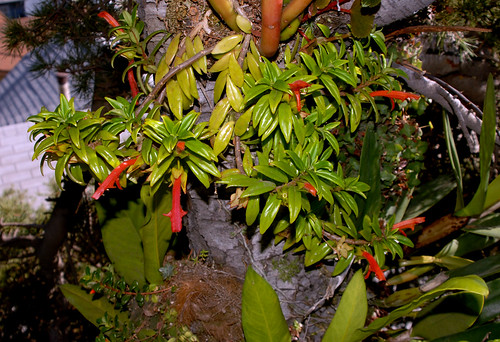
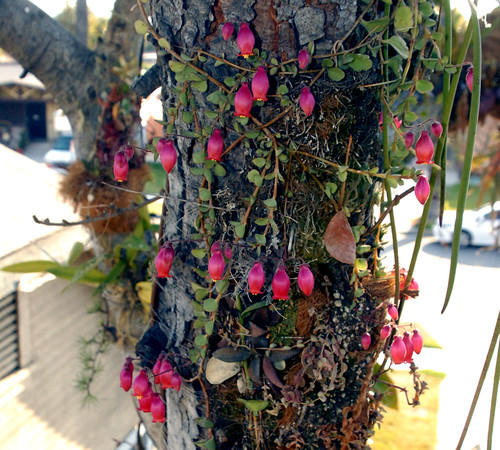
Not sure what its "real" name is... maybe it's Columnea crassifolia?  The leaves are certainly very succulent... for a Columnea.  My plant mentor Elmer Lorenz gave it to me several years ago and I've been really happy with it.  This epiphyte is exceptional because it stays in bloom for almost the entire year.   My friend Dave says the same is true of Columnea schiedeana.  I wonder which one would grow the best epiphytically.

Anthurium scandens (xeric form) seeds


Anthurium scandens Growing Epiphytically


This epiphyte is the winner of the 2011 Epiphyte Grand Prix.  The flowers aren't showy but it does make nice clusters of purplish fruits.

Epiphytic Kalanchoe cuttings (bundle)

Here's what would be included in the bundle...

- Kalanchoe ‘Orangery’ (K. manginii × K. jongmansii)
- Kalanchoe schizophylla (hemiepiphyte)
- Kalanchoe 'Tessa' (K. gracilipes x K. manginii)
- Kalanchoe uniflora (my favorite)


Kalanchoe uniflora Growing Epiphytically


Mixed succulent seeds

I have lots of different succulents, mostly in the Crassulaceae family, happily growing on my tree.  For example...


I'm guessing that this little succulent is Echeveria minima.   The seeds from this succulent, and from several other ones growing on my tree, will be included in this mix.

Mixed Tillandsia seeds

The seeds from various Tillandsias growing on my tree.  Primarily from Tillandsia aeranthos but also from a few others such as ionantha...


Tillandsia ionantha -  My Highest Epiphyte


Reed-stem Epidendrum seeds

Most orchid seeds don't have enough nutrients to germinate on their own.  In order to germinate in nature they depend on specific varieties of microscopic fungus to supply the necessary nutrients.  My impression is that the seeds of some orchids, such as those of reed-stems, are an exception to the rule.

Sowing Instructions

I sow all these seeds, except for the Tillandsia seeds, the same way.  First I put some well-drained medium into a small pot.  Then I add a layer of New Zealand Sphagnum moss on top.  I sow the seeds on the moss, put the pots in zip lock bags and place them near a bright window or under grow lights.

For the pots I use 500 ml water bottles.  I cut the tops off, remove the labels and cut some drainage holes in the bottom.  Three of these fit nicely in a gallon zip lock bag.

Usually I don't completely seal the bags, but this means that every so often I'll have to inspect them to make sure that pots aren't drying out too much.  I think it's safer to err on the side of too dry rather than too moist.  If the pots are too moist then they can start to get slimy.

I rarely ever sow one type of seed by itself.  For example, when I sow the reed-stem seeds I'll include one or two seeds from Anthurium scandens in the pot.  This helps me hedge my bets.  Using small pots also helps to hedge bets.  It's important to avoid putting too many eggs in one basket.  For example, my friend had several different nice plants in a terrarium.  They were all wiped out when she introduced a new plant.  Putting three small pots in one bag helps to limit the spread of pathogens.

I also hedge my bets by using different medium mixes.  Mixes include different combinations of...

- peat
- perlite
- pumice
- small bark

For the Tillandsia seeds I usually sow them directly on suitably sized branches which I'll soak at night 3-4 times per week.

Seed Sowing Logic

The point of growing plants from seed is select for trait combinations which are the most closely suited to your conditions.   Seeds are all different, which means that they won't all prefer the same exact conditions.  Some seeds will be better suited to your conditions than others.  Plus, seeds won't be equally tolerant of heat or cold or dryness.   All progress with plants depends on growing them from seed.

Updates 


While I'm at it, here are some recent pics of the plants growing on my Cedar tree...


Meiracyllium trinasutum pretending to be an Encyclia (nematocaulon).  Also in the photo is Tillandsia albertiana and Microgramma vacciniifolia.


This Tillandsia aeranthos volunteer looks a little different... like it's more star-shaped or something.  Looks similar to this one.


This looks like a seedling of Cotyledon orbiculata.... but I don't remember sowing any of these seeds on the tree.


This Crassula pruinosa isn't the most exciting, and this photo isn't so great, but I'm happy with this little dangling succulent.  It has earned some attention.


Several years ago Elmer gave me several seedlings of Anthurium coriaceum.  I shared several with my friends and put a few on my tree.  Mine grew so much slower than my friends'.  Well yeah, they put theirs in pots!  But I'm happy to see that the new leaf on this one is significantly larger than the older leaves.


This is Lemmaphyllum microphyllum, a miniature fern from Japan, growing on a big bunch of New Zealand Spahgnum moss around three stories up on my tree.  The fern hasn't managed to escape from the moss, but a different variety of moss is trying to....


The challenge is that the bark isn't very good at storing water.  Here you can see the fern in context...


The orange flowers are from Columnea Elmer Lorenz.  I wish that I had attached it to a horizontal branch instead.

Further up on the tree I noticed that my clump of plants growing all over Aglaomorpha coronans had been dislodged by some critter.  It didn't help that a nice, but heavy, Echeveria gibbiflora was pulling down on the clump.  Here's a picture that I took last year of the Echeveria...


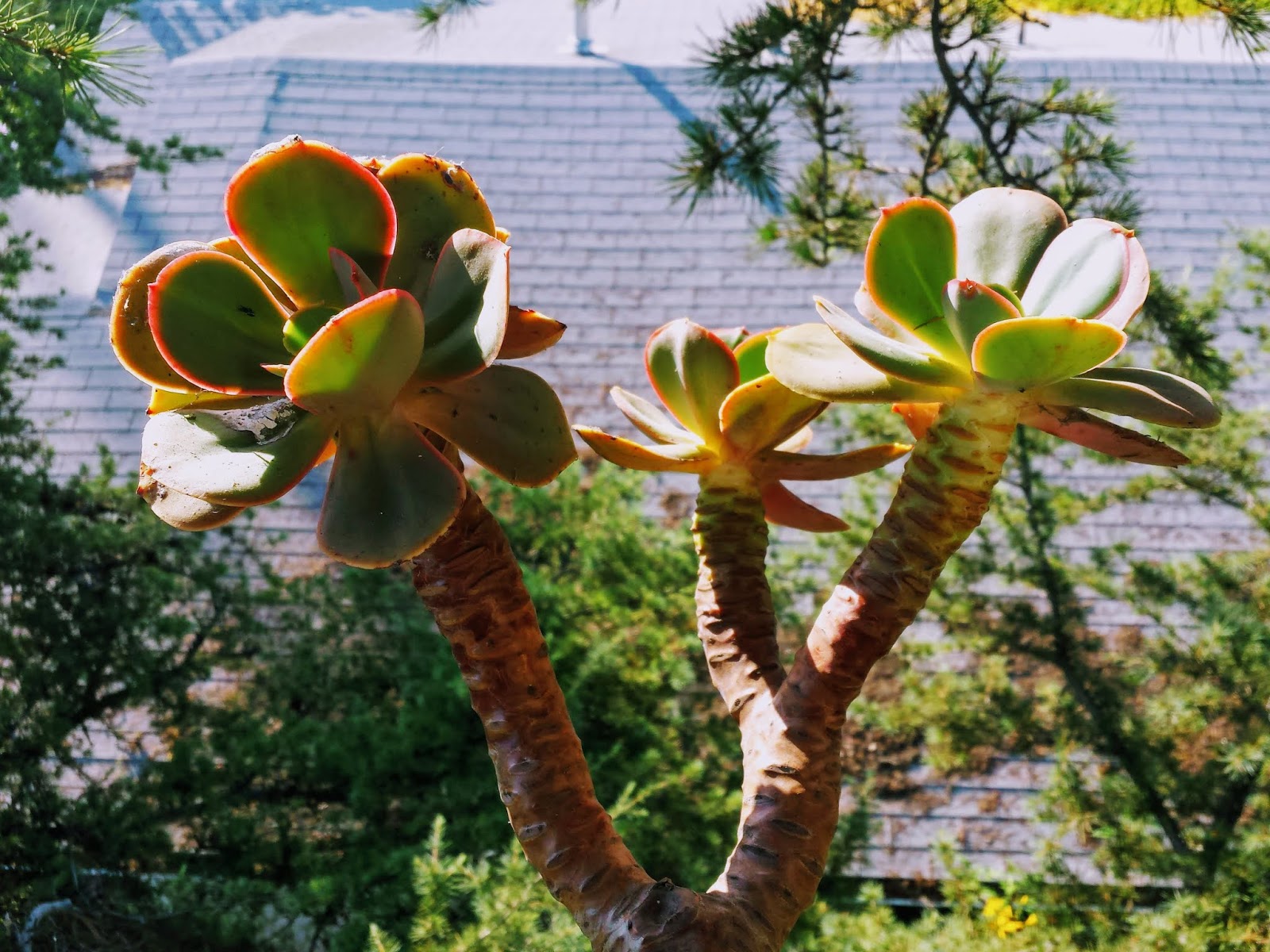
This Echeveria, which grew from seed that I had sown on the tree, is different from the other seedlings because its leaves are more rounded and the plant itself branches.  None of the numerous other seedlings have branched.  I really like the idea of a branching gibbiflora so I decided to cut this one off in order to give it more TLC than it has been receiving.  Here's the pic I took after removing it...


And here's a pic of it with a one gallon pot for reference...


How awesome would it be to have an Echeveria that branches just as much as a Jade plant?

Lastly, here's a context pic of Anthurium scandens....


In retrospect, Columnea Elmer Lorenz should have been a contestant in the 2011 Epiphyte Grand Prix.  How different would the tree look?

I water the entire tree twice a week at night during the summer.  When the weather starts to get cooler, I water less and less frequently and earlier and earlier in the day.

Every tree in California should have at least a few plants growing on it!

Tuesday, July 3, 2018

Patio Peek

This last weekend I attended a patio peek that my friend Scadoxus participated in.  I'm really glad that I did!  I saw some nice patios/plants and met some pleasant plant people. 

Here's one plant that caught my attention...


It's a Trachelium (Blue Throatwort).  I'm particularly interested in it because it readily volunteers.  One of my favorite volunteering plants is Ruellia brevifolia...


Ruellia brevifolia - My Favorite "Weed"


Earlier in the year Scadoxus gave me Ruellia elegans which she had received from her two friends.  They had purchased it from Annie's Annuals.  Coincidentally, while in the Trachelium patio, I randomly met Scadoxus' two friends for the first time.  They mentioned Annie's Annuals, I mentioned the Ruellia, and we put two and two together.  We uncovered a hidden connection. 

I think that R. brevifolia is a warmer grower/bloomer while R. elegans is a cooler bloomer/grower.  The elegans has been blooming non-stop while the brevifolia hasn't started blooming yet.  When it starts to bloom, I'd like to try and cross the two species in order to hopefully create a hercuthermal hybrid (grows/blooms in a wider range of temps).

Here's something that you don't see everyday...


It's a humongous Staghorn fern (Platycerium bifurcatum) growing directly on a brick wall. 

Here's a really nice epiphyte...


It's either a bromeliad or a Tillandsia.  I'm guessing that it's a Tillandsia, but I could be wrong.   I'm also guessing that it's monocarpic.  This would mean that it wouldn't produce any offshoots after it dies.  Ugh, I'm not a fan of monocarpic plants.  Hopefully this one is not monocarpic because I'd sure love to have an offshoot!  The vine with the pink flowers is Mandevilla.  In front of it is a very inviting couch.  It's wonderful when the lines between "inside" and "outside" are blurred.

Here's another really nice epiphyte...


Maybe it's Anthurium schlechtendalii?  It's being propped up by some cherubins.  The lady statue, the owner of the Anthurium, and me in the mirror are all interestingly arranged.  The three of us are facing in different directions... just like in a Hal Hartley movie. 

 Here's a tree fern...


Sorry about the blurry photo.   What's remarkable about this tree fern is that it's developing several heads.  It's not every day that you see a multi-headed tree fern.  More heads are better than one!

Here's a multi-headed tree Aloe...


Wow!  Wow!  Wow!  This is by far the best Aloe arborescens that I've ever seen in person.   I'm pretty sure that it's arborescens.  It is one of the most commonly grown Aloes here in California.  For some reason, despite its name, all the ones that I've seen are more like shrubs than trees.  But in nature you can see some distinctly tree like forms... for example.  Sometimes orchids will grow on them. 

The Aloe in the photo should definitely have one, or two, orchids growing on it.  Then it would be a phorobana.  Here's one orchid that sometimes grows on Aloe arborescens in nature...


A few years ago I attached this Mystacidium capense to a potted Bougainvillea.  Unfortunately, the medium in the pot was too barky and the Bougainvillea didn't make it.  In retrospect, I should have used a more gritty medium.  The plan was to have the white flowered orchid and the red flowered Bougainvillea bloom at the same time.  It would have been a lovely living bouquet.  Here's an example in nature.

Another great epiphyte for the Aloe would be a Tillandsia...


This Tillandsia kirschneckii is attached to my potted Ficus rubiginosa (Rusty Leaf Fig). 

Because epiphytes can grow on other plants, and even sometimes on walls, they are very useful for maximizing the diversity, interest and charm of small spaces.  The challenge is choosing the right ones.

One idea that I shared with one of the organizers of the patio peak is to create a plant society for the plant people in the area.  This way all the members can benefit from each other's different plant knowledge.  Plus, they can share plants and seeds with each other. 

Another idea that I had is that it would be nice to see other people's photos of the patios.  I wasn't the only person taking photos.  Personally I think Flickr is a useful platform for sharing photos. 

While it would be nice to see other people's photos of the patios, it would be even nicer to see their valuations.  This could be accomplished by using donations to judge the patios.  People would have the opportunity to "donate vote" for their favorite patios.  The money that was raised would go to a good cause... such as helping to transform local schools into botanical gardens.  Of course some of the money could also be awarded to the people with the top patios. 

Everybody who toured the patios was given a helpful map beforehand.  It was essentially a treasure map... but there was no indication of each treasure's value.  Would the map be even more helpful if everyone could see and know the value of each treasure? 

When a bee visits a patch of flowers, she uses dancing to communicate its value to the other bees.  This creates a dynamic and interactive treasure map of the flower patches in the area.  The more valuable a flower patch is, the more bees that will visit it.  I think it would be so cool if we could also see this treasure map.  Naturally, if somebody's garden in our area spiked in value, we would be very curious to learn the cause. 

No bee can be in two places at once, and the same is true for us humans.  This is why it's so useful to be able to communicate to each other the value of our discoveries.