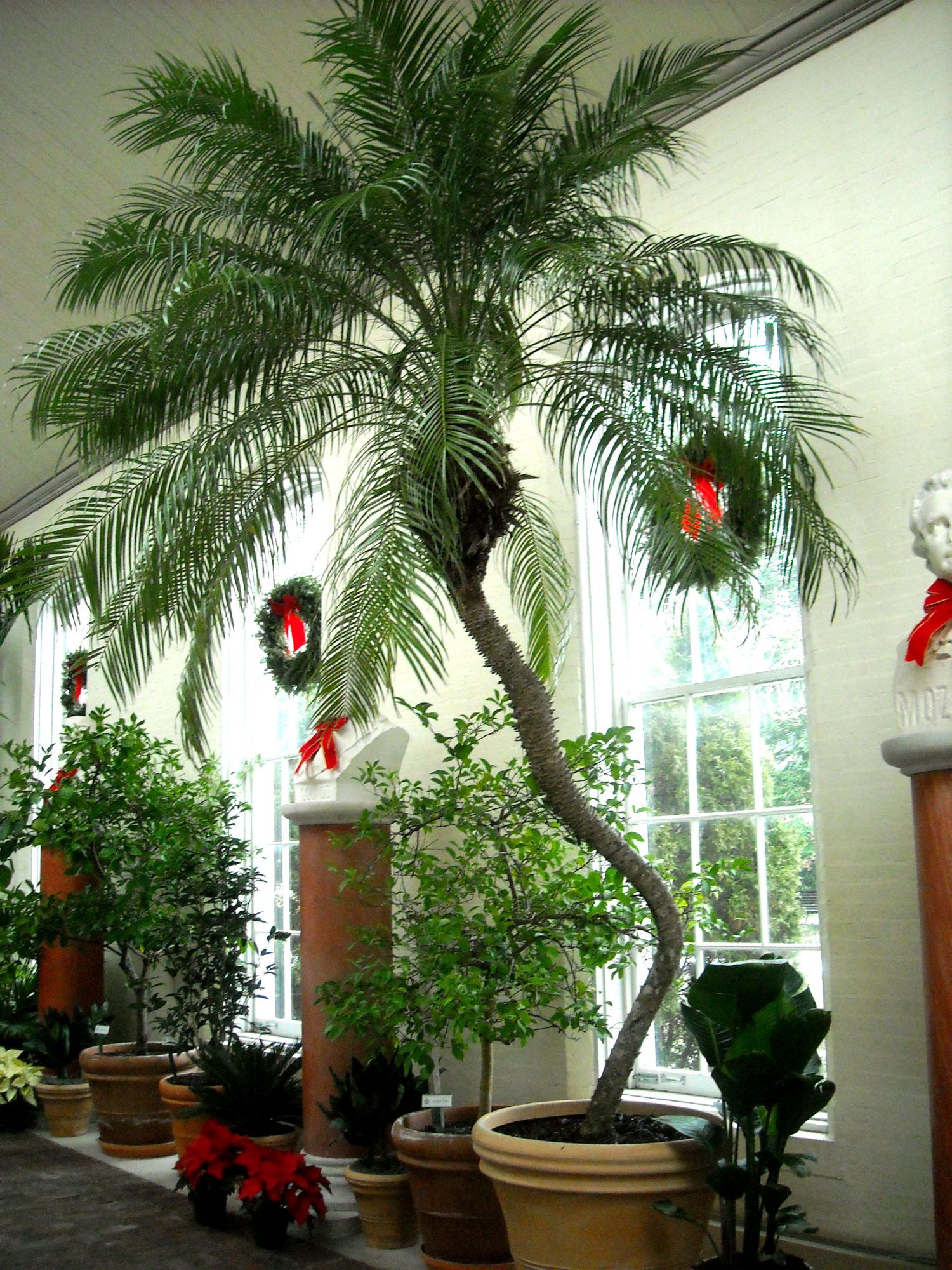
Here's one plant that caught my attention...

It's a Trachelium (Blue Throatwort). I'm particularly interested in it because it readily volunteers. One of my favorite volunteering plants is Ruellia brevifolia...
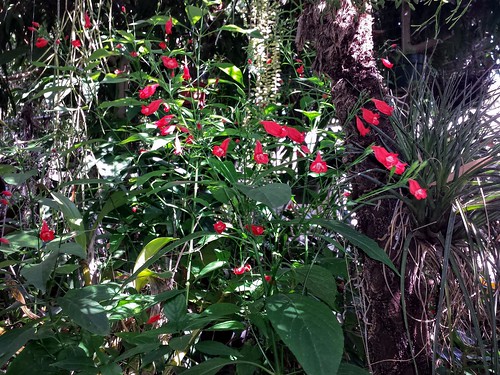
Earlier in the year Scadoxus gave me Ruellia elegans which she had received from her two friends. They had purchased it from Annie's Annuals. Coincidentally, while in the Trachelium patio, I randomly met Scadoxus' two friends for the first time. They mentioned Annie's Annuals, I mentioned the Ruellia, and we put two and two together. We uncovered a hidden connection.
I think that R. brevifolia is a warmer grower/bloomer while R. elegans is a cooler bloomer/grower. The elegans has been blooming non-stop while the brevifolia hasn't started blooming yet. When it starts to bloom, I'd like to try and cross the two species in order to hopefully create a hercuthermal hybrid (grows/blooms in a wider range of temps).
Here's something that you don't see everyday...

It's a humongous Staghorn fern (Platycerium bifurcatum) growing directly on a brick wall.
Here's a really nice epiphyte...

It's either a bromeliad or a Tillandsia. I'm guessing that it's a Tillandsia, but I could be wrong. I'm also guessing that it's monocarpic. This would mean that it wouldn't produce any offshoots after it dies. Ugh, I'm not a fan of monocarpic plants. Hopefully this one is not monocarpic because I'd sure love to have an offshoot! The vine with the pink flowers is Mandevilla. In front of it is a very inviting couch. It's wonderful when the lines between "inside" and "outside" are blurred.
Here's another really nice epiphyte...

Maybe it's Anthurium schlechtendalii? It's being propped up by some cherubins. The lady statue, the owner of the Anthurium, and me in the mirror are all interestingly arranged. The three of us are facing in different directions... just like in a Hal Hartley movie.
Here's a tree fern...

Sorry about the blurry photo. What's remarkable about this tree fern is that it's developing several heads. It's not every day that you see a multi-headed tree fern. More heads are better than one!
Here's a multi-headed tree Aloe...

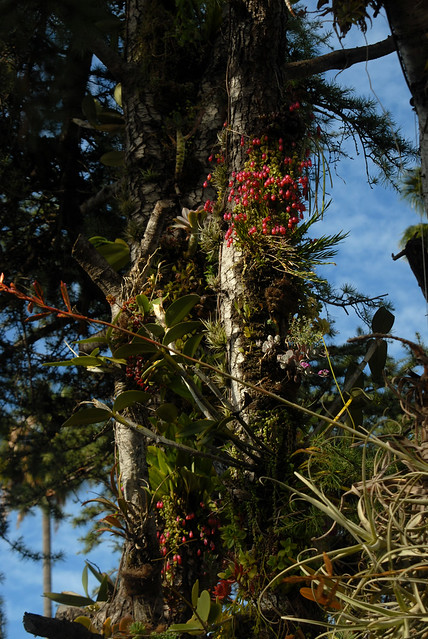
Wow! Wow! Wow! This is by far the best Aloe arborescens that I've ever seen in person. I'm pretty sure that it's arborescens. It is one of the most commonly grown Aloes here in California. For some reason, despite its name, all the ones that I've seen are more like shrubs than trees. But in nature you can see some distinctly tree like forms... for example. Sometimes orchids will grow on them.
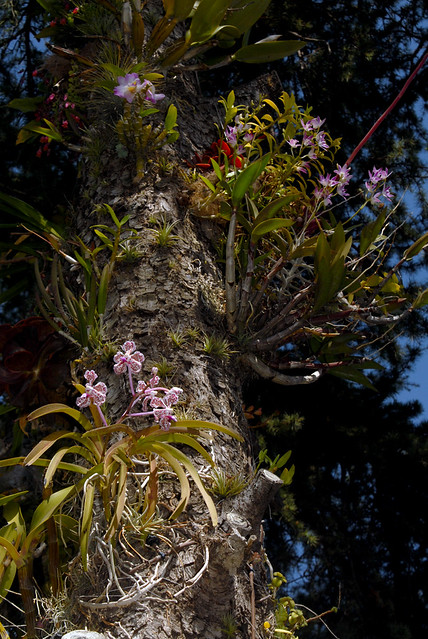
The Aloe in the photo should definitely have one, or two, orchids growing on it. Then it would be a phorobana. Here's one orchid that sometimes grows on Aloe arborescens in nature...

A few years ago I attached this Mystacidium capense to a potted Bougainvillea. Unfortunately, the medium in the pot was too barky and the Bougainvillea didn't make it. In retrospect, I should have used a more gritty medium. The plan was to have the white flowered orchid and the red flowered Bougainvillea bloom at the same time. It would have been a lovely living bouquet. Here's an example in nature.
Another great epiphyte for the Aloe would be a Tillandsia...

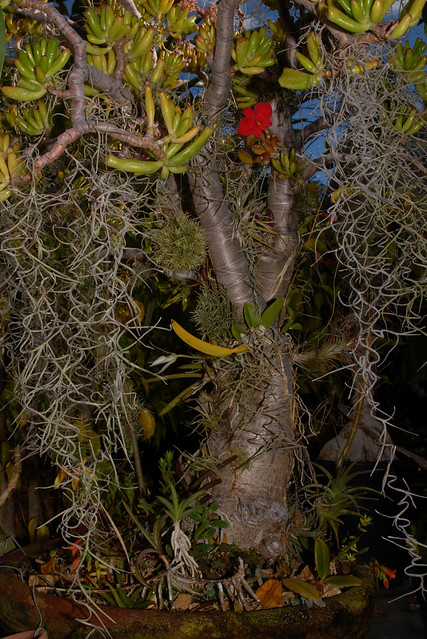
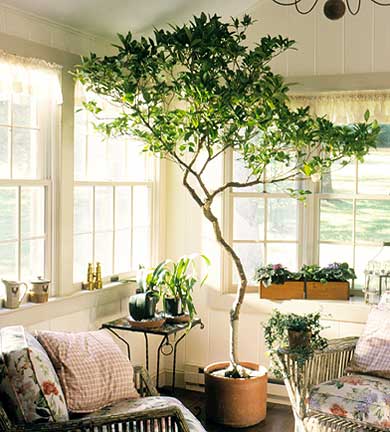
This Tillandsia kirschneckii is attached to my potted Ficus rubiginosa (Rusty Leaf Fig).
Because epiphytes can grow on other plants, and even sometimes on walls, they are very useful for maximizing the diversity, interest and charm of small spaces. The challenge is choosing the right ones.
One idea that I shared with one of the organizers of the patio peak is to create a plant society for the plant people in the area. This way all the members can benefit from each other's different plant knowledge. Plus, they can share plants and seeds with each other.
Another idea that I had is that it would be nice to see other people's photos of the patios. I wasn't the only person taking photos. Personally I think Flickr is a useful platform for sharing photos.
While it would be nice to see other people's photos of the patios, it would be even nicer to see their valuations. This could be accomplished by using donations to judge the patios. People would have the opportunity to "donate vote" for their favorite patios. The money that was raised would go to a good cause... such as helping to transform local schools into botanical gardens. Of course some of the money could also be awarded to the people with the top patios.
Everybody who toured the patios was given a helpful map beforehand. It was essentially a treasure map... but there was no indication of each treasure's value. Would the map be even more helpful if everyone could see and know the value of each treasure?
When a bee visits a patch of flowers, she uses dancing to communicate its value to the other bees. This creates a dynamic and interactive treasure map of the flower patches in the area. The more valuable a flower patch is, the more bees that will visit it. I think it would be so cool if we could also see this treasure map. Naturally, if somebody's garden in our area spiked in value, we would be very curious to learn the cause.
No bee can be in two places at once, and the same is true for us humans. This is why it's so useful to be able to communicate to each other the value of our discoveries.